
How To Get Started In InfoSec With 2024‘s Top 11 Best Online Cyber Security Courses & Certificates


Organizations that depend on the internet for their day-to-day operations are always vulnerable to hacking or infection with harmful, malicious viruses.
So, if you want to be the solution to this problem and dive into the field of cyber security, you’ve come to the right place!
In this guide, I have gathered some of the best online cyber security courses in 2024 that will equip you with the tools needed to become a cyber ‘police officer’.
You will learn about the different kinds of threats that lurk on the internet, and how to go about protecting your company from those. Let’s get started!
Top 11 Best Online Cyber Security Courses & Certificates 2024
1. IBM Cybersecurity Analyst Professional Certificate (Coursera)
First up on my list is a comprehensive online cyber security certification that will get you catching hackers and making large networks secure in no time. This beginner-level specialization consists of 8 modules and has been taken by close to 19,000 students!
As for your instructors, students will learn from the experts within IBM’s cyber security division which has a number of ethical hackers and penetration testers working around the world. So for gold-standard education from a leading tech company, this course can’t be missed.
In total, there is a total of 8 modules in this course, which is estimated to take 8 months to complete, by which point students will have learned enough to easily replace a standard degree, having learned about concepts like network security, endpoint protection, incident response, threat intelligence, and much more.
Once completed, students get a professional certificate from Coursera endorsed by IBM which will be sure to make you stand out in the cyber security job market!
- Beginner level
- 8 months long with 4 effort hours per week
- Taught by subject matter experts from IBM
- Financial aid available
- Certificate of completion
2. The Complete Cyber Security Course: Hackers Exposed! (Udemy)
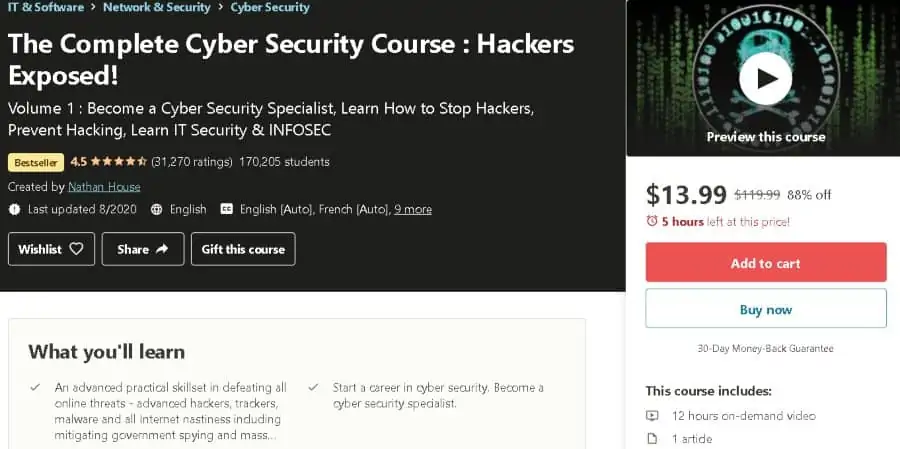
If you’re looking for an online cyber security course that will teach you the fundamentals of implementing security through various case studies, this Udemy course may be a great fit. With a rating of 4.5 stars, this bestselling class has been taken by over 168,000 students and counting!
As for the instructor, students will be led by Nathan House, a cyber-security expert with over 24 years of professional experience. Nathan is also the winner of the ‘Cyber Security Educator of the Year 2020’ award and has taught more than 200,000 students on Udemy.
In this 12 hour long beginner course, Nathan will give students a practical skillset in cyber-security by teaching them concepts like the threat and vulnerability landscape, encryption, how to set up a virtual test environment, security domains, social engineering, and much more.
This online cyber security course is just volume 1 out of a series of 4 courses, so there’s a lot more to learn once you’re done with this one!
- Beginner level
- 12 hours long
- Taught by cyber security expert with 24 years of experience
- Full lifetime access
- Certificate of completion
3. The Absolute Beginners Guide to Cyber Security – Part 1 (Skillshare)
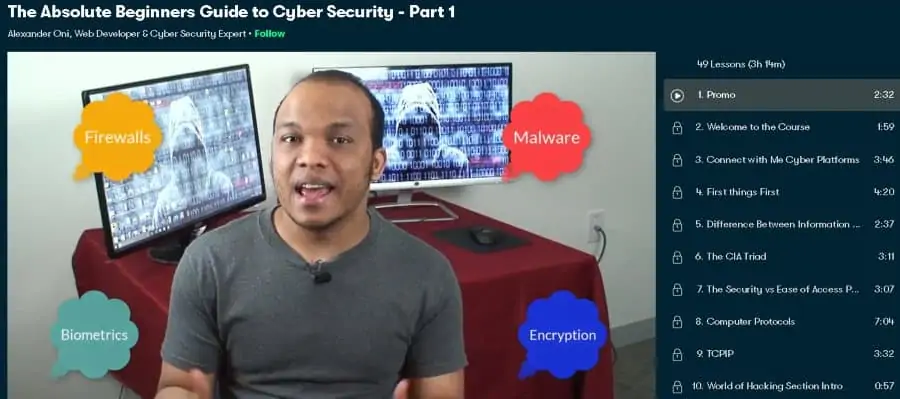
It’s always a good idea to have a foundational level of knowledge about information and cyber security, given the huge threats you can encounter on the internet. So if you’re interested in learning about this field, this beginner-level cyber security course is a great place to start.
Alexander Oni will be teaching students in this online course, who is a web developer and cyber security expert who has been teaching students online for the past 3 years. During this period, Alexander has also authored over 25 courses on various platforms.
Through 3 ¼ hours of video content, students will learn about a wide range of cyber security topics including the difference between cyber and information security, the world of computer protocols like TCP/IP, the world of ethical hacking, pings, bots, botnets, and much more.
Currently, students can take this course for free when taking advantage of the Skillshare Premium trial which also gives access to 27,000 other online classes!
- Beginner level
- 3 ¼ hours long
- Taught by cyber security expert and online educator
- Free 2-month trial of Skillshare Premium
- First in a series of 3 courses
Activate FREE Skillshare Trial
4. Cybersecurity Foundations (LinkedIn Learning)
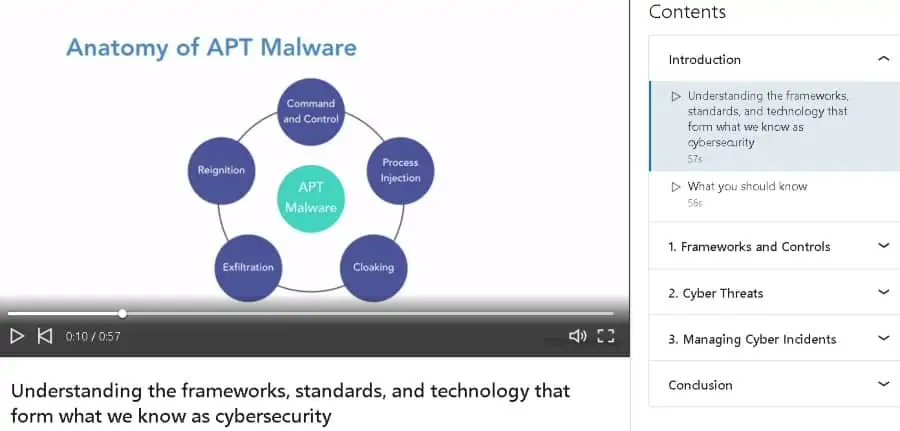
A number of frameworks are available that can aid in ensuring the security of cyber networks, and this online cyber security course on LinkedIn will make you capable of using a wide range of these.
Malcolm Shore, a cyber-security expert who has had an illustrious career, will be teaching students in this online course. Malcolm has also served as the chief security officer at Huawei Australia and has earned a Ph.D. in information security from the University of Otago.
In this 2 hours long online cyber security course, students will learn to identify risk and mitigate it by making use of frameworks like NIST, COBIT 5, and the PCI DSS. Additionally, topics like advanced persistent threats (APTs), fear, uncertainty, and doubt (FUD) are also included.
The best part is that if you’re a new user on LinkedIn, you can access this online course for free, and earn a certificate of completion at the end!
- Intermediate level
- 2 hours long
- Taught by cyber security PhD and expert
- Free access for new LinkedIn users
- Certificate of completion
5. The Beginners Cyber Security Awareness Training Course (Udemy)
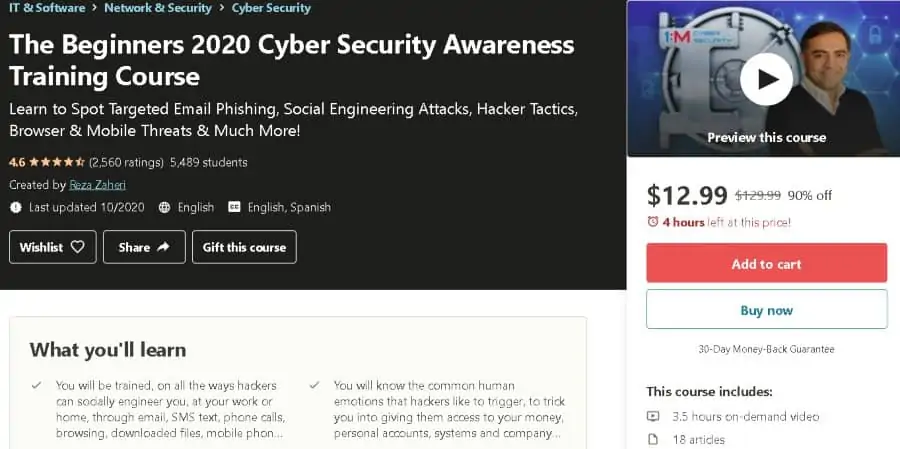
Next on my list is a short but effective online cyber security course that is geared towards beginners who have no prior experience in this field. So whether you are wanting to learn cyber security for yourself, your family, or your business, this course is a great place to start
Your instructor for this online course will be Reza Zaheri, a cyber-security expert who has over 17 years of professional experience in the field that includes working with multiple Fortune 100 companies. Reza is also an ISC2 CISSP certified professional.
Through this 3 ½ hours of video classes, students will get comfortable with the basics of cyber security by going through topics like targeted phishing and social engineering, macro malware, business email compromise, ransomware, banking Trojans, fake antiviruses, and much more.
Don’t worry about forgetting what you learn in this online course. Udemy gives you full lifetime access, so you can be sure to stay on your toes even when you’re 80!
- Beginner level
- 3 ½ hours long
- Taught by ISC2 Certified professional
- Full lifetime access
- Certificate of completion
6. Cybersecurity with Cloud Computing (LinkedIn Learning)
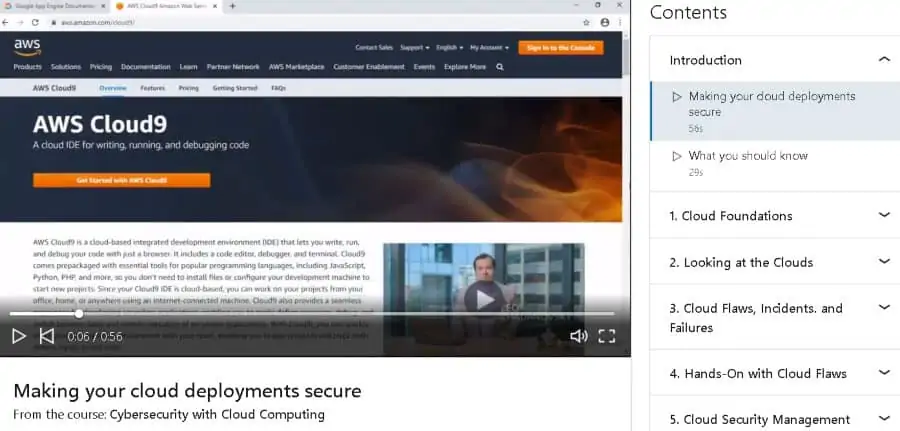
With more and more companies migrating their day-to-day operations to the cloud, users need to understand the security capabilities of cloud platforms more than ever. This intermediate-level online cyber security course on LinkedIn will help you do exactly that!
In this online course, you will be taught by Malcolm Shore, a cybersecurity expert who has worked in high-level positions as a security officer and solutions architect. Malcolm’s career achievements involve acting as the chief security officer at Huawei Australia, among other roles.
In this 2 ½ hour-long online cyber security course, Malcolm will give students an overview of how companies are integrating with cloud platforms, teaching modules including software as a service (SaaS), platform as a service (PaaS), security as a service (SecaaS), and much more.
Get ready to earn a certificate of completion (at the end of this online course) and showcase it to your network to let them know about the new skills you’ve been acquiring!
- Intermediate level
- 2 ½ hours long
- Taught by PhD level cybersecurity expert
- Certificate of completion
- Free access for new LinkedIn users
7. Introduction to Cyber Security (FutureLearn)
Nowadays, it’s everyone’s business to know how their online security can become compromised, and what they can (and should) do to protect against intrusions. So if you’re ready to acquire this important knowledge, don’t miss out on this class hosted by FutureLearn.
Arosha K. Bandara, a software engineer who teaches network security at The Open University, UK, will be instructing you in this online course. Arosha is also a researcher working on building adaptive systems to improve security.
Over a course of 8 weeks, students will be taught cyber security topics that everyone should know in order to remain safe in today’s hyper-connected world. Arosha will go over concepts including the threat landscape, authentication, malware, cryptography, network security, managing risks, and much more.
By undertaking this course, students will get a National Cyber Security Center (NCSC) accredited certificate of completion at the end, so this is definitely something you should not be taken lightly!
- Beginner level
- 8 weeks long with 3 effort hours per week
- Free access to course contents
- Certificate of completion
- Taught by network security researcher
8. Cybersecurity Specialization (Coursera)
If you’re looking for a deep dive into the world of cybersecurity, this online cyber security specialization consisting of 5 courses is an excellent choice for you. Over 55,000 students have already taken this intermediate-level online course and you can join them!
A team of highly qualified instructors from the University of Maryland, USA, will be teaching you in this online course. The team consists of computer science and cyber security experts who have taught more than 150,000 students on Coursera.
Through 8 months of intense learning, students will become capable of building both the software and hardware ends of secure systems, linking them up with human-computer interfaces. By the end of these 5 courses, students will have developed a security-oriented mindset and a diverse skillset.
If the monthly subscription fee looks like something you can’t afford, you have the option to apply for financial aid. So don’t worry, there are no barriers to learning over here!
- Intermediate level
- 8 months long with 2 effort hours per week
- Taught by team of professors from University of Maryland, USA
- Certificate of completion
- Financial aid available
9. Zero to Engineer (NexGenT)
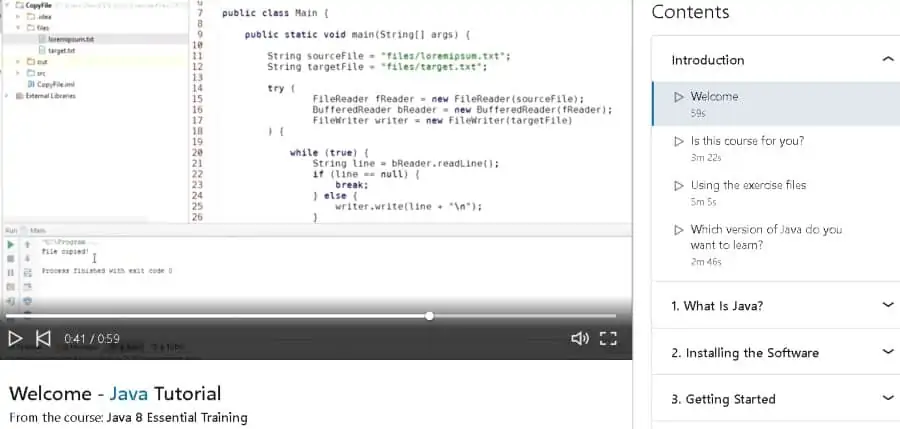
For those of you looking for a short path that leads straight towards a lucrative job in the computer network and security industry, this online cyber security course by NexGenT is a great choice. It has helped over 110,000 individuals get high-paying jobs in the US and now it can help you!
You will be instructed in this online cyber security course by industry-expert professionals from NexGenT who will take you through a curriculum designed to get you up and running in this in-demand field in no time.
In this 22 weeks long online cyber security course, students will learn all the networking and security basics to graduate as a full-fledged cyber security specialist. NexGenT will make you comfortable with a wide range of full-stack networking technologies, and much more.
Don’t worry about the tuition, because NexGenT will not take any upfront fees from you. You will only be paying them for their services once you have an excellent job!
- Beginner level
- 22 weeks long
- Taught by cyber security experts from NexGenT
- No upfront fees
- Job placement support for 3 years after graduation
10. The Cybersecurity Training and IT Career Development Platform (Cybrary)

Securing the next slot on my list is an online course platform that has an entire catalog of cyber security courses for you to choose from. On Cybrary, you will get the opportunity to learn cyber security concepts according to your level of knowledge through loads of hands-on exercises and assessments.
Cybrary will be providing you with instructors for the online cyber security courses. The online courses are prepared by subject matter experts from companies like Cisco, (ISC)2, and Practice Labs, so you’ll definitely be learning from the best.
In the cyber security catalog available on Cybrary, students will find online courses ranging from just a couple of hours to 40-50 hours long. The collection includes courses offering a beginner’s perspective on security and those that will prepare students for certification exams.
Cybrary is where you will find this great online cyber security course that is not to be missed! Join this online platform if you’re ready to take your cyber security career to the next level (or get started) by learning from the resources used by employees from Fortune 1000 companies!
- Beginner/Intermediate/Advanced level
- Course catalog containing 1300+ online courses
- Taught by subject matter experts from top companies
- Courses containing 2 to 50 hours of content
- Customized career paths to get you industry-ready
11. Professional Certificate in Essentials of Cyber Security (edX)
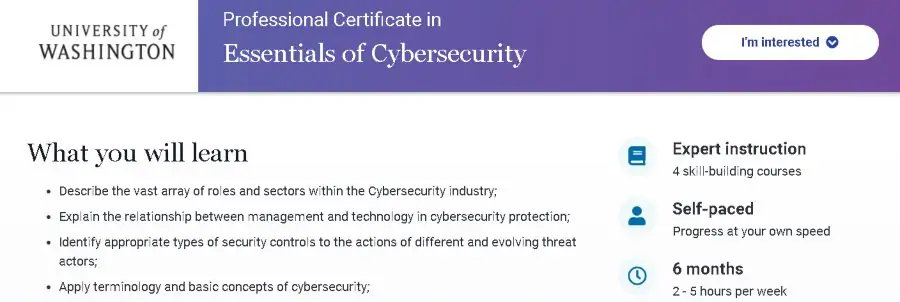
Rounding out my list is a comprehensive online cyber security specialization offered by edX that consists of 4 in-depth courses to get you started in your cyber security career. This advanced-level specialization will help you understand the security landscape and find your niche in it.
In this online cyber security specialization, you will be taught by Barbara Endicott-Popovsky, director of the Center for Information Assurance and Cybersecurity, and David Aucsmith, a senior principal research scientist at the University of Washington’s Applied Physics Lab.
Over a course of 6 months of expert instruction, students will learn about the diverse roles that are found in the cyber security industry, the importance of management and technology in network security, identifying the right controls for security measures, and much more.
The 4 courses are completely self-paced, so it doesn’t matter if you can’t take out time consistently for studying – you get to decide your own schedule!
To learn more, also see my other posts on full-stack development, Go, and R Programming.
- Advanced level
- Specialization consisting of 4 courses
- 6 months long with 2-5 effort hours per week
- Taught by experts from University of Washington
- Self-paced learning
