
Is Udemy Accredited? + Should I Put Udemy Certificates On My Resume?
After writing several posts about Udemy, one of the most common questions I get asked about is “is Udemy accredited?”.
Because of this, I decided to write this post and once and for all settle this question while also shedding some light on some interesting nuances about accreditation.
Also in this post, I will be covering other aspects of this question such as if Udemy certificates are worth putting on a resume. Let’s get started!
Is Udemy Accredited?
According to Udemy.com, “Udemy is not an accredited institution, and as a result, the certificates cannot be used for formal accreditation.” However, some individual courses do provide CPD or CEU credits that are available upon request from third-party education providers.
So in short, Udemy themselves is not an accredited institution and none of their supplied certificates carry any weight or accreditation.
Unfortunately, this is the case as Udemy has over 100,000 courses on a wide range of topics made by independent teachers with varying knowledge, expertise, credentials, and education. When combining these factors, it would be impossible to accredit each course due to time commitment and cost.
However… Some Udemy Courses Can Get Accreditation
After doing a bit more digging, I actually did find some of the courses on Udemy are actually available for accreditation. Let me explain…
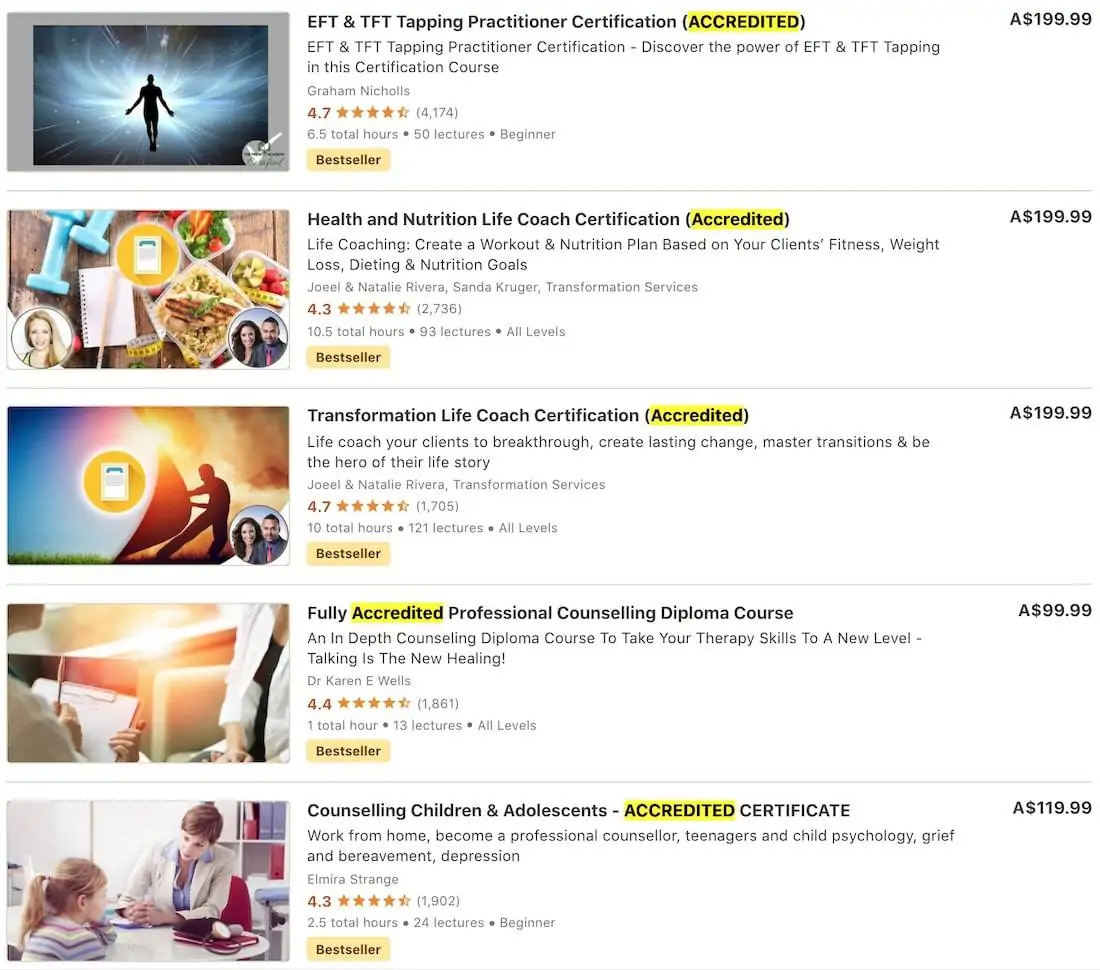
When you do a search for “accreditation” on Udemy, you will get various search results in such topics as life coaching, mindfulness, meditation, CBT, EFT, energy healing, nutrition, and NLP to name a few.
Upon reading more into these types of courses, the teachers/academy also provide their own accredited certificates on top of the existing Udemy certificates.
However, in almost every case, the student themselves have to apply to platforms like the Continuing Professional Development Standards Agency to validate the certificate.
Once an agency recognizes your prior learning, it will distribute the learning credits which will make the non-Udemy certificate accredited from that agency.
While this is a great alternative, one thing to keep in mind that this is only available for certain topics on Udemy which typically have a wide range of standards of accreditations.
Should I Put Udemy Certificates On My Resume
Ok, so you now know that Udemy isn’t accredited and you still want to undertake one of their certificate courses. Now it begs the questions of whether or not you should add a certificate to your resume/CV or to a job position.
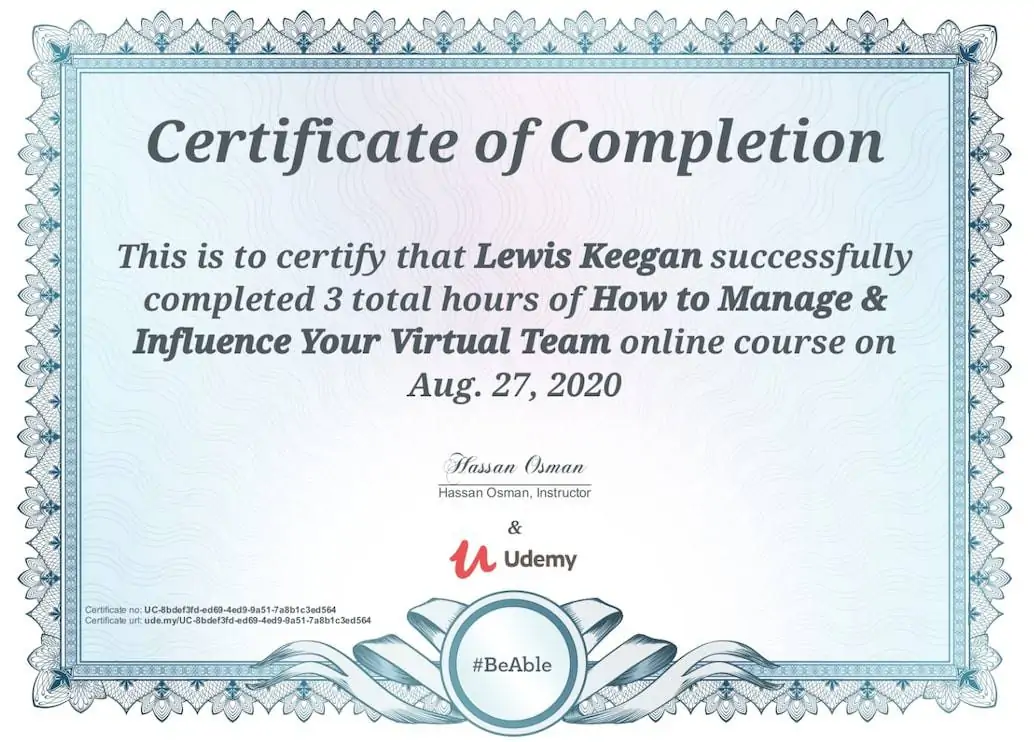
From my own personal experience and opinion, I think it is definitely worthwhile adding the completed Udemy course to your resume. Here are the three reasons why I think this is a good thing todo.
- It shows the potential employer that you have gone the extra mile to learn the topic
- It shows that you are committed to the topic and have the discipline to complete the course
- A completed certificate can give you the edge in a wide range of candidates
Can You Get a Job With a Udemy Certificate?
As a continuation of the above question, is it possible to get a job when completing a Udemy course? In short, yes and no.
At its core, Udemy is there to enable you to learn the skills that will enable you to bring value to a company or business. So if you are to commit 100% and undertake various courses, understand the subject matter, and put it into action that gives results. Then yes, Udemy courses can be extremely beneficial to landing that next job.
However, if you are to complete a Udemy course while not concentrating, taking notes, researching further, and becoming competent in a certain topic. Then it is unlikely that you will be able to stand out in an interview.
If you want to learn more about Udemy, you can check out my full review here and also my guide on how to always get their courses at a massive 90% discount!
What Are The Benefits Of Udemy Certificates?
When it comes to the benefits of completing a Udemy course and getting a certificate, you are essentially showing an employer that you are dedicated to improving and updating your skills.
This is particularly helpful if you have picked specific courses that share new skills on the topic, give a refresher, prepare you for an exam, or give you a specialized skill in a technical industry.
So while a certificate of completion is a great accomplishment, the symbolism behind it can sometimes mean more than the piece of paper itself.
Conclusion
In conclusion, Udemy.com is not an accredited online course provider and does not provide any accreditation for any of their certificates. However, with dedicated studying, focus, commitment, and discipline, Udemy courses can be beneficial in various job positions.
