
Learn How To Do Expert Data Analysis With 2024‘s Top 13 Best Online R Programming Courses

Are you looking to learn the R programming language to launch a career in data analysis? If so, you’ve come to just the right place!
In this guide, I have rounded up some of the best online R programming courses and certificates that will teach you data analysis and sub-fields including data wrangling, visualization, statistics, analytics, machine learning, and so much more!
Throughout these courses, you will have the opportunity to learn from expert data scientists and R programmers, and earn certificates to share with your network. So let’s get started!
Top 13 Best Online R Programming Courses & Certificates 2024
1. R Programming A-Z™: R For Data Science With Real Exercises! (Udemy)
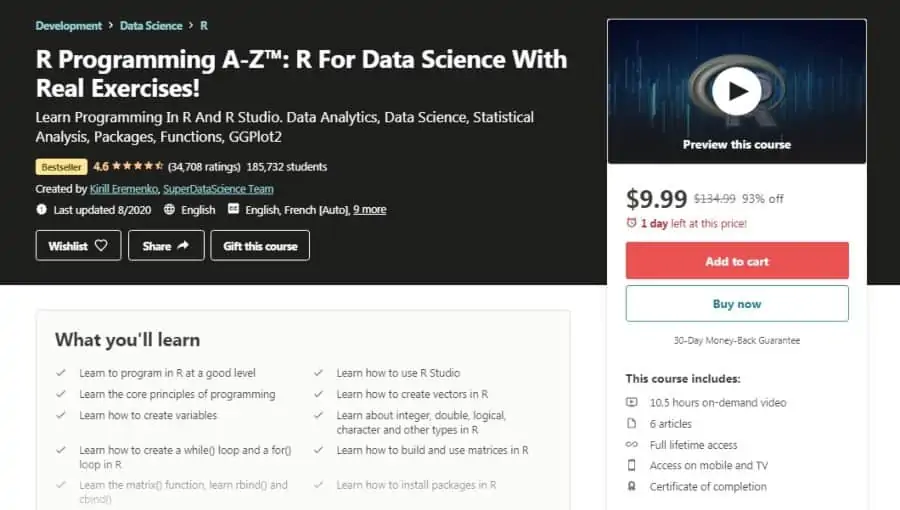
First on my list is a comprehensive online R programming language course that will teach you all the basics of programming using R through hands-on exercises based on real-world problems. Over 184,000 students have taken this top-rated course, giving it an average of 4.6 stars!
Your instructor for this R programming class will be Kirill Eremenko, a data scientist who has over 5 years of experience and has worked in industries like transport, retail, and finance. Kirill has also taught over 1.4 million students on Udemy and earned an instructor rating of 4.5 stars!
Spanning 10 ½ hours of video lessons, students learn all the foundational concepts needed to start efficiently programming in R, with topics including setting variables, using control flow features such as loops, using matrices, creating vectors, working with financial data, and much more.
Udemy is offering full lifetime access to this course on a limited-time discount of 86%. You will also receive a certificate of completion at the end of this course! Overall, this is one of the best online R programming courses on this list!
- Beginner level
- 10 ½ hours long
- Taught by bestselling data scientist
- Full lifetime access
- A limited-time discount of 86%
- Certificate of completion
2. R Essential Training: Wrangling and Visualizing Data (LinkedIn Learning)
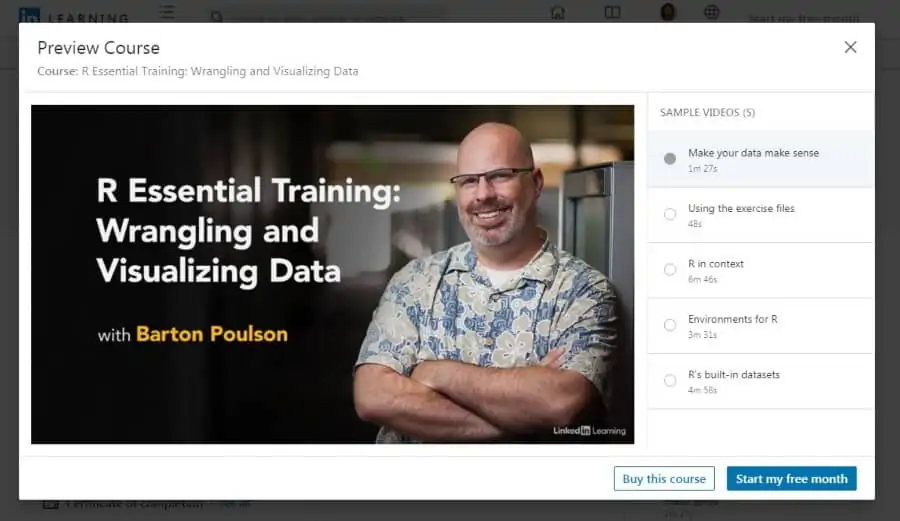
Are you looking to learn the R programming language to effectively preprocess and visualize big data so you can draw out its meaning? If so, this beginner course on data-wrangling and visualization will teach you to do just that!
As for your instructor, you will be taught by Barton Poulson, founder of datalab.cc who is a professor of psychology at Utah Valley University. Barton is also passionate about data analysis and research, subjects which he teaches on a wide range of platforms.
Throughout this 4 ¼ hour online R programming language class, students start by learning how to set up R and the packages used to manipulate and play with data, before going on to topics including using ggplot2 to visualize data, creating scatterplots, histograms, charts, filtering specific cases, and much more!
With LinkedIn, you will be able to access this course for free if you are a new LinkedIn user, and earn a certificate of completion to share with your network!
- Beginner level
- 4 ¼ hours long
- Taught by the founder of datalab.cc
- Free access for new users
- Certificate of completion
3. R Programming (Coursera)
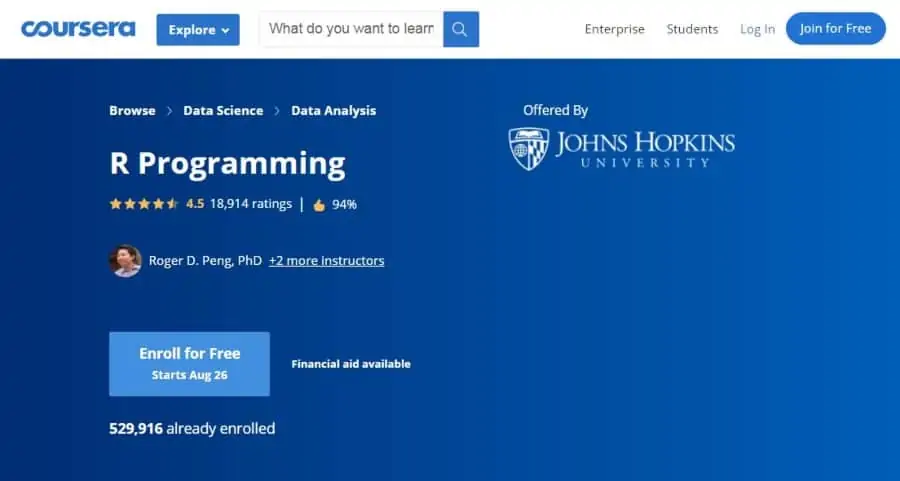
If you’re already familiar with statistics and looking to make use of R to take your simulations and modeling to the next level, this intermediate-level course on Coursera is a great choice!
Currently, this online R programming course has over 500,000 students enrolled, and an average rating of 4.5 stars.
As for your instructors, you will be taught by a trio of biostatistics professors from the Bloomberg School of Public Health: Roger D. Peng, Brian Caffo, and Jeff Leek. Together, this team has served more than a million students on Coursera, earning an instructor rating of 4.4 stars.
Through 58 hours of on-demand video, students will learn how to use R for data analysis with topics including setting up an R environment, using generic programming concepts, dealing with practical issues in statistical computing, performing actual statistical analyses, and more.
You can find this online R programming course hosted on Coursera and can apply for financial aid if you are unable to pay the full fees for the course, and earn a certificate of completion at the end!
- Intermediate level
- 58 hours long
- Taught by a team of biostatistics professors
- Certificate of completion
- Financial aid available
4. Data Analysis with R (Udacity)
Developed by Facebook, this intermediate-level course offered on Udacity will give you the deep dive you’re looking for into the field of exploratory data analysis using the R programming language.
Udacity will be providing you with expert instructors for this online R programming language course that picks top industry professionals to curate and develops its courses. Also, since Udacity has partnered with Facebook, this class includes practical and in-demand skills sought out by large tech companies.
Over the 2 months that it will take to complete this online course, students will be introduced to the basics of Exploratory Data Analysis (EDA) and be taken through the basics of programming in R by learning about using single and multiple variables.
You can take this course on Udacity for free and learn completely at your own pace through rich learning content and loads of interactive quizzes! Overall, a great online course for R programmers to expand their knowledge and professional opportunities!
- Intermediate level
- 2 months long
- Taught by Facebook data scientists
- Free of cost
- Self-paced learning
USE CODE UPSKILL21 FOR AN EXTRA 50% OFF ANY OF THE UDACITY NANODEGREE COURSES.
5. R for Data Science: Lunchbreak Lessons (LinkedIn Learning)
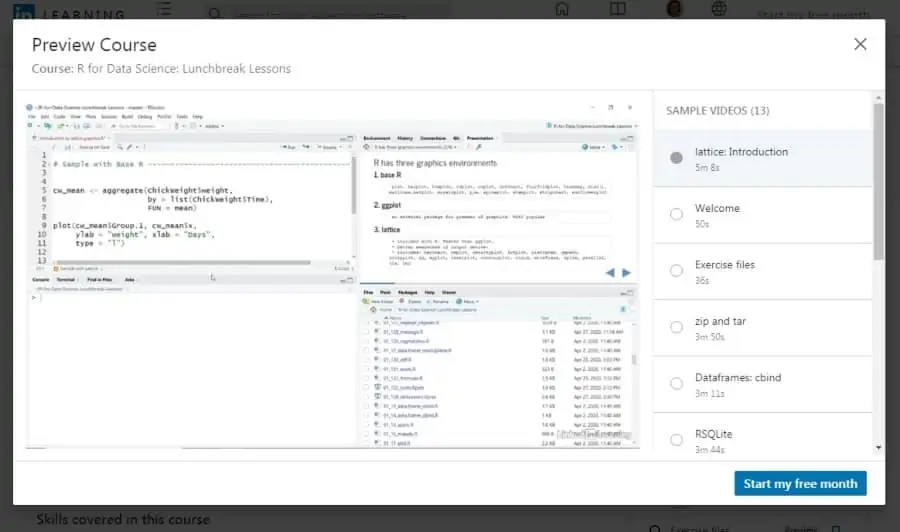
Next on my list of the best online R programming courses is a beginner class that is ideal if you have a busy schedule and very little time to invest. You will also be joining 56,000 students who are already enrolled in this course on LinkedIn Learning.
Mark Niemann-Ross, a technologist with 30+ years of experience, will be your teacher for this course. Mark has helped develop third party programs for Adobe and Quark and has a degree in industrial education. So you will be in expert hands!
Included in this 8 ¾ hour free R programming course (with more content still being added), students receive 5-minute lessons every week that will teach them concepts like R language basics, improving R code, exploring new features, and learning useful libraries.
You can join a learning group of 2,000+ members to discuss problems and ideas, and access this course for free if you are a new LinkedIn user!
- Beginner level
- 8 ¾ hours long
- Taught by a technologist with 30+ years of experience
- Learning group of 2000+ members
- Free access for new users
6. R Programming Fundamentals (Pluralsight)
If you’re looking for a course that teaches you everything you need to know about R programming from scratch, this PluralSight course is a great starting point!
As for your instructor, you will be taught by Abhishek Kumar, a data scientist who has a master’s degree from the University of California, Berkeley. Abhishek is also a Google Developers Expert (GDE) with an average rating on Pluralsight of 4.4 stars.
Across 7 hours of instruction, students will learn a number of programming essentials of R including topics like R variables and operators, data structures, functions, flow control, packages, using data, and tons more!
You can access this online R programming course on Pluralsight, offering a free 10-day trial during which you can access hundreds of courses other than this one, and earn a certificate of completion!
- Beginner level
- 7 hours long
- Taught by GDE data scientist
- Free 10-day trial
- Certificate of completion
7. Data Wrangling in R (LinkedIn Learning)
Most data analysts spend huge amounts of time cleaning and sorting data to bring it into an understandable form. So if you’re looking to learn techniques to improve your data wrangling skills using R, this LinkedIn Learning course can’t be missed.
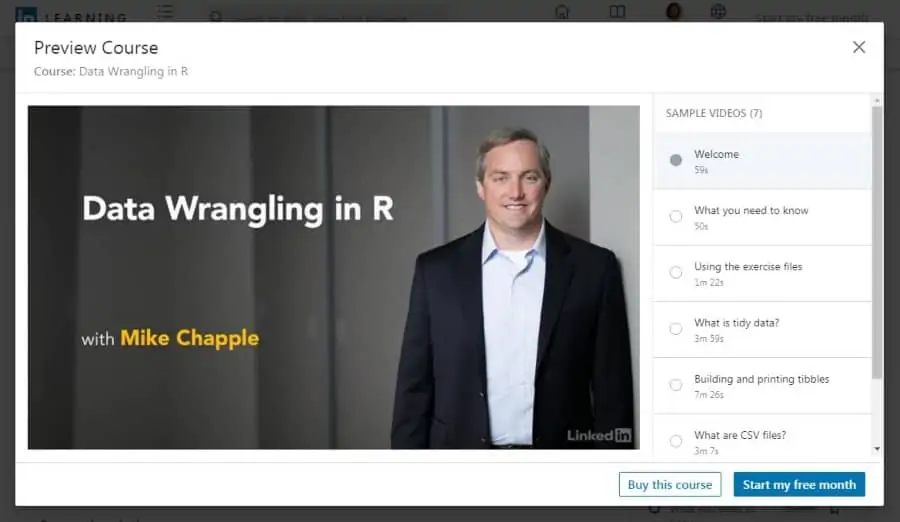
Your tutor for this online R programming language course will be Mike Chapple, a data science expert who has completed a doctoral degree in computer science and engineering from the University of Notre Dame. Mike has also worked for Brand Institute, a consulting firm in Miami, as its executive vice president.
In this intermediate-level 4 ¼ hours long course, Mike will first introduce students to ‘tidy data’, before showing them how they can use the Ridyverse package in R. Students also learn how to work with Tibbles, how to filter and subset them, how to import data, manipulate datasets and data types, and much more.
You will have the opportunity to access this course for free if you are a new LinkedIn user, and earn a verified certificate of completion at the end to share with your network!
- Intermediate level
- 4 ¼ hours long
- Taught by a data science expert
- Free access for new LinkedIn users
- Certificate of completion
8. Data Science and Machine Learning Bootcamp with R (Udemy)
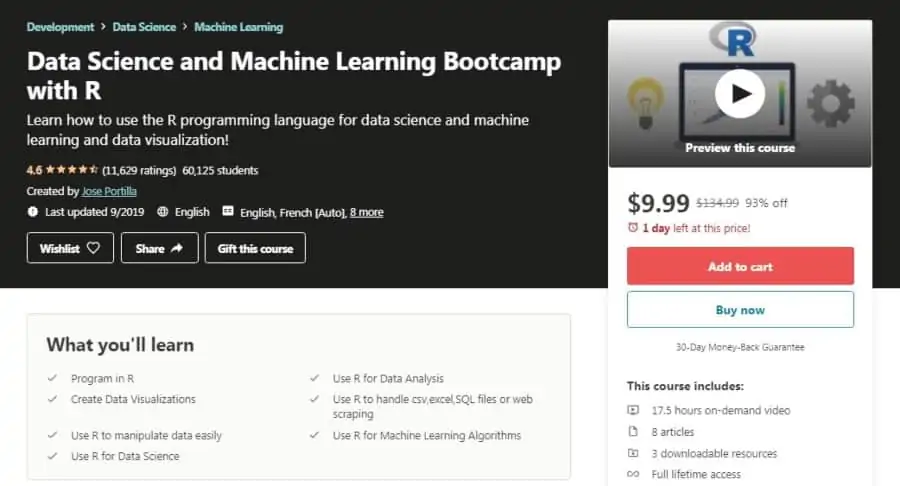
For those in search of a comprehensive course that will teach you all about data visualization, data science, and machine learning using R programming in the same package, this course is a great pick! Over 59,000 students have taken this beginner-level course on Udemy which has a 4.6-star average rating.
As for your instructor, Jose Portilla, the head of data science at Pierian Data Inc., will be teaching you in this course. Jose is an expert in R programming and has published 30 courses on Udemy that have allowed him to teach almost 1.9 million students!
Over 17 ½ hours of learning, Jose will teach students everything they need to know about data visualization, science, and machine learning in R from scratch with topics including setting up the R environment.
And not to mention other lessons on working with matrices and lists, inputting data, manipulating and visualizing it with R, applying machine learning libraries, and tons more.
You should enroll now to get full lifetime access to this course on a limited-time discount of 86%, along with a certificate of completion to share with your network!
- Beginner level
- 17 ½ hours long
- Taught by top Udemy instructor
- Full lifetime access
- A limited-time discount of 86%
- Certificate of completion
9. Statistics and R (edX)
If you are a researcher who wants to learn and implement statistical concepts using the R programming language, this specialized course from edX and Harvard University is not to be missed.
Your teachers for this free R programming course will be Rafael Irizarry, professor of biostatistics at Harvard University, and Michael Love, assistant professor of biostatistics at the UNC Gillings School of Global Public Health. You can gauge the quality of teaching in this course by the fact that over 300,000 students are enrolled in it already.
In the 1 month that it will take to complete this class, students will learn about statistical concepts for implementing in R including random variables, various types of distributions, p-values and confidence intervals, exploratory data analysis, non-parametric statistics, and much more.
Although you can access the course contents for free, you can pay a nominal, one-time fee to upgrade and earn a verified certificate of completion as well! Overall, one of the best R programming courses in 2024 taught by the prestigious Harvard University.
- Intermediate level
- 4 weeks long with 2-4 effort hours per week
- Taught by professors of biostatistics
- Free access to course contents
- Certificate of completion (paid)
10. R Programming in Data Science: Dates and Times (LinkedIn Learning)
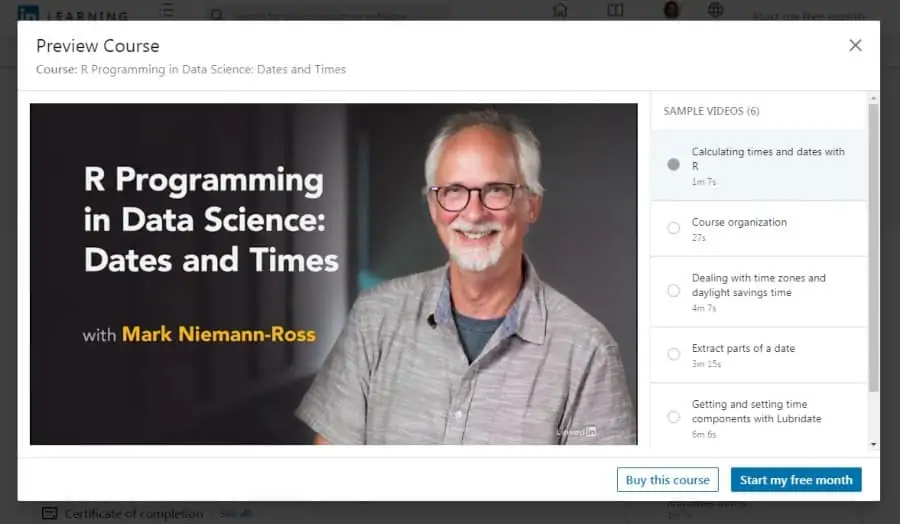
Dealing with dates and times can be a nightmare for many time-series data scientists, but this intermediate-level course makes the process dead simple.
Your instructor for this class will be Mark Niemann-Ross, a technologist who has over 30 years of experience in helping software engineers navigate APIs. Mark has also published 9 courses through LinkedIn and currently serves as a content manager for LinkedIn Learning.
During this 2 ¼ hour course, students will learn how to store and retrieve dates and times, perform addition, subtraction, and other operations, use exclusive R packages like lubridate, zoo, timelineR, and datetime, use built-in R functions, and much more.
With LinkedIn, you will receive a certificate of completion at the end, and the opportunity to access the course contents for free if you are a new user on the platform!
- Intermediate level
- 2 ¼ hours long
- Taught by the LinkedIn content manager
- Free access for new users
- Certificate of completion
11. R Programming for Absolute Beginners (Udemy)
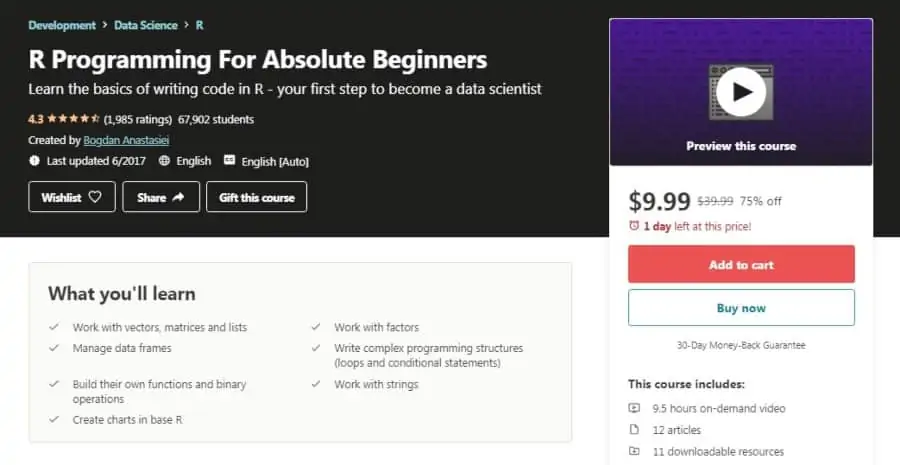
As the name suggests, this is a fantastic course for those who have zero programming experience and want to learn the R programming language to launch a data science career! With over 67,000 students enrolled already, this beginner-level course has an average rating of 4.3 stars.
As for your instructor for this R programming language class, you will be taught by Bogdan Anastasiei, an assistant professor at the University of Iasi in Romania who has over 24 years of teaching experience.
Through 9 ½ hours of learning material, students get the opportunity to start from scratch and learn how to code using the R programming language. After setting up R in their devices, students learn about data structures like vectors, matrices, lists, and arrays, flow control methods like loops and conditionals, and much more.
All you have to do is pay a one-time fee to gain full lifetime access to this course, along with a certificate of completion at the end!
- Beginner level
- 9 ½ hours long
- Taught by the professor with 24+ years of teaching experience
- Certificate of completion
- Full lifetime access
- A limited-time discount of 53%
12. Data Science: Foundations using R – Specialization (Coursera)
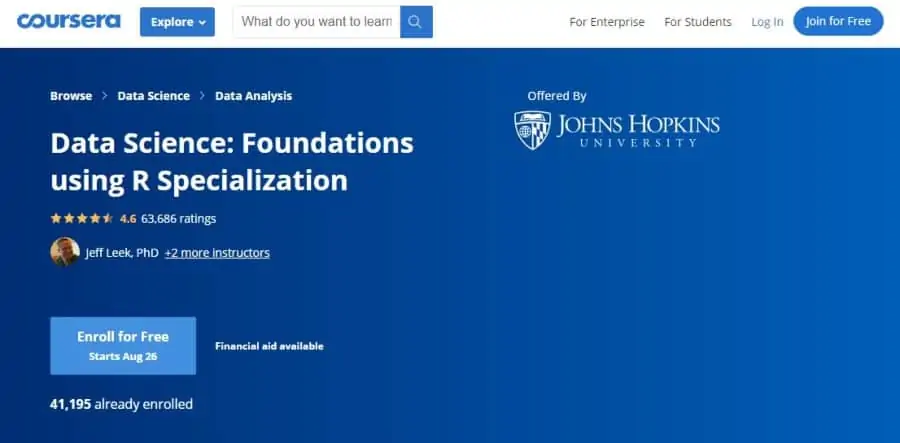
Before you can build data-backed products, you first need to be comfortable with gathering, cleaning, and visualizing data. You will learn all of this and more in this excellent online R programming course!
As for your instructors, a team of biostatistics professors from the Bloomberg School of Public Health including Jeff Leek, Brian Caffo, and Roger D. Peng, will be teaching you in this online R course. Together, they have published over 20 courses on Coursera that have helped more than a million students learn fundamental skills.
Spread across 5 beginner-level courses that will take around 5 months to complete, students will start off with an introduction to data science before diving into R programming and learning about acquiring and cleaning data, exploratory data analysis, conducting reproducible research, and much more.
Coursera offers you the option to apply for financial aid if you are unable to pay the subscription fee for these courses, and earn a certificate of completion at the end verifying your huge achievement! Overall, a top-rated, expert-led online course to really build up your R programming language skills!
- Beginner level
- 5 months long with 8 effort hours per week
- Taught by 3 biostatistics professors with 1 million+ students on Coursera
- Certificate of completion
- Financial aid available
13. R Programming for Statistics and Data Science 2020 (Udemy)
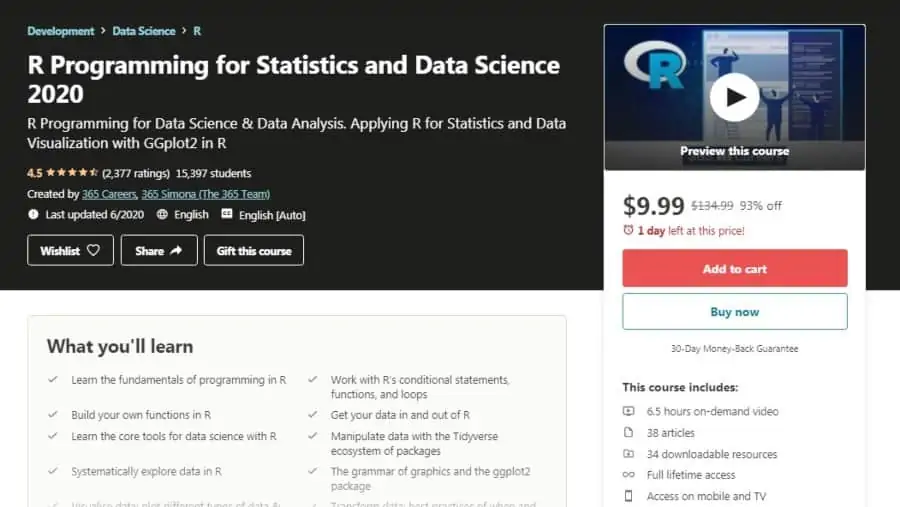
Rounding out my list of the best online R programming courses is a beginner-level course on Udemy giving you the push you need to confidently jump into a data science career! You will join over 15,000 students who have completed this course and given it an average rating of 4.5 stars.
Simona, a data science instructor in The 365 Team, will be teaching you in this online R programming course. Simona is a graduate of the University of Edinburgh who has served more than 84,000 students on Udemy and earned an average instructor rating of 4.5 stars which is a testament to her quality of teaching.
In this 6 ½ hours long class, students will first be introduced to basic statistics so that they have a strong foundation before you move on to learning how to program in R with topics including vector operations, matrices, conditionals, loops, data frames, data manipulation, and visualization, and much more.
For a limited time, you can buy full lifetime access to this course at a 86% discount, and share the certificate of completion that you get at the end with your professional network!
To learn more, you can also see my guides on computer networking and big data!
- Beginner level
- 6 ½ hours long
- Taught by data science instructor from The 365 Team
- Full lifetime access
- Certificate of completion
