
Learn How To Program Networks With 2024‘s Top 13 Best Online Go Programming Courses & Classes
Google’s Go (golang) programming language has exploded in popularity due to its effectiveness in network programming, AI, and machine learning.
Because of this, I have found some of the best online Go programming courses in 2024 that will teach you one of the most in-demand skills in the programming industry.
Below, you will find a wide range of free and paid online Go programming classes taught by industry-leading experts that are ideal for complete beginners all the way to advanced users. Let’s begin!
Top 13+ Best Online Go Programming Courses & Classes 2024
1. Learning Go (LinkedIn Learning)
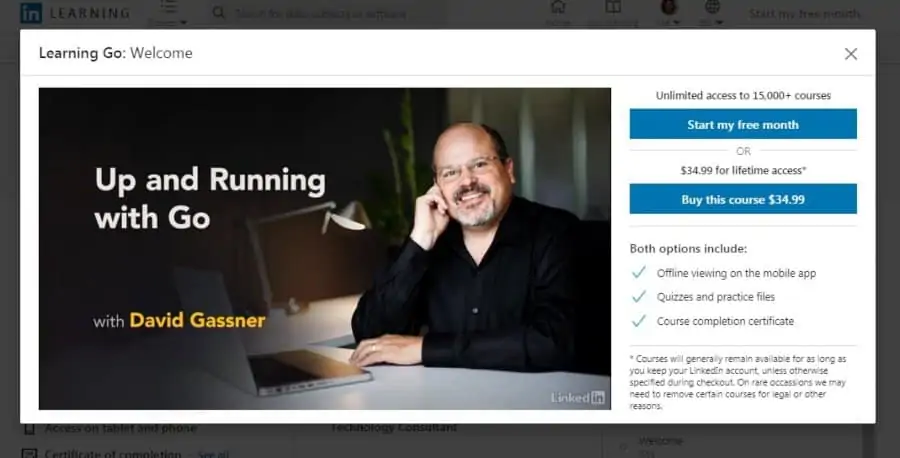
For those of you who are complete strangers to the Go language and looking for a thorough introduction, this beginner-level course is an outstanding pick! Over 23,000 students have already benefitted from this resource and it comes highly recommended.
For this online class, you will be taught by David Gassner, former president and founder of Bardo Technical Services who has 30 years of experience working as a software developer. David has also published 60+ technical training courses for developers and Go programmers.
In this beginner-level 3 ¾ hour online course, David will take you through all the basics of programming using Golang including setting it up on your computer, working with variables and data types, coding loops and conditionals, working with errors, and microservices to name a few!
As this online course is hosted on LinkedIn Learning, new students can get full access to all lessons, downloadable resources, quizzes, and also a certificate of completion. There is also a 1-month free trial available! Overall, this is one of the best online Go programming courses in 2024!
Strengths of this online course:
- Beginner level
- 3 ¾ hours long
- Taught by software developer with 30+ years of experience
- Free access for new LinkedIn users
- Certificate of completion
2. Learn How To Code: Google’s Go – golang – Programming Language (Udemy)
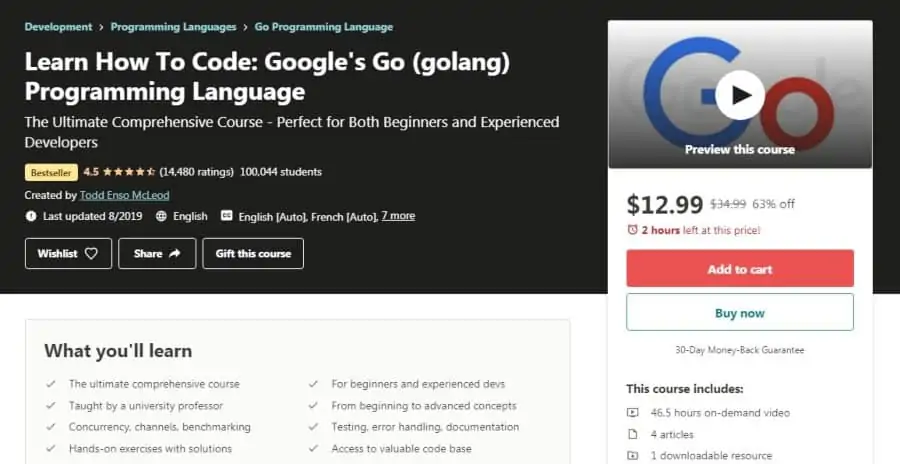
If you’re looking for the ultimate online Go course that contains everything needed to start learning Golang from scratch, this beginner class can’t be missed! You’ll also be joining 100,000 other students who have already benefited from this class.
As for your instructor, you will be taught by Todd Enso McLeod, a professor at Fresno College in California who is one of the leading Go educators in the world. Todd’s teachings have also helped close to 300,000 students across all of his online training courses.
Through a massive 46 ½ hours of on-demand video content, you will learn everything about using Go from building applications/development environments, playing with variables, values/types, working with numeral systems, iota, bit shifting, understanding control flow, and grouping to name a few.
Since this online course is hosted on Udemy, students get access to all lessons, downloadable resources, the ability to view on mobile, and a printable certificate of completion!
Strengths of this online course:
- Beginner-to-advanced level
- 46 ½ hours long
- Taught by leading Go educator in the world
- Full lifetime access
- Limited-time discount of 46%
- Certificate of completion
3. Programming with Google Go – Specialization (Coursera)
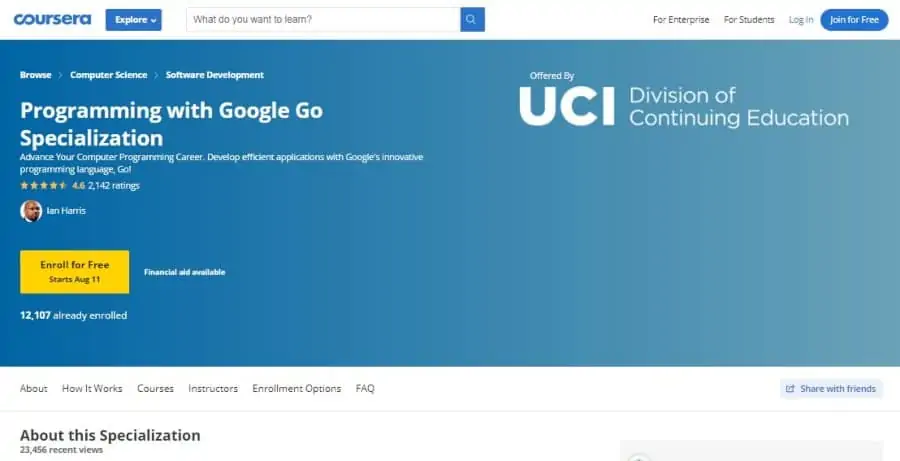
Brought to you by the University of California, Irvine, this 3-course specialization on Coursera will enable you to make clean and efficient applications using the Go programming language in no time.
As for your teacher, you will be taken through the course contents by Ian Harris, a Professor in the Computer Science Department at UCI who has earned degrees in computer science from MIT and UC San Diego. Ian also has over 347,000 students across 9 of his online courses!
Over the 3 months that it will take you to complete this intermediate-level course, you will go through 3 classes that will start with the fundamentals of programming in Go, then moving on to topics like functions, methods, interfaces, concurrency, and much more.
With Coursera, you can apply for financial aid if you are unable to pay the full fees for this course (or audit it for free), and earn a shareable certificate of completion at the end! Overall, this is one of the best online Go programming courses taught from a world-renown university.
Strengths of this online course:
- Intermediate level
- 3-course specialization
- 3 months long with 3 effort hours per week
- Taught by CS professor at UCI
- Financial aid available
- Certificate of completion
4. Learn Go Programming (Codecademy)
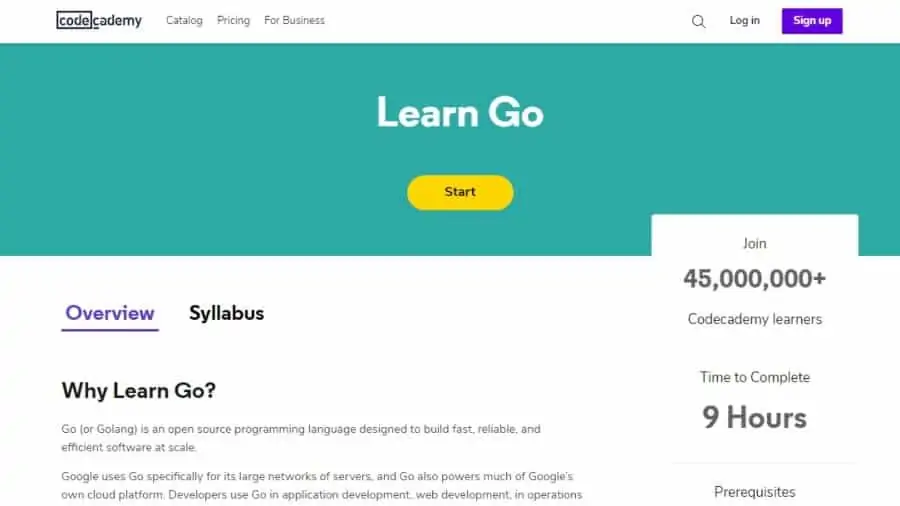
Next on my list is an online Codecademy course that is best suited for those who want to learn all the basics of programming using the Go language while also getting loads of hands-on practice. By signing up for this beginner-level course, you will be also joining a community of 45 million+ Codecademy learners.
Instructors for this course are provided by Codecademy itself, which recruits top professionals and experts who have a proven track record of delivering quality education across multiple programming languages.
Through 9 hours of practically oriented learning, you will complete 4 units that will first introduce you to the Go language and then teach you about using variables and formatting the code, using conditionals, and functions, all while making your very own project with Golang.
Fortunately, new students can access all the course contents for free, and subscribe to Codecademy’s monthly plans to gain access to a plethora of useful features!
Strengths of this online course:
- Beginner level
- 9 hours long
- Taught by hand-vetted experts
- Free access to course contents
- Work on 4 hands-on projects
5. Go: The Complete Developer’s Guide – Golang (Udemy)
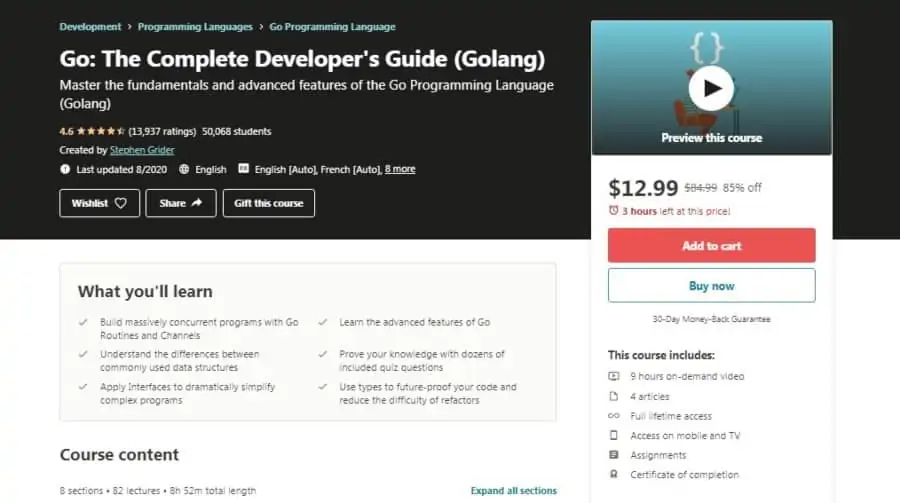
If you’re an experienced programmer who is looking to quickly get up to speed with the Go language and dive into the advanced features, this online Udemy course is a fantastic resource!
Stephen Grider, an Engineering Architect with 26 published courses on Udemy, will be your teacher for this course. Stephen has over 620,000 students on Udemy alone with an average instructor rating of 4.6 stars which is a testament to the quality that he offers.
In this 9-hour online course, you will quickly go through the basics of programming with Go before going deep into advanced topics such as Go’s concurrency model, using packages to organize code, working with the Go runtime, understanding critical design decisions, and applying interfaces to name a few.
Udemy is offering a limited-time discount of 78% on this course to get full lifetime access, along with the chance to earn a certificate of completion when you pass!
Strengths of this online course:
- Advanced level
- 9 hours long
- Taught by Udemy instructor with 620,000+ students
- Full lifetime access
- Certificate of completion
6. Go: The Big Picture (Pluralsight)
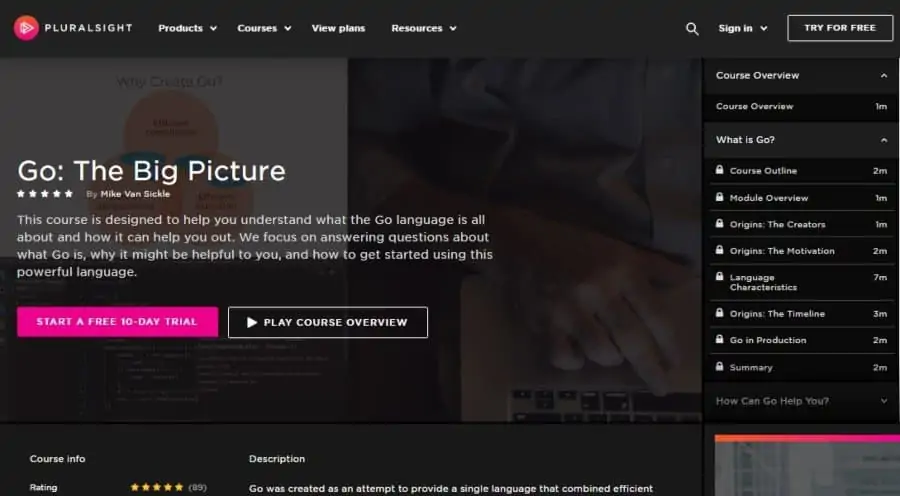
Before you start learning and using a programming language, it is worth investigating how the language will help you solve your problems. So if you’re curious to learn about the applications of Go (Golang), you should get enrolled in this beginner-level Pluralsight course right away.
Your instructor for this course will be Mike Van Sickle, a software engineer who is working as an application architect in Akron, Ohio. Mike has published a total of 26 courses on Pluralsight that have earned him a high average rating of 4.6 stars.
In the 1 ¾ hours you will spend going through the course’s contents, you will be introduced to the history and background of this cutting-edge programming language, its ecosystem, and the range of applications that it is suitable for. By the time you’re done with the course, you will know exactly how this language will be of use to you.
You can take advantage of a free 10-day personal trial offered by Pluralsight and cover the course contents for free, all the while learning about the latest industry trends!
Strengths of this online course:
- Beginner level
- 1 ¾ hours long
- Taught by highly-rated Pluralsight author and software engineer
- Free 10-day personal trial
- Gain access to thousands of other courses through nominal subscription rates
7. Go Essential Training (LinkedIn Learning)
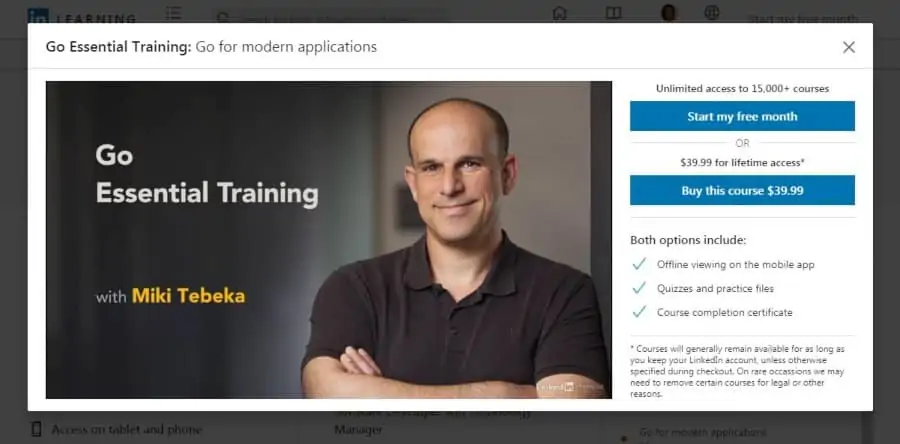
As the name suggests, this beginner-level online course on programming using the Go language will teach you all the essentials needed to make powerful and elegant applications. The course has already been taken by more than 16,000 professionals and students.
In this course, you will be taught by Miki Tebeka, CEO of 353Solutions that conducts workshops to help professionals strengthen their grasp on Go and other programming languages. Miki has a computer science degree from the Ben-Gurion University of the Negev.
In this short 2 hours long course, Miki will first teach you all the basics of the Go language including syntax, numbers, conditionals, and loops, before teaching you how to create object-oriented code, handle errors, work with concurrency, use connectivity features, and much more.
After completing this Go programming course, you will be awarded a verified certificate of completion that you can share with your network to update everyone with the new skills you’ve acquired!
Strengths of this online course:
- Beginner level
- 2 hours long
- Taught by expert Go trainer and consultant
- Certificate of completion
- Free access for new users
Activate Your FREE LinkedIn Trial
8. GOLANG (freeCodeCamp)
Up next on my list is a useful Golang resource that will prove to be beneficial for you if you’re looking to dive into specific Go techniques, applications, and frameworks. Brought to you by the non-profit organization freeCodeCamp, the resources are completely free for you to access.
Resources for your benefit on freeCodeCamp are uploaded by the wider software developer and software engineer community. The mix of authors includes senior software engineers and web developers who have a mastery of the Go programming language.
In the collection of 29 posts related to the Go language, you will find several hands-on projects teaching you to automate your GitHub profile, build Blockchain applications, make Twitter bots, write compilers, build photo feeds, manage project dependencies, and much more.
With freeCodeCamp, you can not only access this education for free, but you can also tap into thousands of study groups around the world to speed up your learning process! Overall, one of the best free Go courses that is sure to provide a wealth of knowledge.
Strengths of this online course:
- Beginner/intermediate/advanced level
- 29 posts & resources
- Prepared by expert software engineers and developers
- Access everything for free
- Tap into thousands of study groups around the world
9. Web Development w/Google’s Go (golang) Programming Language (Udemy)
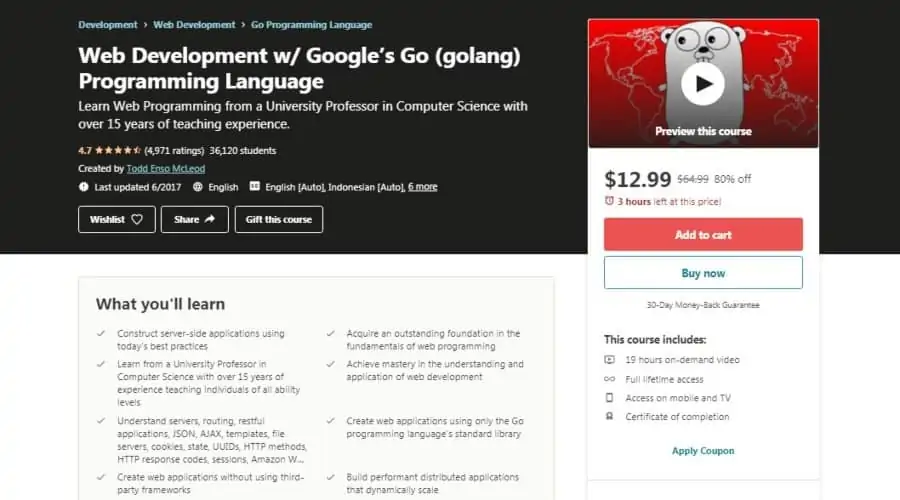
Your instructor for this course will be Todd Enso McLeod, a tenured Professor at the Fresno City College in California who has over 15 years of experience in teaching. He is also the leading Go educator globally with close to 300,000 students served and a rating of 4.5 stars.
In this 19 hours long online class, you will learn everything required to become a master at web development using Go, with topics including server-side applications, servers, routing, file servers, cookies, applications without third-party frameworks, best practices, and much more.
Overall, this is one of the top online Golang programming courses due to the in-depth lessons, real-world examples, and an industry-leading teacher!
Strengths of this online course:
- Intermediate level
- 19 hours long
- Taught by tenured professor with 15+ years of experience
- Full lifetime access
- Certificate of completion
10. Go Language Overview (Treehouse)
Go’s syntax is fairly similar to several other compiled languages such as Java and C, so if you’re already familiar with those languages and want to learn Go, this course is right for you. Brought to you by Treehouse, this intermediate-level course will get you comfortable with the core features of Google’s programming language.
Your teacher for this online course will be Jay McGavren, who is a teacher at Treehouse and an expert in development tools such as Go. Jay has authored the Go tutorial book named Headfirst Go and spoken at a number of conferences including OSCON.
In this approximately 3 hours long Go programming course, you will first go through some of the basics of Go including its syntax, variables, packages, conditionals, loops, and some data structures, before moving to core features such as custom types and concurrency.
You will be able to start a free 7-day trial offered by Treehouse during which you can easily complete this entire course!
Strengths of this online course:
- Intermediate level
- 3 hours long
- Taught by author of Head first Go
- Free 7-day trial
- Monthly subscription for nominal rates
11. Getting Started With Go (Coursera)
For those of you who have experience with several programming languages and want to get started with the basics of Google’s Go language, this intermediate-level course is suited to your needs. Offered by the University of California, Irvine, the course has 22,000+ students and a rating of 4.6 stars.
Ian Harris, Professor of Computer Science at UCI, will be your instructor for this course. Ian is also the Vice-Chair of Undergraduate Education in the same department and has over 348,000 students on Coursera with a rating of 4.63 stars.
In this 16 hours long course, Ian will take you through fundamental Go topics including protocols, formats, and data types, incorporating RFCs and JSON, and much more. You will also be completing a number of hands-on assignments that will be reviewed by your peers in this course.
Coursera offers you the chance to obtain financial aid if you are unable to pay the full fees for this course, and earn a shareable certificate of completion at the end!
Strengths of this online course:
- Intermediate level
- 16 hours long
- Taught by CS professor from UCI
- Financial aid available
- Certificate of completion
12. Master Go (Golang) Programming (Udemy)
The best way to learn anything is to do loads of practice, and so if you’re looking to learn the Go programming language through heavy practice, this Udemy course is the perfect choice for you. With an average rating of 4.6 stars, this beginner-level course will make you ready to become a professional Go developer.
In this online Go programming course, you will be instructed by Andrei Dumitrescu, a software engineer who has over 15 years of professional experience and runs a training center in Romania. Andrei has over 18,000 students on Udemy along with a rating of 4.5 stars.
Through 13 hours of on-demand video lessons, you will start learning Go from scratch by going over basics like syntax, conditionals, loops, and functions, before moving on to more advanced features like concurrency and Goroutines.
You can benefit from a limited-time discount of 86% off to gain full lifetime access to this course, along with a certificate of completion at the end! Overall, this is one of the best online Go programming courses for complete beginners!
Strengths of this online course:
- Beginner-to-intermediate level
- 13 hours long
- Taught by professional with 15+ years of experience
- Full lifetime access
- Limited-time discount of 86%
- Certificate of completion
13. Gophercises (Gophercises)
Excellent hands-on courses that make learning easy and enjoyable without charging anything are very hard to come by on the internet, but this free beginner-level course on Gophercises is exactly that.
As for your instructor, you will be taken through all the exercises by Jon Calhoun, a full stack web developer who has previously worked at Google and is also a guest on Go Time, a podcast that is all about the Go programming language.
In this course, you will be going through 20 hands-on exercises to build mini-applications that will each introduce you to a specific area of Go programming. Examples of these include making a quiz game, URL shortener, file renaming tool, building PDFs and images, and much more.
All you need to do to gain access to this free Go programming course is to register with your email address, and rest assured, your inbox will not be spammed!
Strengths of this online course:
- Beginner-to-intermediate level
- 20 hands-on exercises
- Taught by expert full stack developer
- Completely free of any charges
- Register using your email address
Or Would You Like Some Help With Go?
If you need immediate Go programming help and are worried about your learning curve, what about hiring a freelancer from Fiverr to help? They’ve bailed me out on tight deadline projects many times. Plus, most of these Pros are more than willing to teach you while they deliver on the gig.
Here are a few Go Pros just to give you a feel for what’s out there.
