
Learn How To Start Programming With 2024‘s Top 10 Best Online Java Courses
Java has cemented its position as a highly popular programming language and is behind the rise of millions of Android-powered smartphones sold every year.
So, if you’re looking to learn this in-demand programming language, you’re in the right place!
In this guide, I have sourced some of the best online Java courses and certificates that will make you an expert software and application developer with Java in no time!
Within these classes, students will learn everything from syntax and control statements to advanced concepts like object-oriented programming, concurrency, and much more. Let’s get started!
Top 10 Best Online Java Courses & Certificates 2024
1. Java from Beginner to Expert (Skillshare)
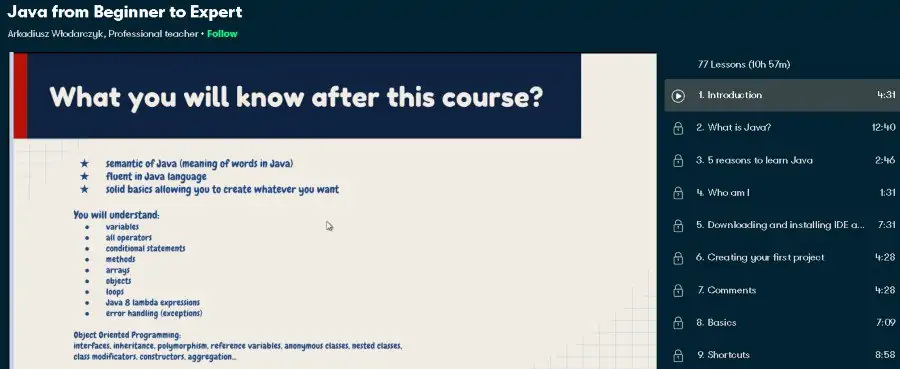
First on my list is an immersive online Java course that will get you building applications using Java even if you have never coded before in your life! This beginner-level class has been taken by over 6,800 students and has a catalog of 20 student projects.
Your instructor for this class will be Arkadiusz Włodarczyk, a Poland-based programmer, and web development expert. Arkadiusz has also taught 240,000+ students through 27 highly popular online courses, so you are in great hands!
Through 11 hours of course material, students will develop a strong grasp on both the basic and advanced features of Java, by learning about operators, classes, inheritance, interfaces, how to use the Android Studio, and tons more.
Don’t worry about drowning in theory without any practice – you will be doing a lot of programming as part of this online Java course to strengthen your coding muscles! Also, don’t forget to take advantage of the Skillshare free trial!
- Beginner level
- 11 hours long
- Taught by programming and web development expert
- Free 1-month trial of Skillshare Premium
Activate FREE Skillshare Trial
2. Java Programming Masterclass for Software Developers (Udemy)
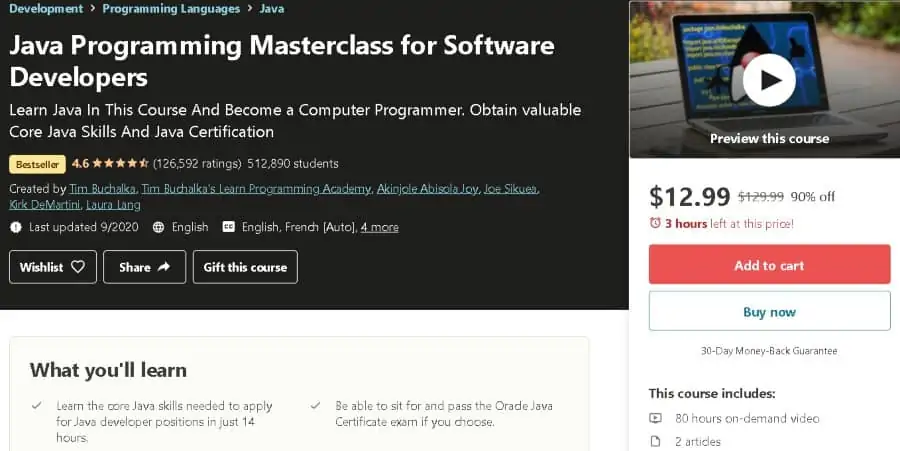
What if I told you that it will only take 80 hours of learning before you can start applying for Java developer positions with confidence? If that sounds appealing, then this beginner-level online Java course will help you achieve just that.
For this class, students will be taught by Tim Buchalka, an expert software developer with 35 years of experience. In total, Tim has helped teach over 500,000 students across his many courses to gain new positions in the programming and development industries.
While the 80 hours of classes might seem daunting, you’ll be glad you did them as it gives students an immersive and comprehensive learning experience. Some of the many topics included in this course cover OOP, concurrency, JavaFX, debugging, unit testing, and much more!
Once you’ve gone through this online Java course, you’ll be all set to give and pass (with flying colors, no less) the Oracle Java Certification exam!
- Beginner level
- 80 hours long
- Taught by expert software developer and his team
- Full lifetime access
- Certificate of completion
3. Java Basics – For Complete Beginners (Skillshare)
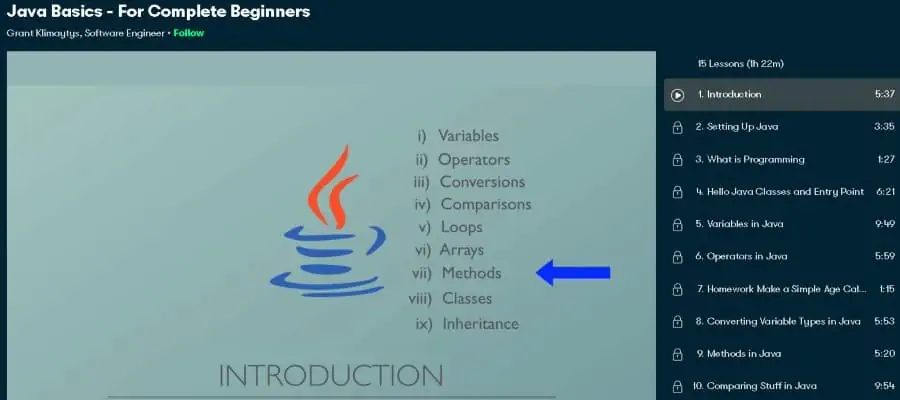
If you’re intimidated by a 50-100 hour long course and are looking for something quicker and more concise, you won’t want to miss this short beginner Java course!
For these lessons, you will be instructed by Grant Klimaytys, a freelance software engineer who is an expert in a number of languages and frameworks including Java.
Through 1 ½ hour of video lessons, Grant will take students through the basics of Java, teaching you as if you’re trying out coding for the first time in your life. Grant also covers how to set up Java, how to work with variables, operators, control flows, methods, arrays, classes, inheritance, and much more.
This is the perfect online course if you just want a taste of coding through Java, and get the opportunity to browse through a diverse catalog of 30+ student projects!
- Beginner level
- 1 ½ hours long
- Taught by freelance software developer
- Free 1-month trial of Skillshare Premium
- 30+ student projects
Activate FREE Skillshare Trial
4. Learning Java (LinkedIn Learning)
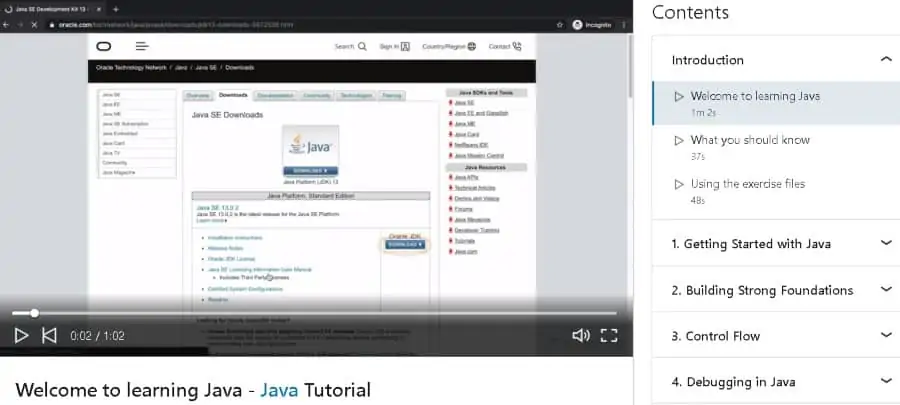
Next on my list is a condensed Java course that is a great pick for those who want to get up to speed with Java quickly. Students will also be following in the footsteps of 34,000 others who have completed this class from LinkedIn Learning.
As for your instructor, Kathryn Hodge will be teaching you in this online Java course. Kathryn is a software developer who makes YouTube videos to help her audience learn to code and was a teaching assistant in the computer science department of her college for 3 years before graduating.
During the 2 ½ hours of video lessons, students will learn the basics of Java including basic data types, functions, strings, loops, control and logic flow, debugging, and tons more.
Here’s the best part: you can take this online course for free if you are a new LinkedIn user, and earn a certificate of completion at the end!
- Beginner level
- 2 ½ hours long
- Taught by YouTube coding instructor
- Free access for new users
- Certificate of completion
5. Java For Beginners (Skillshare)
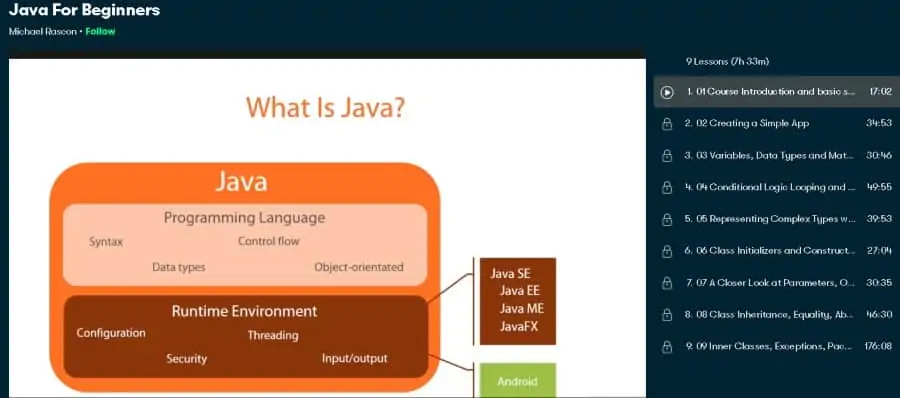
Whether you’re brand new to coding or a seasoned developer looking to transition over to Java, this online Java class will help you develop the strong foundation needed to pursue a successful career as a Java developer!
Through video lessons that span 7 ½ hours, students will start with the basics of Java such as setting up an environment, playing around with variables and operators, before going into advanced topics like class initializers, constructors, overloading, inheritance, and equality to name a few.
Currently, this class is hosted on Skillshare which provides all class materials, downloadable recourses, class discussions, and access to all 29,000 other classes!
- Beginner/intermediate/advanced
- 7 ½ hours long
- Taught by professional Java developer
- Free 1-month trial of Skillshare Premium
Activate FREE Skillshare Trial
6. Java Programming and Software Engineering Specialization (Coursera)
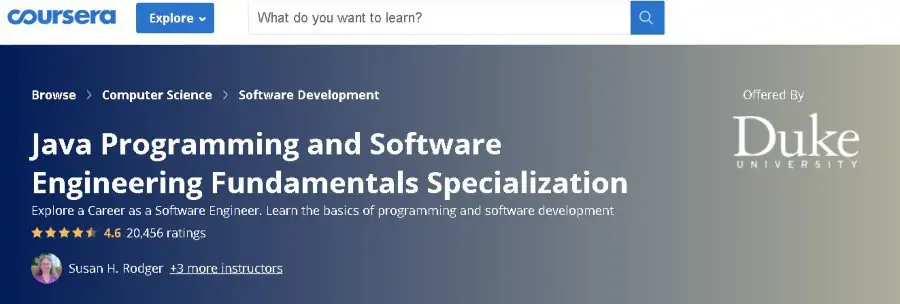
If you’re looking to transition over to software engineering but don’t have entire days to dedicate to intense online courses, then this Java specialization can’t be passed! You will also be joining over 180,000 students who have are already enrolled in this course.
For this specialization, students will be instructed by a team of professors and lecturers from the computer science department of Duke University. The team has published 20+ courses in total on Coursera, teaching close to 2 million students from all around the world, so they come highly recommended!
By spending 4 hours a week over a span of 5 months, students will go through 5 online courses that will gradually build your skills in Java programming, with topics including JavaScript, HTML, and CSS, before diving deep into Java and implementing these newfound skills by making a portfolio project. We have a full list of JavaScript course reviews here as well.
Don’t worry if the monthly subscription fee for this specialization proves to be a barrier – Coursera offers financial aid for all those who are unable to afford the full price!
- Beginner level 5-course specialization
- 4 effort hours per week for 5 months
- Taught by team of professors/lecturers from Duke University
- Certificate of completion
- Financial aid available
7. Java Programming for Complete Beginners (Udemy)
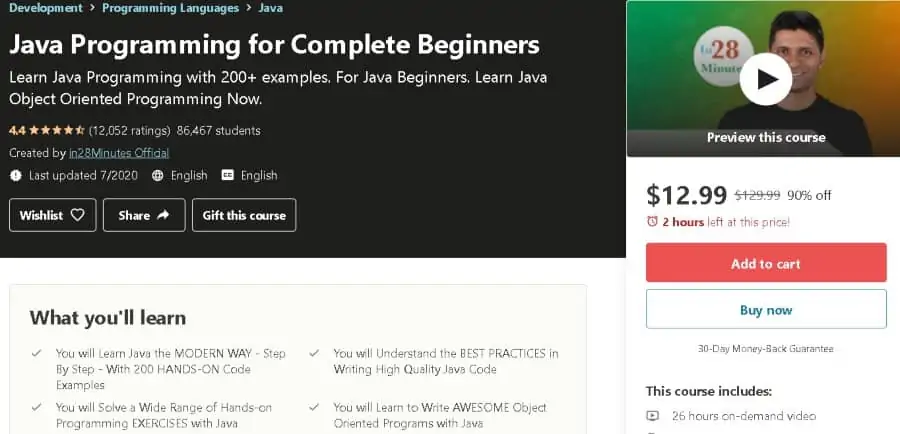
Do you prefer project-based learning rather than lengthy lecture-based instruction? If so, this beginner-level online Java course is a fantastic choice. In total, 85,000 other students have completed this class with an average rating of 4.4 stars.
Tutoring for this course will be provided by in28Minutes Official, an e-learning education company that develops online classes in a number of learning paths. The company has published 34 courses on Udemy alone, teaching over half a million students.
In this 26 hours long class, students will get started with Java through the Eclipse IDE where they will complete over 200 hands-on coding exercises that will teach various topics like loops, conditionals, arrays, generics, collections, object-oriented programming, and much more.
It doesn’t matter if you forget anything later on – you can always come back to this online course and access all the contents, thanks to the full lifetime access given by Udemy!
- Beginner level
- 26 hours long
- Taught by instructors from in28Minutes e-learning company
- Certificate of completion
- Full lifetime access
8. Professional Certificate in Java Programming (edX)
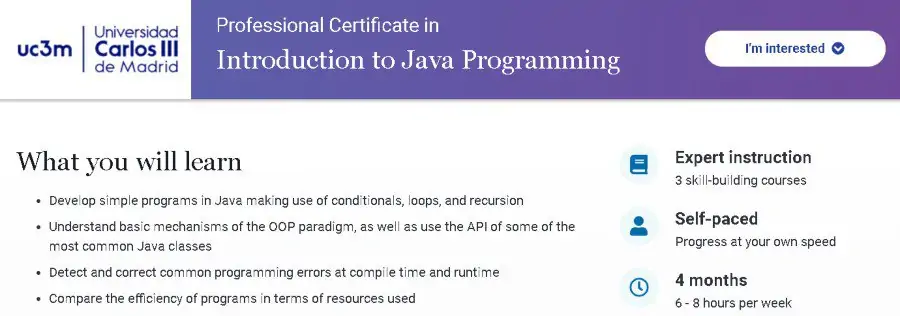
Next on my list is a comprehensive online Java professional certificate that will take you from zero to hero in Java programming, even if you’ve never coded before in your life! The program consists of 3 online Java courses that will build your Java expertise one step at a time, so you won’t want to miss it!
Instructors for this online professional certificate will be provided by the Universidad Carlos III de Madrid. A group of professors, lecturers, and teaching assistants have worked together to produce this series of high-quality online Java courses for you.
By investing -8 hours a week, these 3 Java courses will take around 4 months to complete. During this period, students will start by learning the basics of coding in Java in a simple and interactive way before learning best coding practices, important data structures and algorithms, and much more.
The entire program is completely self-paced, so you don’t need to worry about deadlines. However, you do need to make sure you don’t end up falling way behind!
- Beginner level
- Professional certificate consisting of 3 courses
- 6-8 effort hours a week for 4 months
- Certificate of completion
- Self-paced learning
9. Java Language Fundamentals (Pluralsight)
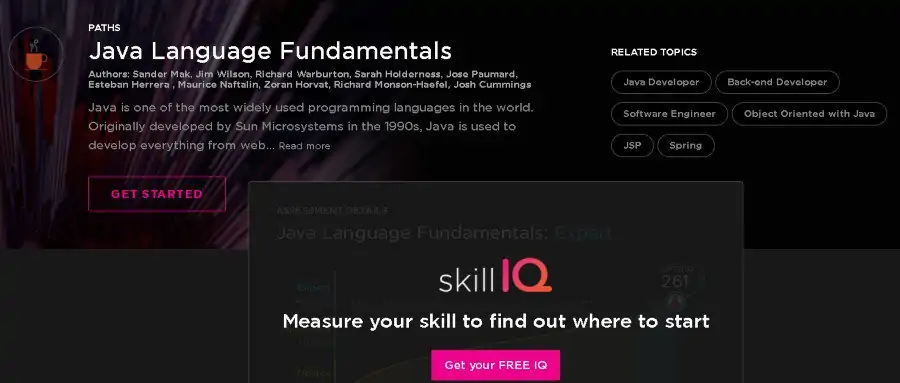
Even better than a single online Java course is a whole collection of them for all different levels! With these online Java courses (called a ‘Path’), you can find online courses sorted out for beginners, intermediates, and advanced-level developers.
Your instructors for this collection of online Java courses will include highly experienced and hand-vetted software developers who have passed Pluralsight’s stringent quality criteria. So one thing’s for sure: you’ll be getting nothing less than top-quality.
In this collection, students will find 21 online Java courses sorted based on difficulty level. By taking these online courses, students will learn not only basics like the syntax, operators, and control loops in Java, but also advanced topics like exception handling, OOP, Java streams, and much more.
Along with a certificate of completion, Pluralsight also offers a ‘skillIQ’ test to help you determine where you stand and recommend the best online course that you should take!
- Beginner/intermediate/advanced level
- Collection of 21 courses
- Taught by hand-vetted experts
- Certificate of completion
- Take the skillIQ test to receive recommendations
10. Java 8 Essential Training (LinkedIn Learning)
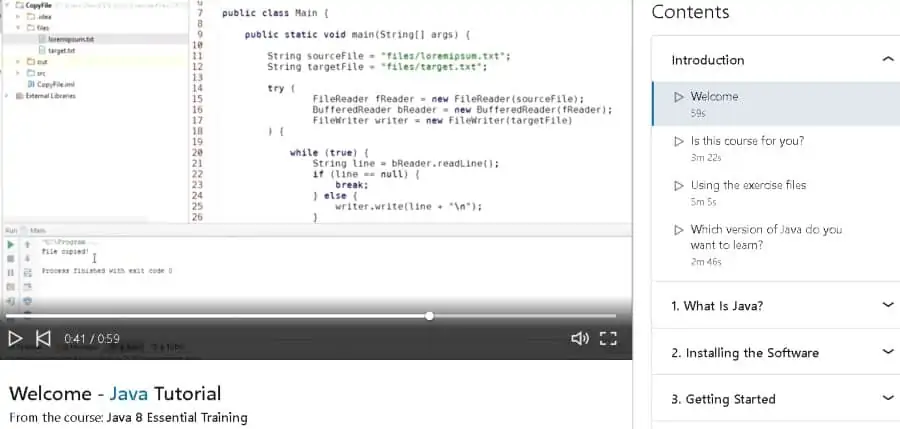
Rounding out my list is a holistic online Java course on LinkedIn that is an excellent choice for both beginner and intermediate-level programmers alike. Taken by over 74,000 students, this online Java course will teach you the tools needed to build exciting mobile, desktop, and web applications.
David Gassner, the former president and founder of Bardo Technical Services, will be teaching you in this online course. David is a specialist in Android and Java, and has authored more than 60 training courses for developers.
In this 6 hours long online Java course, David will take students through a wide range of Java topics including variables, data types, control flow tools like loops and conditionals, and a number of advanced topics like object-oriented programming, inheritance, polymorphism, and much more.
Once you’re done with this online Java course, you will get a certificate of completion that you can share with your network and let it be known that you’re ready to build some killer apps!
For more learning, also see my posts on computer networking, full-stack development, and R Programming.
- Beginner/intermediate level
- 6 hours long
- Taught by Android and Java specialist
- Certificate of completion
- Free access for new users
