
The Top 17 Best Online Game Development Courses Right Now

Game development is a thriving industry in the world of software, with bigger and better games being pumped out every year. So if you want to launch a career in game development by learning how to build games, you’ve come to the right place!
In this article, I have gathered the best online game development courses for programmers in 2024 that will teach you a wide range of tools and programming languages to build immersive games. You will learn how to program in C++ and C#, how to use the Unity and Unreal Engine, making 3D models, using javascript, and much more.
Get ready to build loads of exciting games by yourself through hands-on exercises in these courses. Let’s get started!
Top 17 Best Online Game Development Courses
1. Game Development – An Introduction To Unity® For Absolute Beginners (Skillshare)
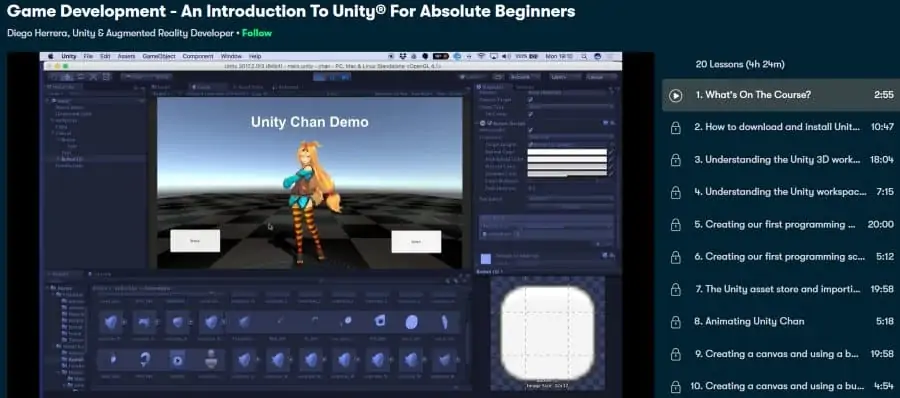
First on my list is a popular online game development course on Skillshare that will teach you how to code using the C# programming language and build games using the Unity 3D engine. This beginner-level online class has been taken by over 3500 students.
Your instructor for this online course will be Diego Herrera, a software engineer with over 17 years of professional experience in app development, web design, multilingual software, and 3D. Recently, Diego has taken to diving deeper into augmented reality and 3D applications.
In this 4 ½ hours long online course, you will start from scratch by first learning how to program using C# before diving into the basics of Unity 3D, a popular engine for building games. You will learn about adding various elements like weather to a game, building a fun car app, and much more.
With a free 2-month trial of Skillshare Premium up for grabs, you can take this video game development course for free!
- Beginner level
- 4 ½ hours long
- Taught by experienced software and game developer
- Free 2-month trial of Skillshare Premium
- Learn Unity 3D game engine
Activate FREE Skillshare Trial
2. Complete Beginners Guide to Unity C# Game Development (Skillshare)
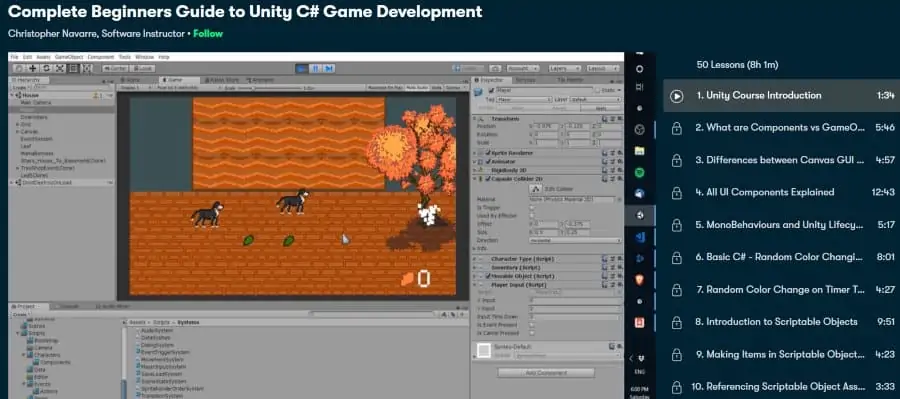
Unity is widely used for building immersive 2D and 3D games, and this beginner-level online game development course on Skillshare will teach you how to use Unity to build your own games. Taken by over 800 students, this comprehensive online course will make you an expert in using Unity.
In this online course, you will be taught by Christopher Navarre, a software expert and instructor with more than 2200 followers on Skillshare. Christopher runs his own YouTube channel named ‘Chris’ Tutorials’ where he posts tutorials about a wide range of software languages and topics.
Through 8 hours of bite-sized video content, Chris will teach you how to build detailed games using the Unity game development engine. You will go through topics like working with components of game objects, building a solid Unity workflow, manipulating audio, making UIs, and much more.
You will have all the scripts and assets from this online course available online for you to access and use at will!
- Beginner level
- 8 hours long
- Taught by software instructor from Chris’ Tutorials on YouTube
- Free 2-month trial of Skillshare Premium
- Scripts and assets available publicly
Activate FREE Skillshare Trial
3. Complete C# Unity Game Developer 2D (Udemy)
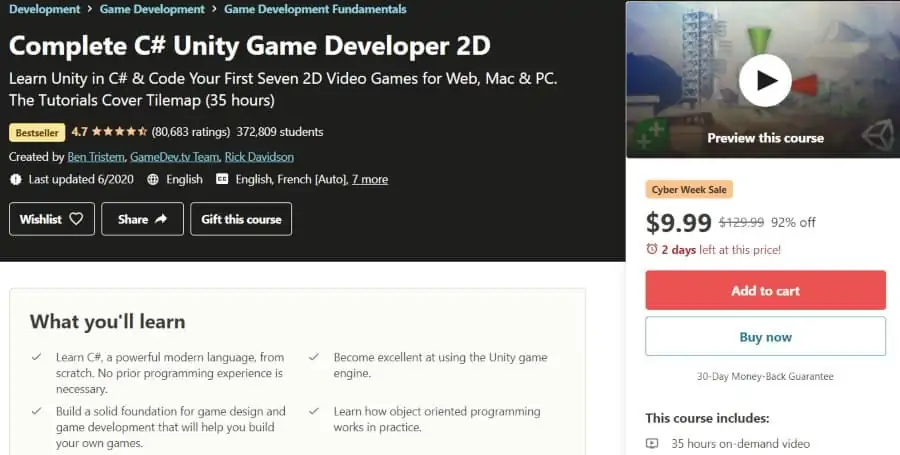
If you’re looking for an online game development course that will teach you how to build 2D games using the Unity engine through project-based learning, this online course on Udemy is for you. Taken by over 370,000 students, this beginner-level online course has an average rating of 4.7 stars.
As for your instructors, the GameDev.tv team will be teaching you in this online game development course. Instructors Ben Tristem and Rick Davidson are experienced game industry professionals who will bring their expertise to bear on the content in this online course.
In this massive 35 hours long online course, you will start by learning how to code using C# and quickly get comfortable with object-oriented programming before building a series of games and learning the ins and outs of using Unity to make production-ready 2D games, and much more.
Once you’re done with this online course, you will receive a certificate of completion to share with your network and showcase your newly acquired skills!
- Beginner level
- 35 hours long
- Taught by GameDev.tv team
- Certificate of completion
- Full lifetime access
4. Unity 2D Game Development Course (Skillshare)
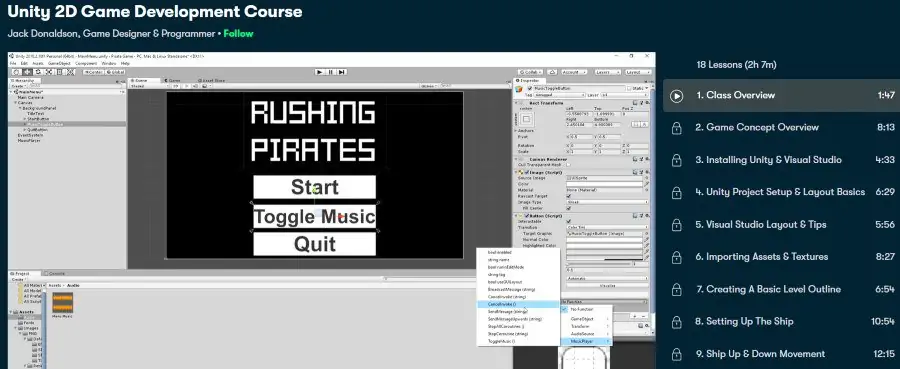
For those of you looking for a high-level and fun introduction to game development using Unity, this beginner-level online course on Skillshare is the perfect choice. Taken by 1400+ students, this online course will help you convert the board game ‘Rush Hour’ into a digital video game.
Jack Donaldson, a programming and software development expert with more than 5 years of experience, will be teaching you in this online game development course. Jack is experienced with a number of languages like C#, C++, and Python, and is an expert at developing games.
Through his short 2 hours long online course, Jack will show you how you can take the famous board game ‘Rush Hour’ and slowly build a video game version of it using Unity. He will teach you topics like designing levels, importing assets, basic game design principles, and much more.
By completing this basic hands-on project, you will find yourself ready to take on much bigger ones and build games of your own!
- Beginner level
- 2 hours long
- Taught by game developer with 5+ years of experience
- Free 2-month trial of Skillshare Premium
Activate FREE Skillshare Trial
5. Unreal Engine C++ Developer: Learn C++ and Make Video Games (Udemy)
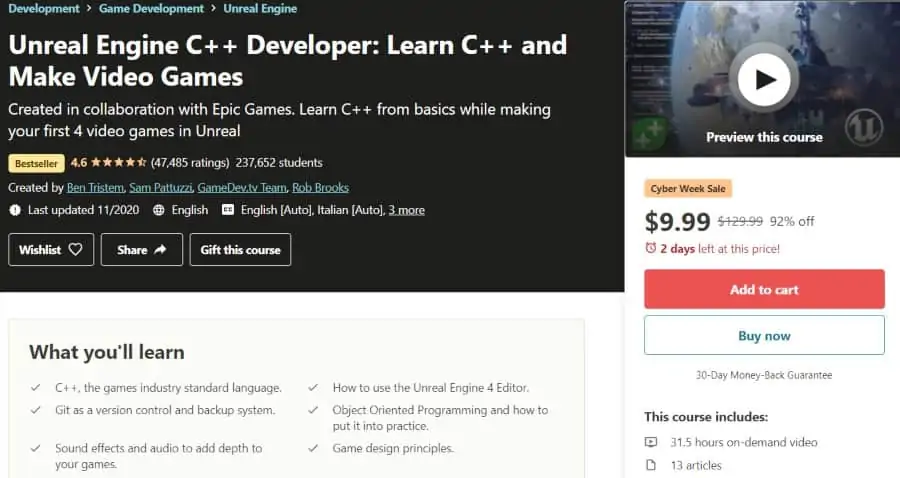
Next on my list is a beginner-level online game development course on Udemy that will make you an expert at building games using C++ and the Unreal engine. With an average rating of 4.6 stars, this bestselling online course has been taken by over 234,000+ students.
You will be provided with instructors for this online course by the GameDev.tv team, an e-learning company that creates online courses to teach game development. The company has published 20 courses on Udemy on various game dev topics, teaching more than 700,000 students.
In this 31 ½ hours long online course, you will learn how to code using C++ and use Git as a version control system. Then, you’ll dive into topics like game design principles, vector math for gameplay and physics, using Unreal’s Terrain Editor and Gameplay Framework, and much more.
You’ll have full lifetime access to this online game development course, so you can come back whenever you want to review rusty concepts and solidify your basic understanding!
- Beginner level
- 31 ½ hours long
- Taught by GameDev.tv team
- Certificate of completion
- Full lifetime access
6. Professional Certificate in Computer Science for Game Development (edX)
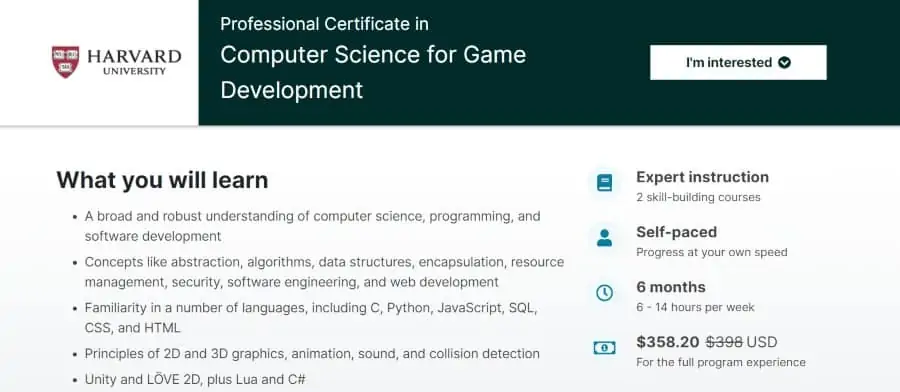
If you’ve ever wanted to learn computer science from Harvard and get into game development, this online professional certificate in game development on edX is the perfect choice for you. As part of this program, you will take 2 online courses taught by some of the best professors from Harvard.
You will be taught in this online course by a group of elite instructors from Harvard’s Computer Science department. This group includes David J. Malan, the Gordon McKay Professor of the Practice of Computer Science.
It will take you about 6 months to complete the 2 beginner level online courses that form this program. The first will teach you the fundamentals of computer science from scratch whereas the second will take you through the basics of game development through multiple hands-on exercises.
You will get the chance to understand the design of games like Super Mario and Angry Birds while learning at your own pace and getting a certificate of completion at the end!
- Beginner level certificate consisting of 2 courses
- 6 months long with 6-14 hours of effort needed per week
- Taught by renowned Harvard professors and instructors
- Self-paced learning
- Certificate of completion
7. Complete C# Unity Game Developer 3D (Udemy)
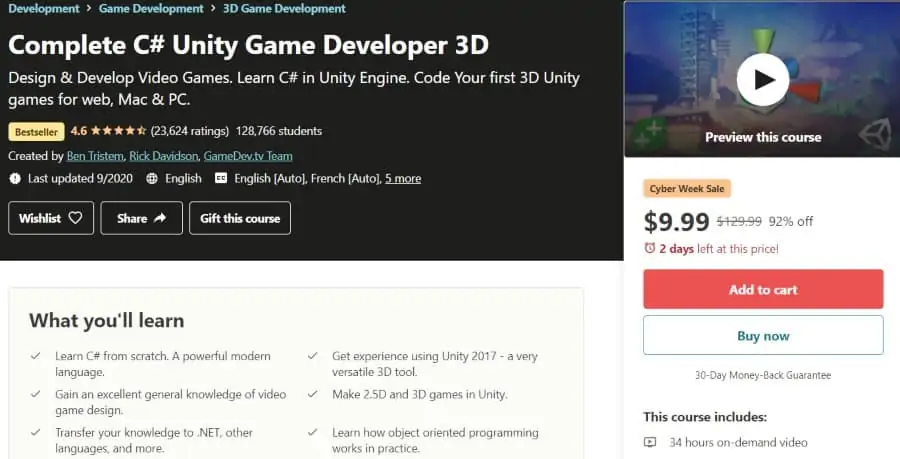
3D games require a lot more skill to build as compared to 2D games, and this online game development course on Udemy will teach you how to build your favorite ones using the Unity engine. This beginner-level bestselling online course has been taken by over 125,000 students.
GameDev.tv, an e-learning company that creates educational materials for aspiring game developers, will be providing you with the instructors for this online course. The company has taught more than 700,000 students from around the world through its 20+ online courses.
In this 34 hours long online course, you will first learn the basics of programming using C# before delving into the basics of Unity. You will be making a series of hands-on games like Argon Assault and Zombie Runner to get a solid idea of the fundamentals of game development, and much more.
The certificate of completion you’ll receive at the end of this online game development course will prove to be crucial in helping you secure a game developer job!
- Beginner level
- 34 hours long
- Taught by the GameDev.tv team
- Full lifetime access
- Certificate of completion
8. Introduction to Game Development (Coursera)
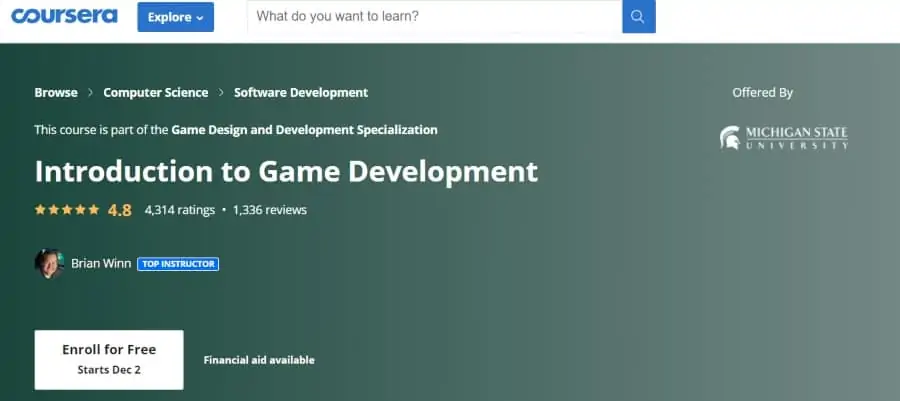
Offered by the Michigan State University (U.S.), this beginner-level online game development course on Coursera will get you started with building video games using the Unity3D engine. Taken by over 113,000 students, this is the first online course in a series of game development courses.
As for your instructor, Brian Winn will be teaching you in this online course. Brian is the Associate Professor of Media and Information at Michigan State University. He has published 3 courses on Coursera and earned an average instructor rating of 4.9 stars.
Over a course of 22 hours, you will go gradually change yourself from being a game player into a game developer skilled in building and setting up a game’s graphics, building an environment in Unity3D, incorporating physics, adding elements like enemies and animations, and much more.
Don’t worry if you are unable to afford the full fees for this online course – you can apply for financial aid through Coursera and complete this online course for free!
- Beginner level
- 22 hours long
- Taught by an associate professor from the Michigan State University
- Certificate of completion
- Financial aid available
9. The Ultimate Guide to Game Development with Unity (Udemy)
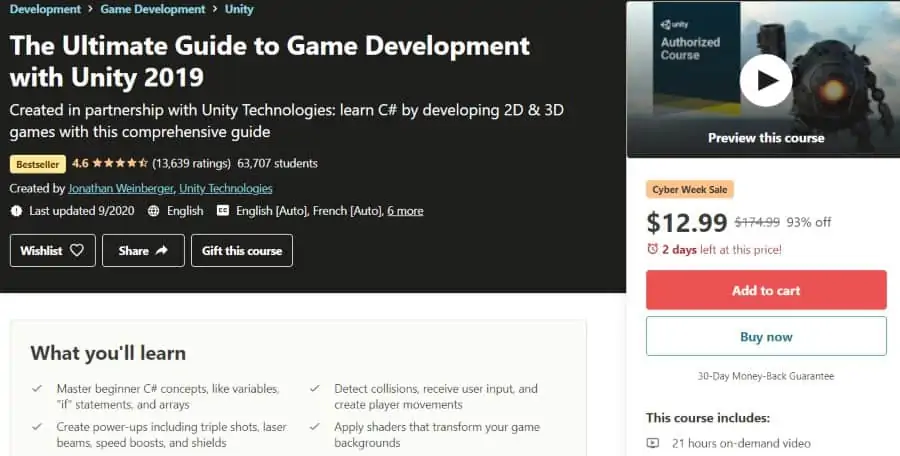
Created in collaboration with Unity Technologies, this online game development course on Udemy will make you capable of building professional 2D and 3D games using the Unity engine. Over 60,000 students have taken this beginner-level online course that has an average rating of 4.5 stars.
In this online course, you will be taught by Jonathan Weinberger, a self-taught software engineer with over 8 years of professional experience. Jonathan has published over 10 courses on Udemy and built applications and games for companies like Cartoon Network and Coca-Cola.
In this 21 hours long online game development course, Jonathan will take you through the exciting world of game development with topics like power-ups like lasers, enemies that have basic AI behavior, sound and background effects, implementing game physics, and much more.
Get ready to take an online course that was built by the creators of the Unity engine itself!
- Beginner level
- 21 hours long
- Taught by self-taught game developer with 8+ years of experience
- Full lifetime access
- Certificate of completion
10. Introduction to Game Design (Coursera)
Next on my list is a beginner level online game development course on Coursera that is a perfect choice for the more artistically-inclined among you. Taken by 70,000+ students, this fun online course has been developed by the California Institute of the Arts (CALARTS).
Your instructor for this online course will be Fran Krause, a faculty member at the School of Film/Video at the California Institute of Arts who teaches character animation. Fran has taught 2 courses on Coursera and earned an average instructor rating of 4.92 stars.
Through 6 hours of learning in this short online course, you will learn the fundamentals of game design by going over the various elements of a game, how to build and implement rules for a game, construct a story that encapsulates all the characters, define multiplayer rules, and much more.
Coursera offers you the option to apply for financial aid so don’t worry if finances are a problem for you, you can take this course for free!
- Beginner level
- 6 hours long
- Taught by faculty from California Institute of the Arts
- Financial aid available
- Certificate of completion
11. Video Game Design and Development: Introduction to Game Programming (FutureLearn)
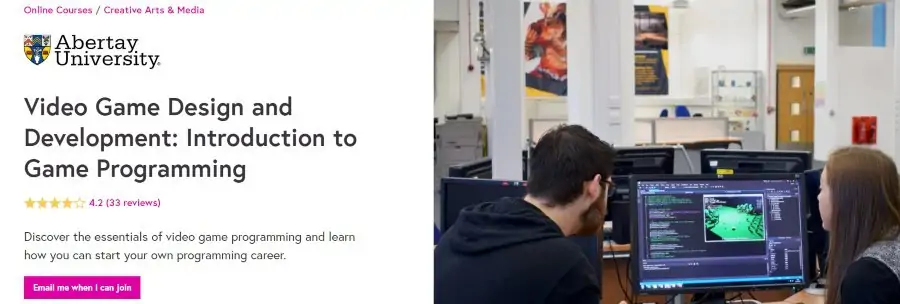
If you’re looking for a short and beginner-friendly online course on game development, this online course on FutureLearn is the right choice for you. This beginner-level online game development course has been produced by Abertay University and has taught over 9,500 students.
In this online course, you will be taught by Paul Robertson, a lecturer in games programming at Abertay, and Christopher Acornley, his colleague. Abertay University is renowned for its computer games education.
In the 2 weeks it will take you to complete this online course (with 3 hours of study per week), you will get an overview of basic programming and game development concepts such as loops and conditionals, user input, sprites and animations, forces, collision detection, and much more.
This is an ideal online game development course if you want to learn from an amazing university and spend some time with the basics before diving deeper!
- Beginner level
- 2 weeks long with 3 effort hours per week
- Taught by instructors from Abertay University
- Certificate of completion
12. Unreal Engine 4: How to Develop Your First Two Games (Udemy)
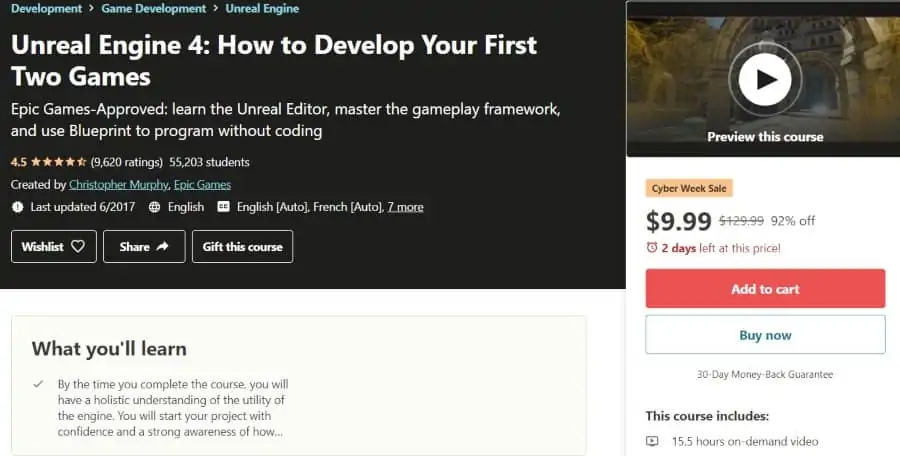
People have loads of creative ideas for games and other interactive experiences but don’t have the skills to translate them into reality. By taking this online game development course on Udemy, you will learn how to use the Unreal Engine 4 to convert your ideas to tangible reality.
As for your instructor, Christopher Murphy will be teaching you in this online course. Christopher is an independent game developer with over 10 years of experience building games for a number of platforms. He is also an Unreal Engine evangelist and strives to help more people learn this tool.
Through 15 ½ hours of on-demand video lessons, Chris will give you a comprehensive introduction to game development in Unreal Engine 4 through 3 complete projects. You will make an Arch Viz game, Pinball, and a survival game, directly applying everything you learn about Unreal Engine 4.
Don’t worry if you find your skills getting rusty after some time – with full lifetime access from Udemy, you can always come back to the contents and review topics at will!
- Beginner level
- 15 ½ hours long
- Taught by Unreal Engine evangelist and game developer with 10+ years of experience
- Full lifetime access
- Certificate of completion
13. Game Development for Modern Platforms (Coursera)
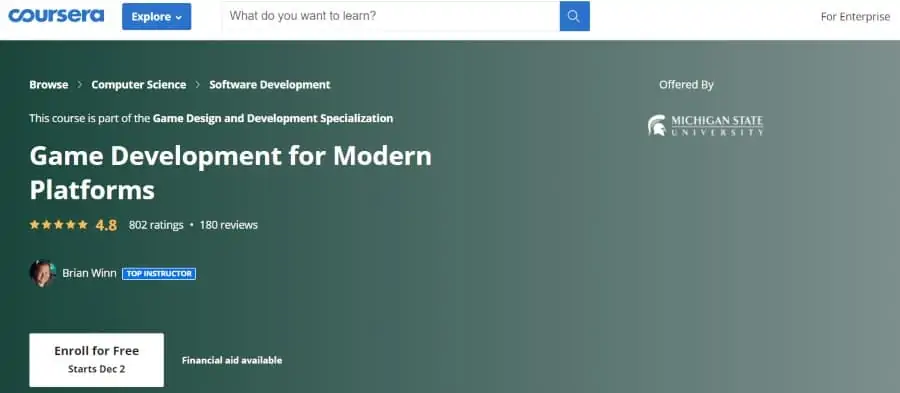
Developing a game for Windows is not the same as developing a game for Android or Mac OS X. If you want to learn how to develop games for all modern platforms, this intermediate-level online game development course on Coursera is the perfect choice for you.
Brian Winn, an associate professor of media and information at the Michigan State University, will be teaching you in this online course. Brian has taught more than 122,000 students on Coursera earning an average instructor rating of 4.8 stars.
In this 12 hours long online course, you will start with a basic overview of game development concepts and make a playable game by implementing features like game managers and character controllers. Finally, you will learn how to ship the game on all modern platforms, and much more.
With Coursera, you can apply for financial aid if you are unable to pay the full fees for this online course. You will also get a certificate of completion at the end!
- Intermediate level
- 12 hours long
- Taught by faculty from Michigan State University
- Certificate of completion
- Financial aid available
14. Data Science in the Games Industry (FutureLearn)

Games collect a lot of data from players and users and if utilized properly, it can lead to a lot of interesting insights and developments. So if you want to learn how to manage the data collected by games and put it to good use, this online course on FutureLearn is definitely for you.
Your teachers for this online course will be Andy Cobley and Mark Whitehorn. Andy is a senior lecturer and director of the data science master’s degrees at the University of Dundee. Mark is also a professor from the same university who specializes in data analytics and data science.
Over a course of 4 weeks of learning, you will learn about how games store data, how you can use non-relational database tools to manage it, how to use applications to sort and process the data, how to conduct analyses on the data using tools like R, machine learning, data mining, and much more.
If you’re already a part of the gaming industry, this is an ideal online course that will help you unlock a completely new world of information from your games!
- Intermediate level
- 4 weeks long with 3 effort hours per week
- Taught by senior lecturer and professor from University of Dundee
- Certificate of completion
15. RPG Core Combat Creator: Learn Intermediate Unity C# Coding (Udemy)
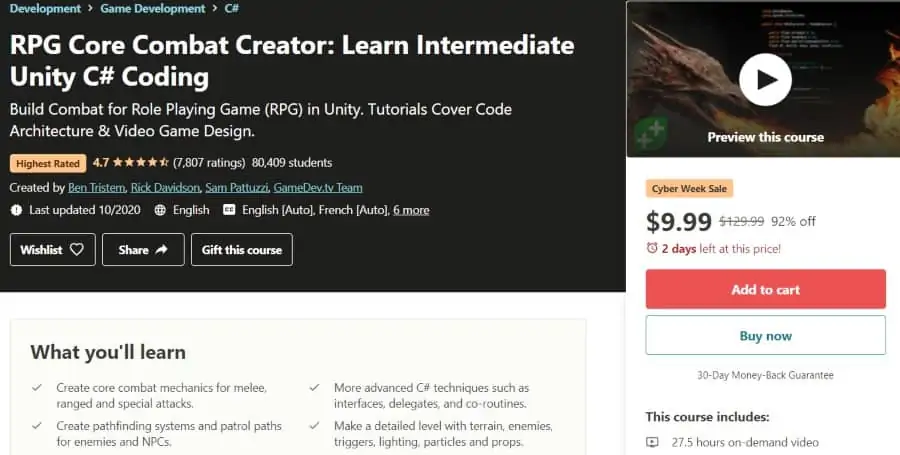
Next on my list is another intermediate-level course from the GameDev.tv team that will teach you the basics of building core role-player game (RPG) elements from scratch using Unity and C#. It has been taken by close to 80,000 students and has an average rating of 4.7 stars.
You will be instructed in this online game development course by members of the GameDev.tv team including Ben Tristem, Rick Davidson, and Sam Pattuzzi. They are all experienced game developers who have taught more than 700,000 students through their online courses on Udemy.
In this comprehensive 27 ½ hours long online course, they will make you capable of building your own RPG by teaching you topics like building core combat mechanics for different kinds of attacks, path-finding systems, balancing player and enemy stats, and much more.
Closed captions for this online course are available in 8 languages including French, German, Indonesian, and Spanish, so you can take this online course in your native language!
- Intermediate level
- 27 ½ hours long
- Taught by the GameDev.tv team
- Certificate of completion
- Full lifetime access
16. Create Your First Game with Python (Coursera)
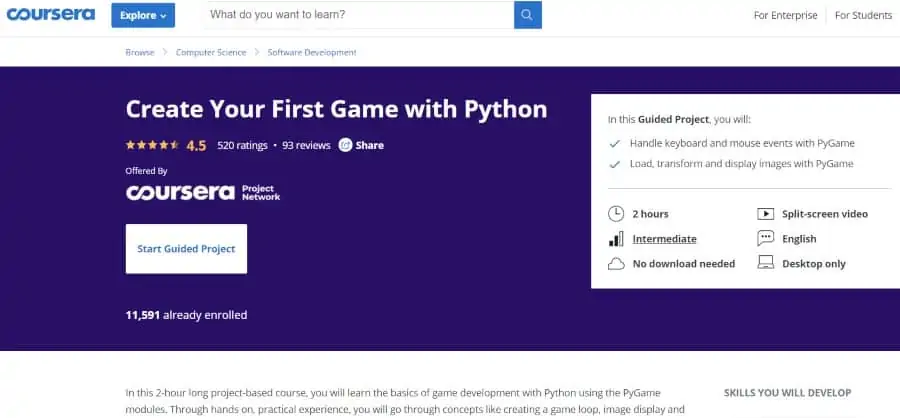
Python’s PyGame library has useful tools and functions to build simple 2D games in a short time. This intermediate-level online game development course on Coursera will teach you how to make games using Python by making you work on a guided project.
In this online course, you will be taught by Amit Yadav, a machine learning engineer who works as an ML and data science instructor at Rhyme.com, an e-learning company acquired by Coursera. Amit now is a part of Coursera’s Guided Project Network.
Through 2 hours of guided instruction, you will step by step build a complete game using Python’s PyGame library. You will learn to initialize the game loop, add images and sprites, make classes for your elements, handle events, add finishing touches, and much more.
You won’t need to install any software for this because everything will be done in the browser through a split-screen – you will code and learn at the same time!
- Intermediate level
- 2 hours long guided project
- Taught by machine learning engineer
- Certificate of completion
- Learn PyGame
17. Video Game Design and Development: A Bit-by-Bit History of Video Game Music (FutureLearn)
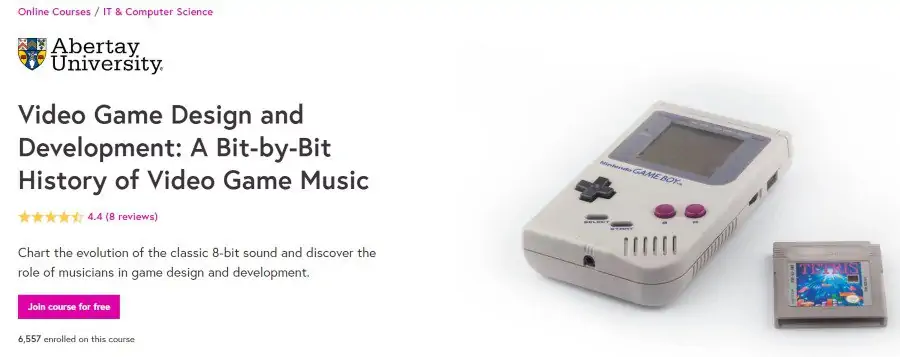
The final entry on my list is a beginner-level online game development course on FutureLearn that is perfect for anyone interested in learning about video game music and how it has developed over time. Over 6,500 students have enrolled in this online course which has a rating of 4.4 stars.
Kenny McAlpine, an Abertay University musician, author, and academic, will be teaching you in this online course. Kenny specializes in video game music and teaches the history of the development of music in video games.
In this 2 weeks long online course (with 2 hours of weekly study), you will learn how old games introduced music on platforms like the Atari VCS, ZX Spectrum, and the Commodore, and how modern games like first-person shooters go about their music, and much more.
You can take this online game development course for free through FutureLearn, or pay a nominal fee and get extra benefits like a certificate of completion!
- Beginner level
- 2 weeks long with 2 effort hours per week
- Taught by musician and academic from Abertay University
- Free access to course contents
- Certificate of completion (for extra fee)
