
Top 16 Best Online AI Courses & Certifications Right Now 2024

Artificial Intelligence and machine learning is revolutionizing various industries and disciplines all over the world, changing our lives for the better.
From healthcare to finance, AI is becoming more and more relevant to all walks of life. If you’re looking for resources to launch a career in this thriving field or just learn more about it, you’ve come to the right place!
In this article, I have gathered the best online AI courses in 2024 that will not only give you a good understanding of what AI is all about but will also teach you how to build your own AI systems through technologies like artificial, convolutional, and recurrent neural networks, robotics, and much more.
You will get the opportunity to build your own machine learning and AI models that match human-level performance via big data in a lot of tasks. If you want the best artificial intelligence and AI courses, we have your back!
Top 16 Best Online AI Courses & Certifications
1. Demystifying Artificial Intelligence: Understanding Machine Learning (Skillshare)
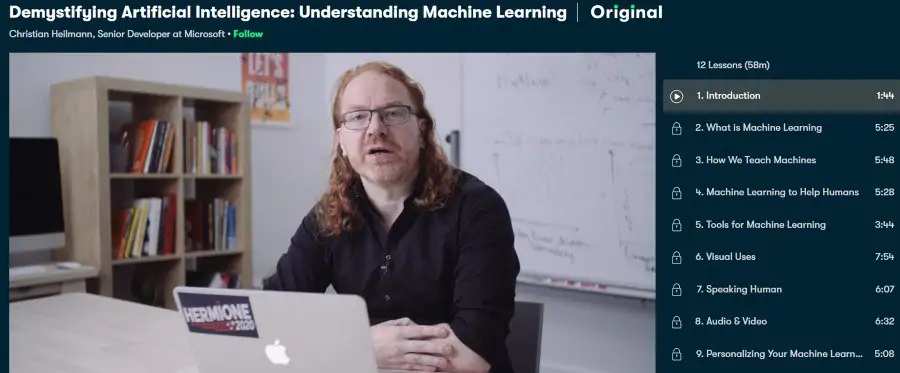
First on my list is a beginner-level online AI course on Skillshare that is a perfect intro for everyone who wants to better understand what AI is in an awesome introduction to artificial intelligence. You will also be joining 60,000 other students who have already completed this training!
Your instructor for this artificial intelligence course will be Christian Heilmann, an experienced developer at Microsoft who has more than 20 years of professional experience. Christian currently serves as a senior program manager and focuses on AI and fundamental machine learning courses.
In this 1 hour-long class, you will gain an intuitive understanding of what AI is and how it came to be. You will go through topics like how training takes place, how training programs are helping humans, what tools are used, what audio/video applications are developed, and much more.
After taking this online AI course, you’ll be able to have an intelligent conversation about AI confidently with anyone who brings up the subject! Also, don’t forget to take advantage of the 2-week free trial!
- Beginner level (no prerequisites required)
- 1 hour long
- Taught by senior program manager at Microsoft
- Free 2-month trial of Skillshare Premium
Activate FREE Skillshare Trial
2. AI For Everyone (Coursera)
Every company needs to have an AI strategy and so needs to have employees who know how AI projects are set up. If you’re looking to bring this knowledge to your company, get enrolled in this online AI course on Coursera that has been taken by more than 500,000 students.
In this online course, you will be taught by Andrew Ng, the co-founder of Coursera and the founder of deeplearning.ai. Andrew is an adjunct professor at Stanford and has worked in the Google Brain team as well as at Baidu as a chief scientist.
Through 6 hours of video lectures, Andrew will demystify AI for you, showing you what terms like ‘neural networks, programming languages, deep learning, natural language processing, and data science’ mean. He will show you the powers and limitations of AI, how to spot opportunities for your company, and much more.
Don’t worry if you’re not good at programming or are not technically sound – this beginner-level online AI course is designed for everyone, and will allow you to use the information in practical applications.
- Beginner level (great for new learners!)
- 6 hours long
- Taught by the founder of deeplearning.ai
- Certificate of completion
- Financial aid available
3. Artificial Intelligence – AI (edX)
If you’re interested in getting hands-on with AI and getting a broad overview of the entire field, this advanced-level online AI course on edX is the right choice for you. Taken by more than 250,000 students, this online AI course will give you a thorough training on various AI practices.
As for your instructor, Ansaf Salleb-Aouissi will be teaching you in this online course. Ansaf is a lecturer in the computer science department of Columbia University who has a Ph.D. in computer science and specializes in machine learning and deep learning models.
Over a course of 12 weeks (with 8-10 hours of weekly effort), you will take a broad tour de force through the field of AI, learning topics like the history of AI, intelligent agents and heuristic search, adversarial games, machine learning algorithms, applications of AI like NLP, and much more.
You can access the contents of this online AI course for free, but you can also get a verified certificate of completion if you’re willing to pay a one-time fee of $249!
- Advanced level
- 12 weeks long with 8-10 hours of study per week
- Taught by computer science lecturer from Columbia University
- Free access to course contents
- Certificate of completion
4. Advanced AI: Deep Reinforcement Learning in Python (Udemy)
Reinforcement learning is one of the frontiers of AI with intense research going on. If you’re an experienced AI practitioner looking to break into this exciting branch, get enrolled in this advanced level online python programming course on Udemy that has been taken by more than 32,000 students.
You will be taught in this online course by Lazy Programmer Inc., an AI and machine learning engineer who specializes in deep learning and has a master’s degree in computer science. He has taught more than 400,000 students through his 25+ online courses on Udemy.
In this 10 ½ hour-long online course, you will learn to apply reinforcement learning algorithms in a practical fashion via tutorials and by going over topics like building deep learning agents like DQN and A3C, making RBF networks, using policy gradient methods, doing hands-on exercises, and much more.
You will receive a certificate of completion at the end of this online AI course which you can showcase to your network and let them know about your newly acquired knowledge!
- Advanced level
- 10 ½ hours long
- Taught by AI and machine learning engineer
- Certificate of completion
- Full lifetime access
5. Machine Learning (Coursera)
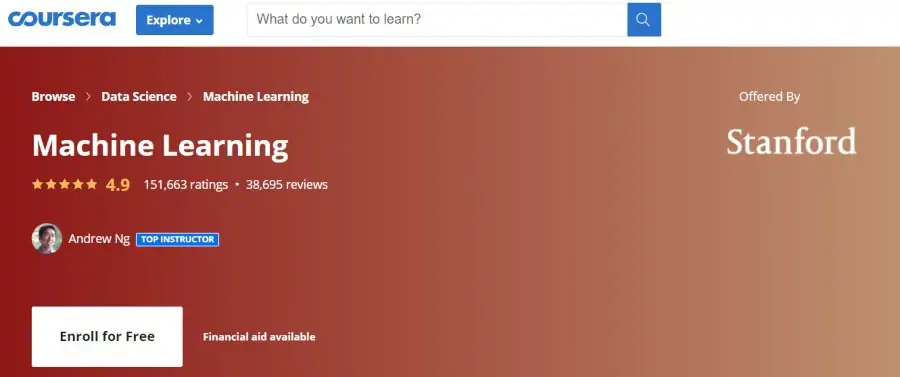
Next on my list is a widely popular online AI course on Coursera that has been taken by more than 3.5 million people from around the world. This intermediate-level online course will give you a full introduction to the world of machine learning and automation, including all the latest technologies.
Andrew Ng, adjunct professor of machine learning and AI at Stanford University, will be teaching you in this online course. Andrew has worked as part of the team that developed Google Brain and has taught more than 4.5 million students from around the world through Coursera and comprehensive certification programs.
Through a massive 60 hours of video lessons and hands-on work, you will learn everything about the workflow of machine learning by going through topics like supervised and unsupervised learning, best AI practices used in silicon valley, and the latest applications like NLP, and computer vision, and much more.
If you can’t afford the full fees for this online course, you can apply for financial aid through Coursera and get access to this online AI course for free!
- Intermediate level
- 60 hours long
- Taught by chief scientist at Baidu and adjunct professor at Stanford
- Certificate of completion
- Financial aid available
6. Artificial Intelligence Tools and Concepts (LinkedIn Learning)
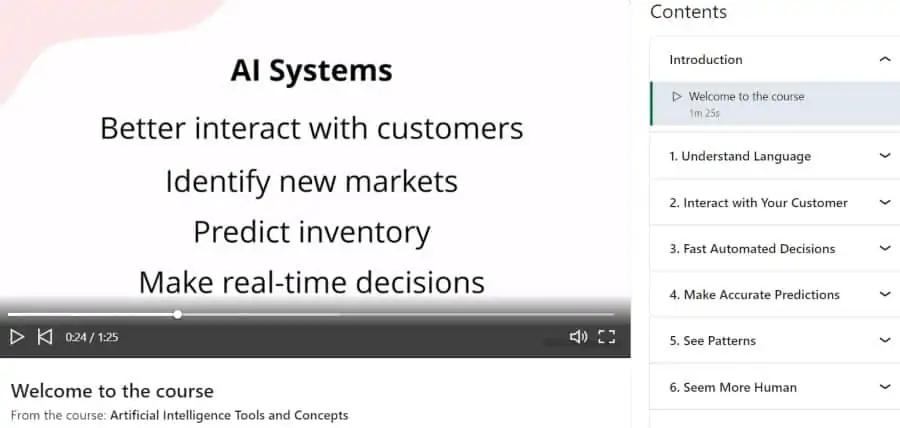
AI has revolutionized a number of fields but it can be difficult to identify the right solution for your problem without having the right knowledge. So if you’re looking to learn how to better select AI solutions for your business needs, take this intermediate-level online AI course on LinkedIn.
Your teacher for this online course will be Doug Rose, the founder of Doug Enterprises LLC who has a master’s degree in information management. Doug provides coaching services to Fortune 500 companies, helping them leverage data sets and AI to best tackle problems in a variety of ways.
In this 1 ½-hour-long online AI course, you will learn how AI can provide smart and effective solutions for automating customer service, managing logistics and inventory, and making better sales and demand predictions. You will also cover major AI platforms like hour TensorFlow, and much more.
If you’re a new or premium user on LinkedIn, you can take this online course for free and get a certificate of completion at the end!
- Intermediate level
- 1 ½ hour long
- Taught by an experienced Fortune 500 coach
- Certificate of completion
- Free access for new/premium LinkedIn users
7. Artificial Intelligence A-Z™: Learn How To Build An AI (Udemy)
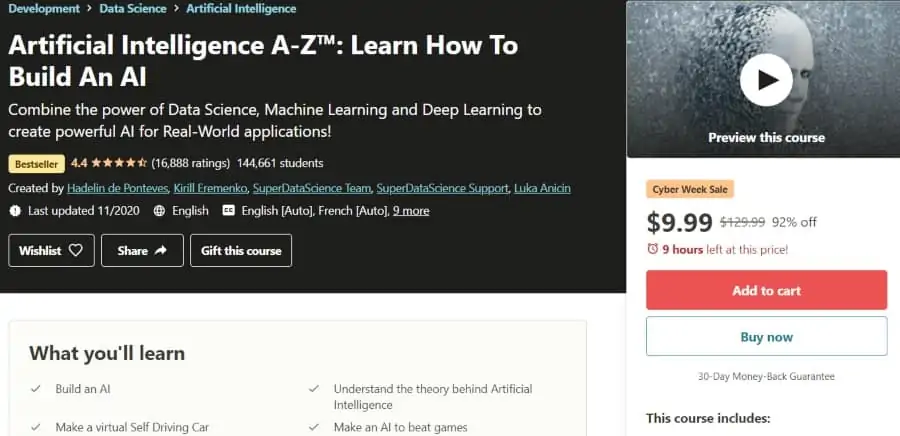
If you’re a complete beginner with little knowledge of programming and want to break into AI, this beginner-level online AI course on Udemy is the best choice for you. Taken by more than 144,000 students, this bestselling online course will quickly get you building your own AI applications.
In this online course, you will be instructed by Hadelin de Ponteves, Kirill Eremenko, and Luka Anicin. The trio is experienced AI engineers and entrepreneurs who have published a large number of online courses on Udemy, teaching more than 1 million students.
Through 16 ½ hours of on-demand video lessons, you will dive into the field of AI by going over topics like decision-making, making virtual self-driving cars, building solutions for real-world problems, deep convolutional q-learning, and convolutional neural networks, making AI that can beat games, and much more.
With full lifetime access, you can go through any part of this online course whenever you feel that your concepts are getting rusty – even if you’re 80!
- Beginner level
- 16 ½ hours long
- Taught by trio of experienced AI engineers
- Certificate of completion
- Full lifetime access
8. Digital Skills: Artificial Intelligence (FutureLearn)
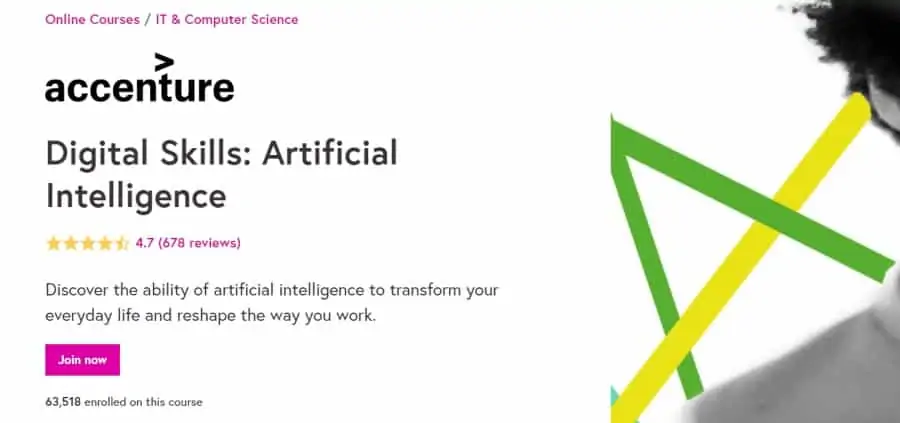
For those of you who are worried about the impact of AI on workplaces and how it will change the way you work, this beginner-level online AI course on FutureLearn is a perfect choice. Taken by over 63,000 students, this online course will help you prepare for an AI-driven future of work.
Instructors for this online course will be provided to you by Accenture, an online digital skills e-learning company that helps people start a business or get a job. Accenture carefully selects professionals who have relevant real-world experience to develop its online courses.
Over a course of 3 weeks in this online AI course, you will explore the history of AI and understand how it is already becoming part of workplaces and changing how people work. You will learn about upcoming trends, the skills needed to work with AI, and much more.
You can take this online AI course for free on FutureLearn, and get a free digital upgrade by Accenture to get tests that check your knowledge and a certificate of completion!
- Beginner level
- 3 weeks long with 2 hours of study per week
- Taught by instructors from Accenture
- Free access
- Certificate of completion
9. Professional Certificate in Applied AI (edX)
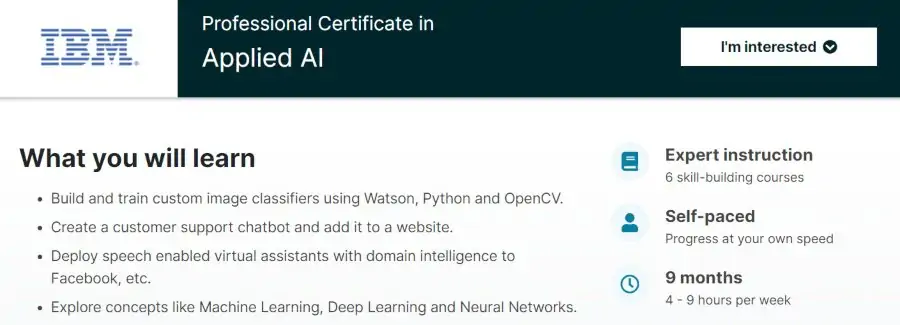
Next on my list is a comprehensive 6-course online AI program on edX that has been developed by IBM. This intermediate-level online professional certificate will make you capable of building your own AI solutions using IBM’s AI services without having a solid background in programming.
Your instructors for this online course will be a team of elite-level data scientists and machine learning engineers from IBM, ranging from computer science Ph.D.’s to experienced software engineers.
Through 9 months of intense learning with 4-9 hours of effort per week, you will gain solid foundational knowledge of AI and will learn how to build various applications like domain-specific chatbots, image classifiers, speech-enabled virtual assistants, and much more.
This is an ideal program for anyone who is serious about switching over to a career in AI and making it big in this exciting field!
- An intermediate-level program consisting of 6 courses
- 9 months long with 4-9 hours of effort needed per week
- Taught by experts from IBM
- Certificate of completion
- Self-paced learning
10. Artificial Intelligence: The Big Picture of AI (Pluralsight)
If you’re looking for an online course that will give you a primer on how AI is changing our lives and how to prepare for the future, take this beginner-level online AI course on Pluralsight. The introductory online course has received a rating of 5 stars from 134 students who took it.
In this online course, you will be taught by Matthew Renze, a data science course industry expert with more than 17 years of professional experience. Matthew has been consulting for tech startups and Fortune 500 companies, helping them implement AI solutions.
In this 1 ¼ hours long online AI course, you will first go through the history of AI before learning about the state-of-the-art of AI, going over topics like deep learning, reinforcement learning, how to train, build, and deploy AI tools, what is the future of AI, and much more.
Start a free 10-day trial of Pluralsight and use this time to complete this online course along with hundreds of others of your choice!
- Beginner level
- 1 ¼ hours long
- Taught by data science expert
- Free 10-day trial of Pluralsight
- Certificate of completion
11. Professional Certificate in Foundations of AI (edX)
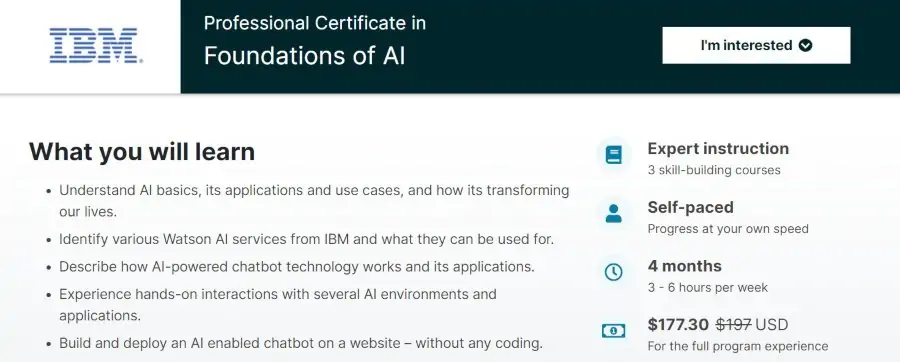
Developed by AI engineers from IBM, this online AI professional certificate consisting of 3 skill-building online courses is perfect for anyone who wants to start a career in this field with strong foundations. These beginner-level online courses are perfect for people with no coding experience.
As for your instructors, Rav Ahuja and Antonio Cangiano will be teaching you in this online course. Rav is the AI and data science program director and Antonio is an experienced software developer at IBM.
Over a course of 4 months (with 3-6 hours of weekly effort), you will master the basics of AI by understanding its applications and key concepts, learn about IBM’s Watson API and all its use cases, how to build a chatbot without coding a single line, and much more.
Because these online courses are self-paced, you will have no pressure to adhere to stringent deadlines – you can complete everything at your own pace!
- Beginner level professional certificate consisting of 3 courses
- 4 months long with 3-6 hours of weekly effort
- Taught by AI and data science experts from IBM
- Certificate of completion
- Self-paced learning
12. Artificial Intelligence: Strategies for Leading Business Transformation (Kellogg Executive Education)
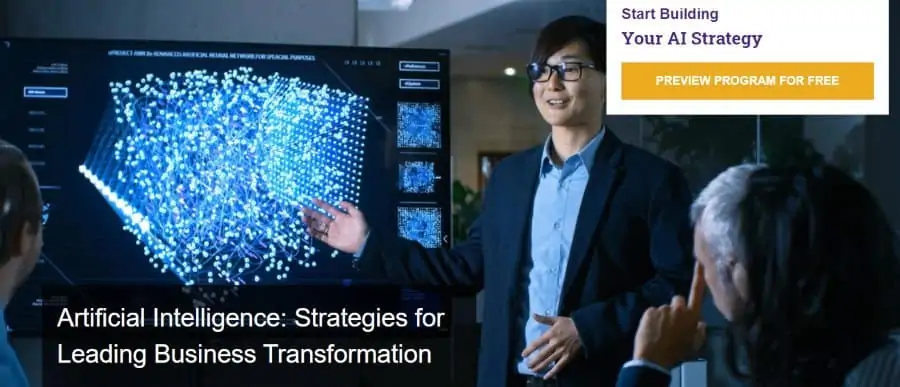
Nowadays, it is necessary for business leaders tasked with charting the future paths of their companies to know how AI should be integrated into their workplace and central business. So if you’re one such leader, get enrolled in this premium and beginner-level online AI course.
Mohanbir Sawhney, the associate dean for digital innovation at the Kellogg Executive Education center, will be teaching you in this online AI course. Professor Sawhney is the McCormick Foundation chair of technology and a renowned scholar and speaker.
In this 2 months long online learning course, you will learn about the 50+ use cases of AI describing how it has created value for companies in multiple sectors, how key industries are integrating it into their business models, use proprietary AI frameworks, study real-world examples, and much more.
By the end of this online AI course, you will have the skills and tools needed to drive real change through AI adoption in your organization!
- Beginner level
- 2 months long with 4-6 hours of weekly studying
- Taught by renowned global scholar
- Certificate of completion
- Ideal for business leaders
Visit Kellogg.northwestern.edu
13. Artificial Intelligence: Distinguishing Between Fact and Fiction (FutureLearn)
People who are not familiar with the reality of AI often ascribe unrealistic expectations about the potential of AI. If you find yourself in a similar situation, you should definitely get enrolled in this beginner-level online AI course on FutureLearn that will help you tell fact from fiction.
Your instructor for this online course will be Mark Elshaw, a lecturer at the Coventry University in the U.K. Mark is an AI enthusiast and performs research in AI topics like neural networks, biology-inspired computing, data analysis, visualization, and neural networks.
Through 2 weeks of light studying (3 hours per week), you will be introduced to the roots of AI and how it was developed. You will dive deep into human intelligence and its various features, learn about Asimov’s laws that govern intelligence, understand the reality of AI, and much more.
The best part is that you can access this online AI course on FutureLearn for free and gain a whole lot of knowledge about an exciting wave that has captured the world!
- Beginner level
- 2 weeks long with 3 weekly effort hours
- Taught by AI researcher from Coventry University
- Free access to course contents
14. Microsoft Azure AI Engineer: Deploying AI Solutions in Microsoft Azure (Pluralsight)
Next on my list is a beginner-level online AI course on Pluralsight that is perfect for AI engineers who want to learn how to deploy their models through Microsoft’s Azure service. This online course will enable you to create value-added and holistic solutions to benefit your company.
In this online course, you will be taught by James Bannan, an IT consultant with 18+ years of professional experience who is based in Melbourne, Australia. James has developed an expertise in helping his clients make the most of Microsoft Azure.
In 2 ¼ hours of video lessons, you will take a thorough tour through the world of Microsoft Azure by going over topics like the basic nature of AI solutions, the right computing services needed to build a solution, deploying a container-based solution, and much more.
If you’ve never used Pluralsight before, this online course is an excellent opportunity to take their free 10-day trial and complete as many online courses as you can!
- Beginner level
- 2 ¼ hours long
- Taught by IT consultant with 18+ years of experience
- Certificate of completion
- Free 10-day trial of Pluralsight
15. AI Foundations for Everyone Specialization (Coursera)
If you haven’t ever written a single line of code in your life and want to get yourself up to speed with the rapidly-advancing world of AI, this 3-course online AI specialization on Coursera is the right choice for you. More than 8,000 students have taken this beginner-level specialization.
As for your instructor, Rav Ahuja and Antonio Cangiano will be teaching you in this online course. Rav and Antonio are AI experts at IBM and have taught more than 500,000 students combined through 15+ online courses on Coursera.
Over a course of 3 months in this online AI specialization, you will go through 3 online courses that will introduce you to the foundational technologies of AI like deep learning, teach you how to use IBM’s Watson API, show you how to make AI-powered chatbots without coding, and much more.
With Coursera’s financial aid option, you can take the 3 online courses in this specialization for free if you are unable to afford the full fees, and get a certificate of completion at the end!
- Beginner level specialization consisting of 3 courses
- 3 months long with 2 hours of weekly effort
- Taught by AI experts from IBM
- Certificate of completion
- Financial aid available
16. Using AI to Gain a Competitive Edge for your Customer Experience (CX) (FutureLearn)
The final entry on my list is a beginner-level online AI course on FutureLearn that is ideal for professionals who want to leverage AI to improve the customer experience for their companies. The course has been developed by BIMA, a digital and tech community.
Jaimie Patel, the VP of marketing science at Critical Mass, will be teaching you in this online course. Jaimie has more than 15 years of professional experience as a data scientist and specializes in helping her clients improve their customer experience services.
In this 2 week long online AI course, you will go over basic AI topics like the history of AI, important methods used in AI, how to leverage AI to track customer experience metrics, and derive useful insights from it, which platforms help optimize the journey, and much more.
As part of this premium online AI course, you will receive a certificate of completion along with loads of articles, peer reviews, and quizzes!
- Beginner level
- 2 weeks long with 2 hours of study per week
- Taught by data scientist with 15+ years of experience
- Certificate of completion
