
Top 12+ Best Free Online HR Courses & Human Resources Certifications

If you are seeking a career in human resources, or are looking to enhance your HR skills, you’re in the right place!
After much research, I have rounded up some of the best free online HR courses in 2024 that cover many aspects of human resources from interviewing, screening candidates, conflict resolution, career development, and many more.
With many of these online learning courses, new users can also enroll for free and even get a printable human resource management certificate of completion.
So let’s get started!
Top 12 Best Free Online HR Courses & Human Resources Certifications 2024
1. Human Resources Foundations Course (LinkedIn Learning)
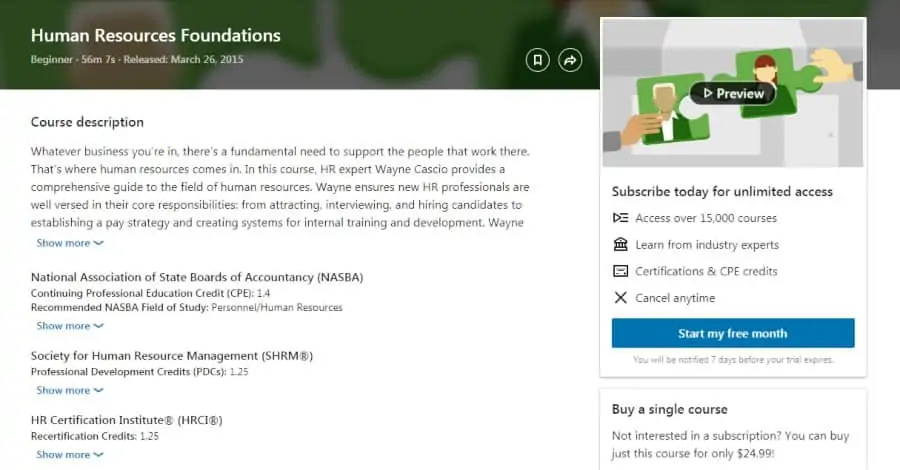
First up on my list of human resource courses is a fantastic LinkedIn Learning beginner course that is led by Colorado University professor Wayne Cascio. Wayne is an award-winning author on the subjects of Human Resources, Business Management, and Applied Psychology.
Some of the core modules in this condensed on-demand video course are interviewing techniques, hiring candidates, establishing a payment strategy, performance management principles, and how to apply internal training and development.
Another benefit to this course is that there is a PDF certificate of completion and also CPE credits for continuing education. LinkedIn Learning is a recognized Approved Provider of the HR Certification Institute®, meaning you can earn credit towards a range of certificate programs.
As for the price of this class, there is none!
Being hosted on LinkedIn Learning, new users can take this HR course for free, plus all the others mentioned in this guide on their 1-month free trial that can be canceled at any time!
This means you can build on this foundational course with Strategic Human Resources, go deep with Human Resources: Payroll, or even pursue an HR certification with Certification Prep: Professional in Human Resources (PHR)®.
Overall, a well-rounded course and an amazing free trial to get up the HR management curve fast!
- Beginner level
- Award-winning author as an instructor
- 1-hour self-paced
- Additional resources available
- CPE credit
- Certificate of completion
2. Recruiting Foundations HR Course (LinkedIn Learning)
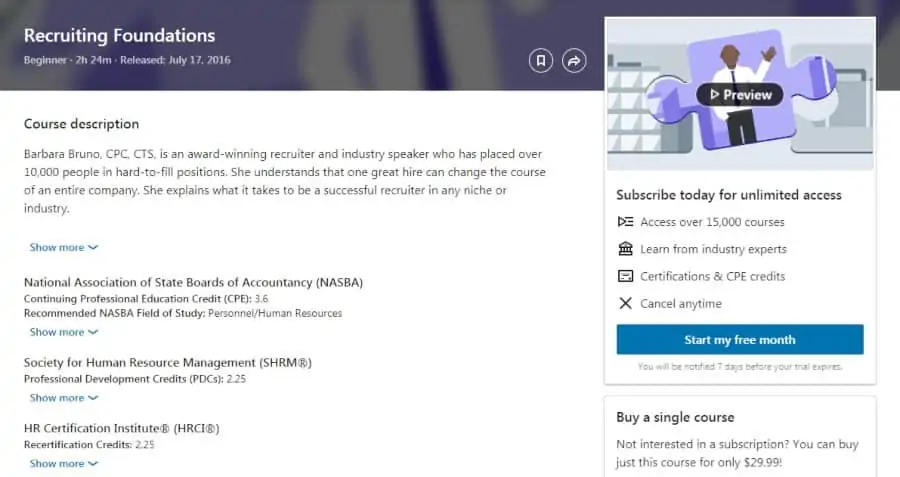
Before you can manage employees, you will first need to find and recruit employees which this HR course is focused on. It will also go beyond the traditional formats of running a help wanted ad in a local newspaper.
As for your instructor, you will be taught by Barbara Bruno, an international expert in staffing and recruiting, and is the president of Gold As Gold Training.
In this 2 ½ hour beginner level Recruiting Foundations course, you will learn how to identify the recruitment needs of your company, how to attract top talent, what methods of recruiting are available such as websites and social media, and what your attitude and expectations should be.
Over 107,000 people have benefitted from this course with CPE credits and a certificate of completion available. New users can take this course, plus 15,000 others on Linkedin Learnings free trial!
- Beginner level
- 2 ½ hours
- Professional trainer
- Focuses on understanding recruiting
- CPE credit
- Certificate of completion
3. HR Interviewing Techniques (LinkedIn Learning)
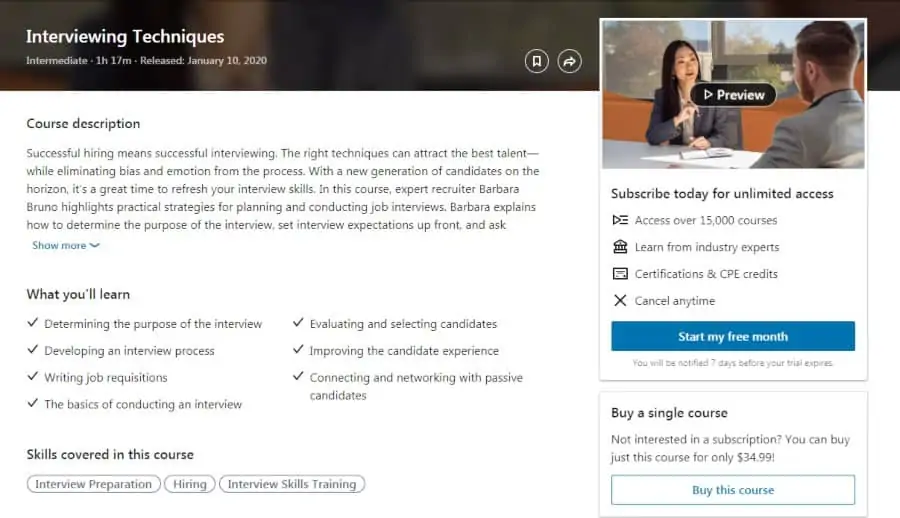
Once you have attracted candidates to your company, you now need to interview them. Interviewing techniques have changed in our modern economy, especially for larger and international businesses, so being up to date is critical.
Some of the lessons covered in this course include how to select an applicant for interviews so neither side is wasting time and resources, how to make a business proposal for seeking applicants, how to leverage social media and workable methods for considering previous applicants.
This class is taught by international staffing and recruitment expert Barbara Bruno, who brings years of experience to the practice. Almost 127,000 students have already completed this intermediate level 1 ¼ hour course. Overall, a great course!
- Intermediate level
- 1 ¼ hour length
- Recruitment professional as an instructor
- CPE credit
- Specific info for interviewing
- Certificate of completion
4. HR Analytics using MS Excel for Human Resource Management (Udemy)
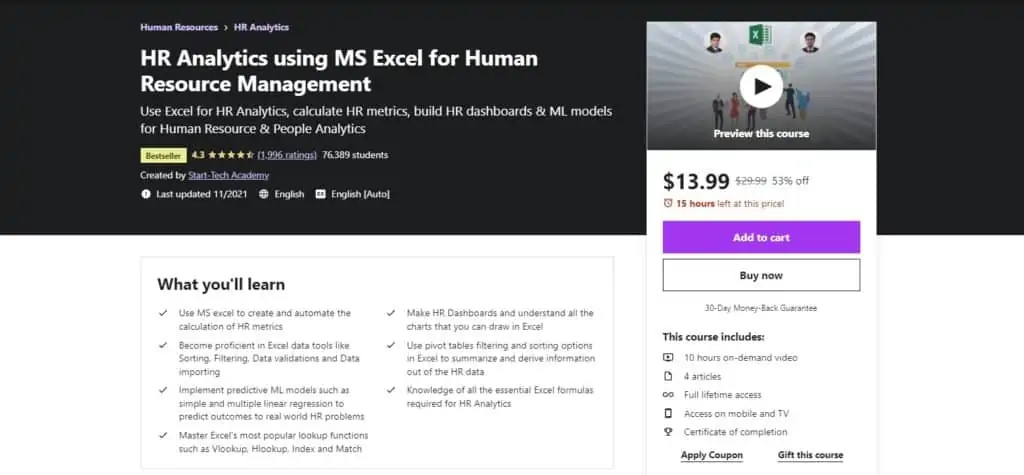
Next up is our first course from Udemy. Today, more than ever, HR professionals need to know just as much about people as it is the data about people. So if you want to thrive in this increasingly important profession, you need to know how to analyze and interpret data.
After this course, you’ll be able to use MS Excel to calculate HR metrics such as staffing projections or retention rates, build HR Dashboards, deploy predictive machine learning HR models to anticipate outcomes to real-world HR problems using and create HR data visualizations to connect the business administration of your company to the people management seamlessly.
This bestselling course is taught by Start-Tech Academy, a company whose instructors have had more than 3,000,000 students across its Excel and Data Analytics catalog.
- Intermediate level
- 10 hours of video courses
- People analytics and data science professionals
- CPE credit
- Certificate of completion
5. HR Fundamentals (Future Learn)
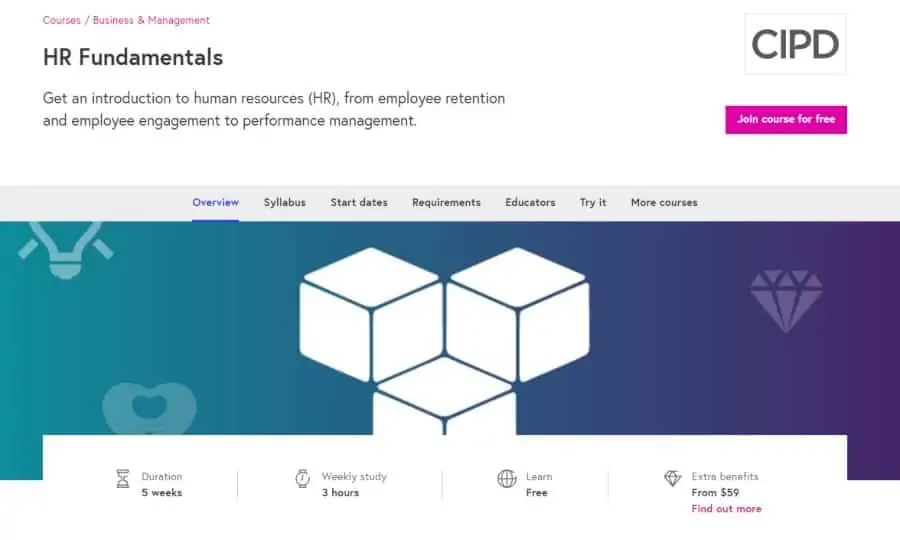
Partnered with multiple international colleges, universities, and other institutes, Future Learn online courses are available in the fields of Business & Management, Healthcare & Medicine, IT & Computer Science, and Teaching.
This is a 5-week course with 3 hours per week. It is designed for beginners in the field of HR but can also be used as a beneficial refresher for anyone in an HR position. It covers professionalism on the job, workforce planning, performance management, and other basic HR fundamentals.
The instructors include business professionals, educators, and life coaches. Combined, they have decades of experience both working in HR and teaching business. Besides the course syllabus, you’ll gain a lot of insider tips from the team of instructors. Overall, this is one of the best free courses online for HR roles in 2024.
- Beginner Level
- 5-week course
- 3 hours a week
- Team of business pros as teachers
- Insider tips
- Certificate of completion
6. Onboarding New Hires as a Manager (LinkedIn Learning)
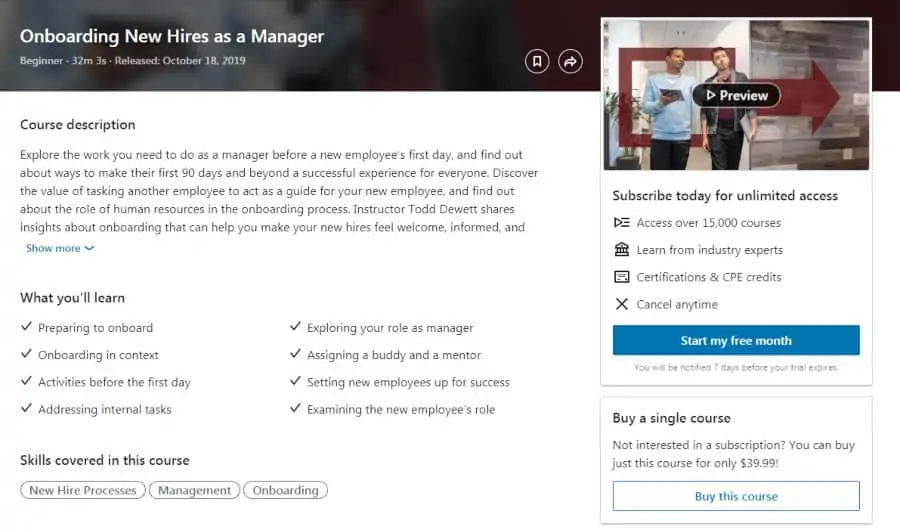
Sometimes you just need a little bit of extra help to guide you through something potentially difficult. Getting your newly hired employees into the company system can sometimes be challenging. You want to have the right balance between quickly getting them on the job versus making sure they are adequately equipped to start working.
That’s where this ½ hour beginner-level course will help you. It tells some of the things you as an HR person should do before their first day, how to get them inserted into the company context, and whether or not mentoring may be in order.
Taught by author and authenticity expert Todd Dewett, Ph.D., you will quickly learn how to make these decisions in a way that benefits the worker and the company.
As with most courses on LinkedIn Learning, you receive a certificate of completion and access to other resources. LinkedIn Learning is also a recognized Approved Provider of the HR Certification Institute® so your learning may apply to a range of HR certifications.
To learn more, you can see my post on the differences between LinkedIn Learning and Lynda.
- Beginner level
- Only ½ hour
- Specific info for onboarding new hires
- Taught by business expert
- CPE credit
- Certificate of completion
7. HR Short Course (Oxford Home Study Center)
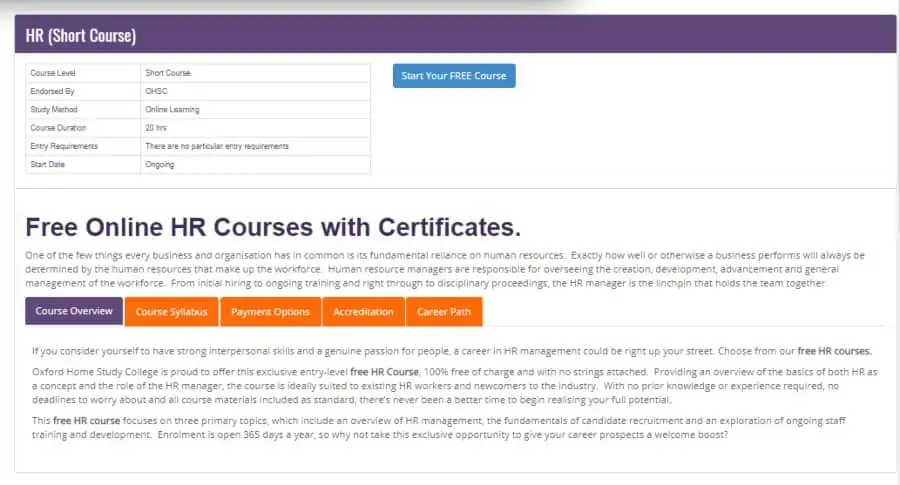
Oxford Home Study Centre is one of the UK’s top online schools for business, art, and industry. They offer many courses, both for continuing education and with accreditation from other institutes of higher learning.
This short free HR course is entry-level and there are no prerequisites for enrolling. Being over 20 hours in total length, it takes you beyond the beginner level and gives you skills and knowledge to seek a career in Human Resources and development.
Some of the course lessons covered are HR management, the fundamentals of candidate recruitment, and a thorough exploration of ongoing staff training and development.
One of the main downsides to this course, however, is that it is all in text format with downloadable resources. So if you learn more effectively by video, this may not be the course for you. Nonetheless, a great pick with an included certificate.
- Beginner to intermediate level
- 20 hours
- Delivers overviews and deeper instruction
- Taught by industry leaders
- Supplemental material
- Certificate of completion
8. Preparing to Manage Human Resources (Coursera)
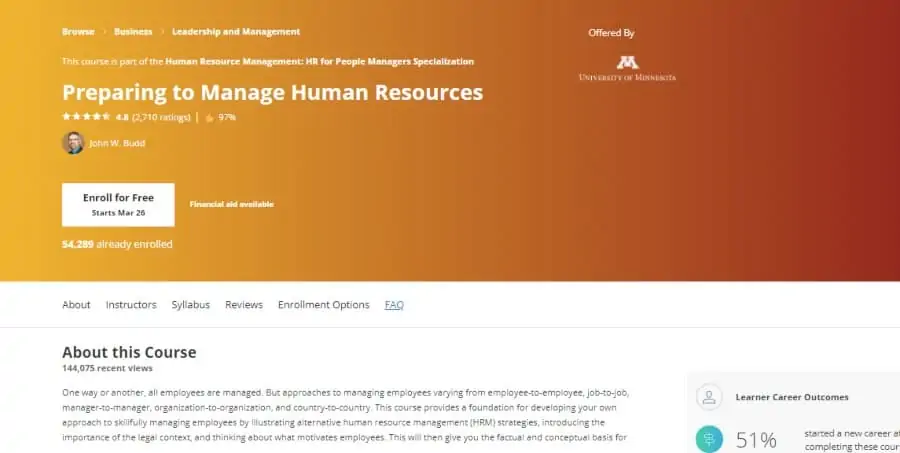
Part of a larger series of courses from the University of Minnesota, this beginner to intermediate level class is 4 weeks in length and delves deeply into some of the disciplines involved in successful HR management including talent acquisition, talent management and employment law.
The course is taught by John W. Budd, a professor at the University of Minnesota in their HR management specialization. Included in the course are peer reviews, quizzes, assessments, and lots of optional extra study.
Coursera is an online portal that brings together many different educators from around the world to share knowledge and expertise. Some of the online human resources courses can be a gateway to a bachelor’s degree and master’s degree programs from multiple different universities and colleges.
For this online program, an assessment of your learning is offered as is a certificate of completion or CPE credit.
- Beginner/Intermediate level
- 4 week course
- Partnered with the University of Minnesota
- College professor instructor
- Quizzes and assessments
- Certificate of completion
9. Strategic Human Resources (LinkedIn Learning)
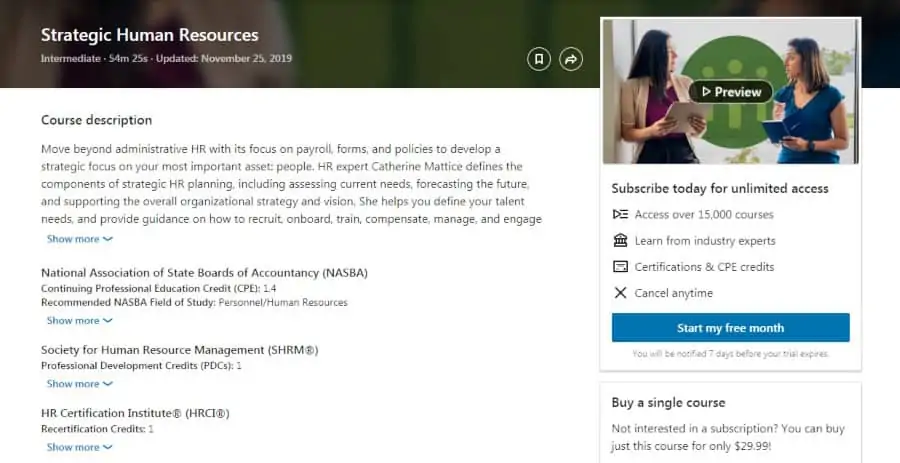
HR strategy expert Catherine Mattice presents this 1-hour class describing the elements of strategic HR planning. This certification course marries people analytics with project management and includes assessing the current needs of the company, forecasting its future, and finding ways to continue with support for the overall organization.
The class shows the tie-in between the company strategy and how that relates to the HR department strategy. Included in the training is how to analyze data and make it relate to real-world situations.
It’s offered by LinkedIn Learning, a fantastic resource for continuing education if you’re already in a position or jumpstarting your HR career path. LinkedIn is also an excellent way to network with other business professionals from around the world.
- Intermediate level
- 1 hour
- Business professional instructor
- CPE credit
- Extra resources
- Certificate of completion
10. Administrative Human Resources (HR) for Beginners (Udemy)
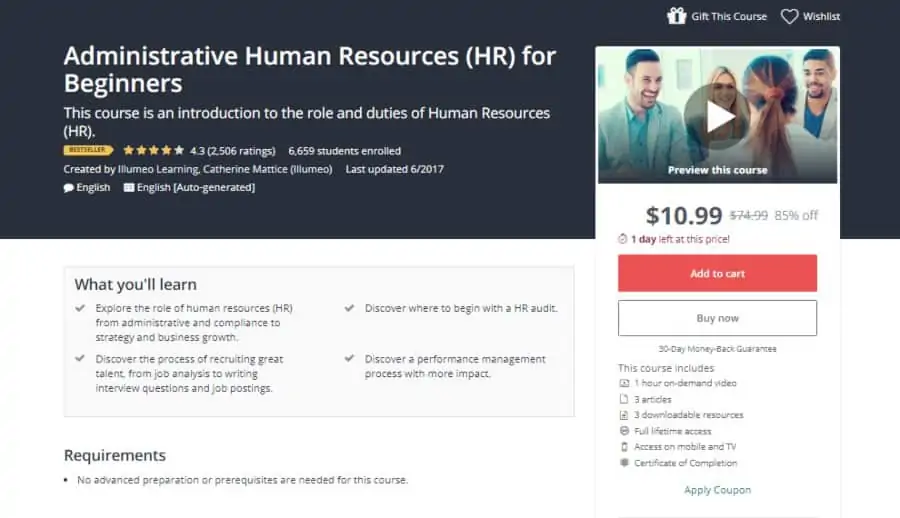
Human Resource departments are responsible for making sure that employees are in compliance with company regulations but also for keeping those employees motivated and happy to work for the company.
This 1-hour course is beginner level and includes articles and other downloadable resources. Your instructor is HR expert Catherine Mattice.
An overlooked possible student for courses such as this is the small business owner, one with very few employees to manage. The same principles that work for large corporations also help small business owners with their company goals.
Udemy hosts this course and they have a huge pool of experts, instructors, and successful professionals giving valuable instruction for you to enhance or supplement your existing skills as well as breaking into any new interest you may develop.
- Beginner level
- 1 hour
- HR expert instructor
- Downloadable resources
- Good for small business
- Certificate of completion
11. Performance Management for Managers (Udemy)
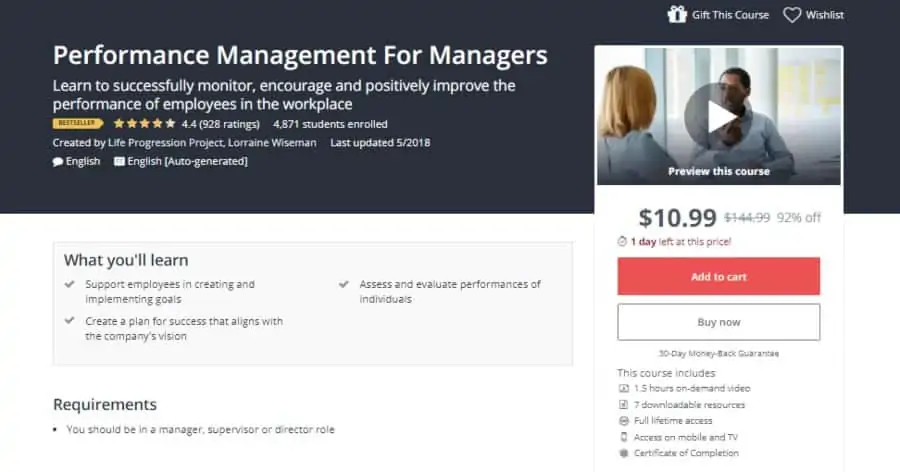
Closely related to HR is performance management. In fact, in many HR departments, it’s a core part of the job.
This Udemy class is an entry-level course for people in a management position, regardless of whether or not you’re in HR. Managing people is similar to HR motivation, in that you are endeavoring to get the most out of the employee for the company while ensuring the company treats the workers well.
Taught by international executive Lorraine Wisemann, this beginner-level course is 1 ½ hour and included several extra resources for students. The course strongly focuses on goals and includes a certificate of completion. Overa
- Beginner level
- 1 ½ hour
- Geared towards management outside of HR
- Taught by business expert
- Extra resources
- Certificate of completion
12. Diploma in Human Resources (Alison)
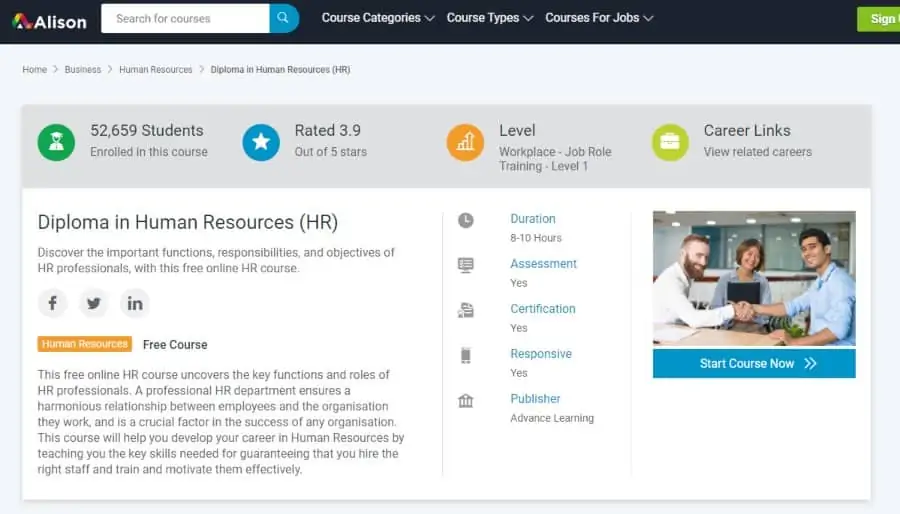
Next on my list is an intermediate 10-hour self-paced learning diploma offered by Alison which also has an included certification once completed.
The primary aim of this course is to help you develop your career in Human Resources by teaching you the foundational topics. Some of these include recruitment, interviewing, communication, training, organizing, management, how to retain employees, compensation, and benefits.
For those looking to take a deep dive into Human Resources, this is a fantastic place to start with over 50,000 other students completing this course.
- Beginner/Intermediate level
- 10 hours
- Diploma
- Assessment
- Taught by worldwide experts
- Basics and in-depth
13. Certification Prep: Professional in Human Resources (LinkedIn)
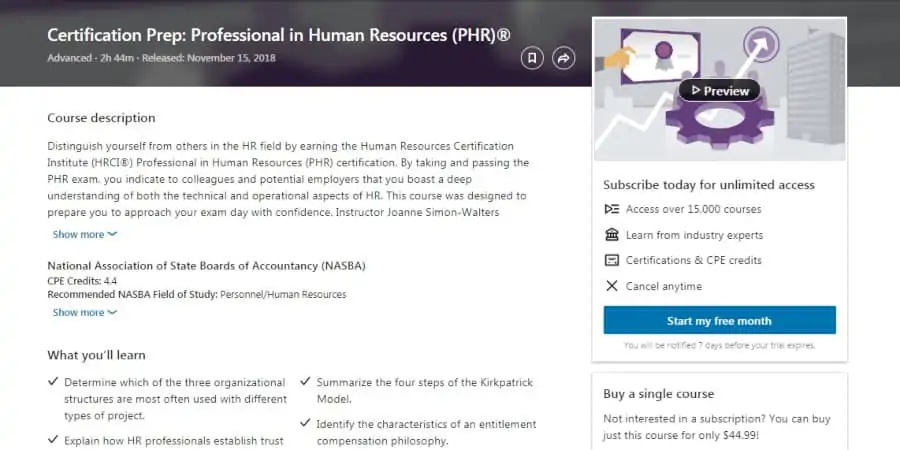
LinkedIn Learning can assist you to get ready for the Professional in Human Resources (PHR) certification test administered by the Human Resources Certification Institute (HRCI®).
This advanced-level course is just under 3 hours and includes what you need to really know to be able to gain that certification. In addition, you receive CPE credit and a certificate of completion for the course itself.
The instructor is a Director of Human Resources and a PhD candidate, already holding an MBA and several other related degrees, Joanne Simon-Walters.
Over 45,000 people have taken this course and it includes many extra resources.
- Advanced level
- Prep course for PHR certification
- Taught by HR expert
- CPE credit
- Lots of extra resources available
- Certificate of completion
