
Top 12+ of the Best Online C# Courses in 2024 Right Now
![max duzij qAjJk un3BI unsplash scaled Top 12+ of the Best Online C# Courses in [year] Right Now](https://skillscouter.com/wp-content/uploads/2020/12/max-duzij-qAjJk-un3BI-unsplash-scaled.webp)
C# is one of the most popular programming languages today used to make cross-platform applications, games, and web applications. So if you’re looking to launch a career as a C# developer and work on exciting applications, you’ve come to the right place!
In this article, I have gathered the best online C# courses in 2020 that will not only teach you the basic syntax, variables, and control flow elements of C# but will also teach you how to use primitive and non-primitive types, work with files, build games and apps, and much more.
Once you’ve completed an online course from my list, you’ll be ready to apply for entry-level roles in most software development companies. So let’s get started!
Top 13 Best C# Courses & Training
1. C# Basics – For Complete Newbies (Skillshare)
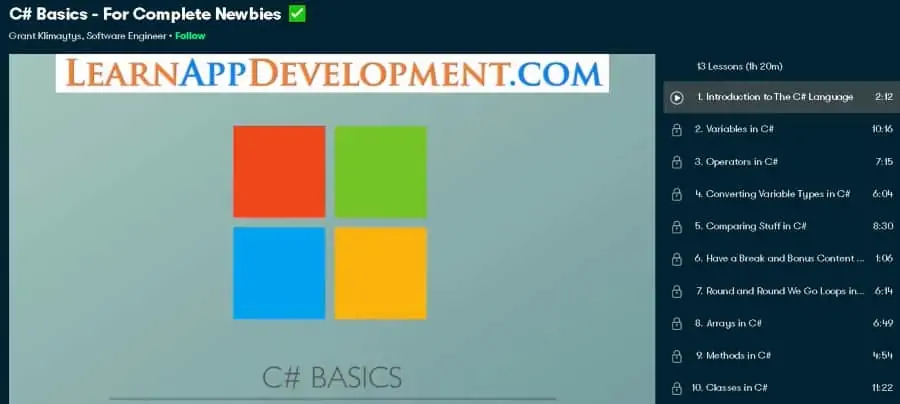
First on my list is a beginner-level online C# course on Skillshare that will give you a solid introduction to the language by teaching you C# from the very basics. More than 4,000 students have taken this popular online course on Skillshare and went on to launch their own careers.
Your instructor for this online course will be Grant Klimaytys, a software engineer who has been coding and building apps for more than 15 years. Grant is an expert in a number of languages such as JavaScript, C#, Bootstrap, .Net, Python, and PHP.
In this 1 ½ hour-long online C# course, you will be introduced to several C# concepts and topics including variables, operators, comparisons, control flow elements like conditionals and loops, arrays, classes, methods, inheritance, exceptions, and much more.
As part of this online course, you’ll have a thriving student community to rely on whenever you find yourself stuck in a problem and unable to get out on your own!
- Beginner level
- 1 ½ hour long
- Taught by a software engineer with 15+ years of experience
- Free 2-month trial of Skillshare Premium
Activate FREE Skillshare Trial
2. Learning C# (LinkedIn Learning)
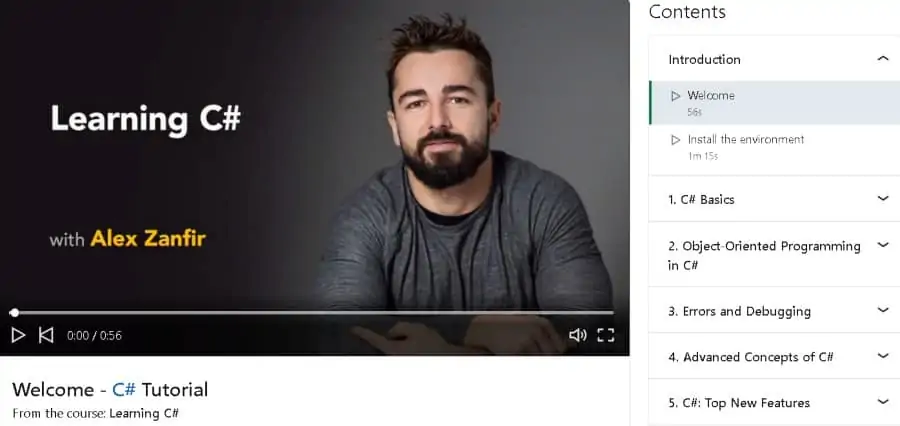
Taken by close to 70,000 people on LinkedIn, this beginner-level online C# course will take you through all the basics of a programming language by going into the latest version 7 of C#. This is an ideal online course for those who want to stay up to date with the latest developments in C#.
In this online course, you will be taught by Alexander Zanfir, an experienced game and application developer who is the president of SocialPlay Inc., an R&D firm centered on game service and technology.
Through 3 hours of video lessons, Alex will teach you the basics of C# based on the latest version of the programming language with topics including how to work with variables, conditionals, loops, functions, and switch statements, how to build object-oriented programs, and much more.
You will get access to dedicated learning groups that will help you to solve all of your problems and share your own ideas for a much better learning experience!
- Beginner level
- 3 hours long
- Taught by experienced game and application developer
- Certificate of completion
- Free access for new LinkedIn users
3. C# Basics for Beginners: Learn C# Fundamentals by Coding (Udemy)
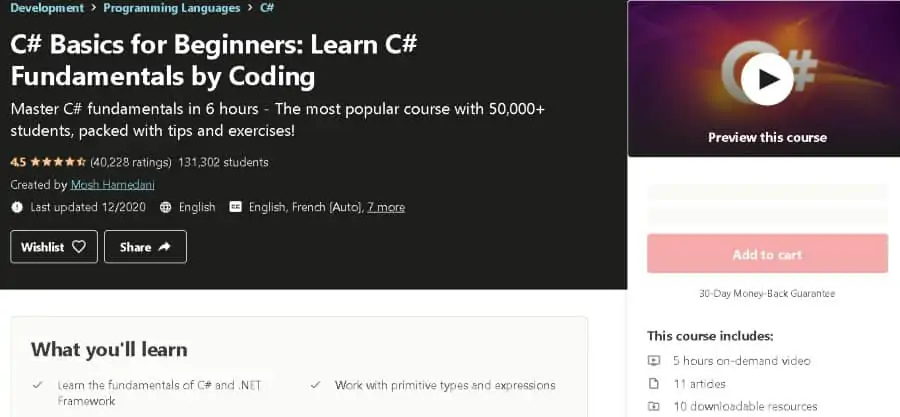
If you’re looking to get yourself started with C# or just need a refresher in basic C# and .Net concepts, this beginner-level online C# course on Udemy is an excellent choice for you. Taken by over 130,000 students, this online course has an average rating of 4.5 stars.
As for your instructor, Mosh Hamedani will be teaching you in this online course. Mosh is a software engineer with 20+ years of professional experience under his belt. He has published 20 courses on Udemy, teaching more than 450,000 students through them.
In this 5 hours long online C# course, Mosh will make you comfortable with the fundamentals of C# by going through topics like primitive and non-primitive expressions, managing the flow of the program, using arrays and lists, working with data, text, and files, debugging apps, and much more.
This online C# course has subtitles available in 9 languages including French, German, Indonesian, Romanian, and Spanish, so no matter which corner of the world you live in, you’re covered!
- Beginner level
- 5 hours long
- Taught by a software engineer with 20+ years of experience
- Certificate of completion
- Full lifetime access
4. Introduction to C# Programming and Unity (Coursera)
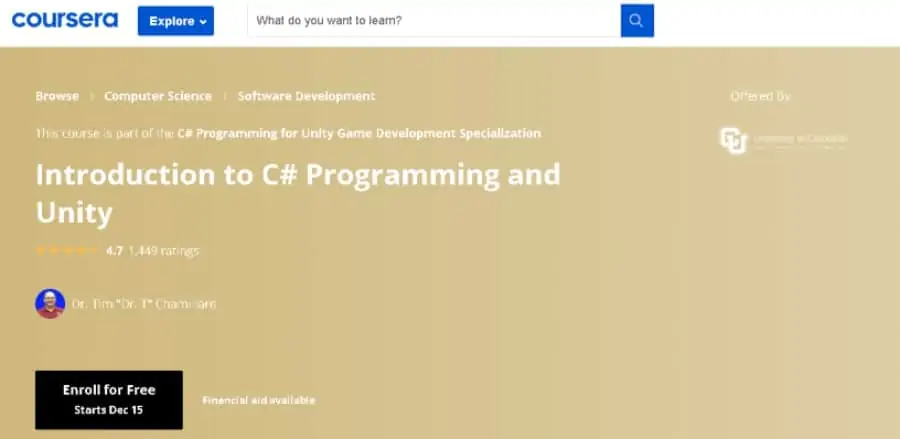
Offered by the University of Colorado through Coursera, this beginner-level online C# course will quench your thirst for building exciting and interactive games through C# and the Unity engine. Taken by over 65,000 students, this popular online course has an average rating of 4.7 stars.
Dr. Tim “Dr. T” Chamillard, an associate professor of computer science at the University of Colorado, will be teaching you in this online course. Dr. Tim provides lectures in game development and has built and maintained the Game Design and Development program.
Through 28 hours of lectures and hands-on exercises, you will get to know the basics of using C# to build a simple Unity program, leverage the versatility of classes and objects to increase complexity, manage basic Unity 2D elements, add functionality and user input to games, and much more.
You will have flexible deadlines so you don’t need to worry about adhering to rigid deadlines in case you find yourself in a tough spot!
- Beginner level
- 28 hours long
- Taught by associate professor of computer science
- Certificate of completion
- Financial aid available
5. C# Essential Training: 1 Syntax and Object Oriented Programming (LinkedIn Learning)
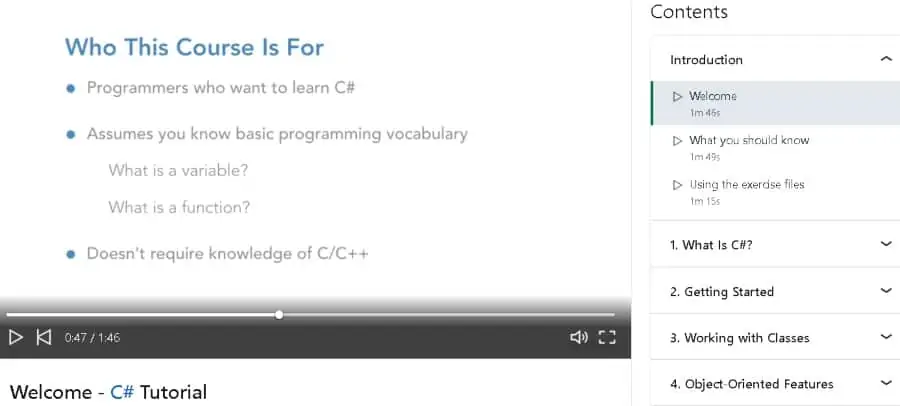
Next on my list is a beginner-level online C# course on LinkedIn that is ideal for those who are looking to dive into the basics of C# and gain strong knowledge of object-oriented programming. This popular online course has been taken by more than 45,000 students on the platform.
Your teacher for this online course will be Bruce Van Horn, a full-stack software engineer with 15+ years of professional experience. Bruce is currently working as the lead software developer at Visual Storage Intelligence, where he creates software for cloud-based intelligence tasks.
In this 3 ¼ hours long online C# course, Bruce will start by giving you a brief background of the development of C# before going into topics like how to set up visual studio, work with strings and mathematical operations, use object-oriented features, extend classes, and much more.
If you’re a new user on LinkedIn, you can gain access to this online course for free, and get a certificate of completion at the end! Also: Check out our best free Linkedin Courses HERE!
- Beginner level
- 3 ¼ hours long
- Taught by veteran software developer
- Certificate of completion
- Free access for new LinkedIn users
6. Complete C# Unity Game Developer 2D (Udemy)
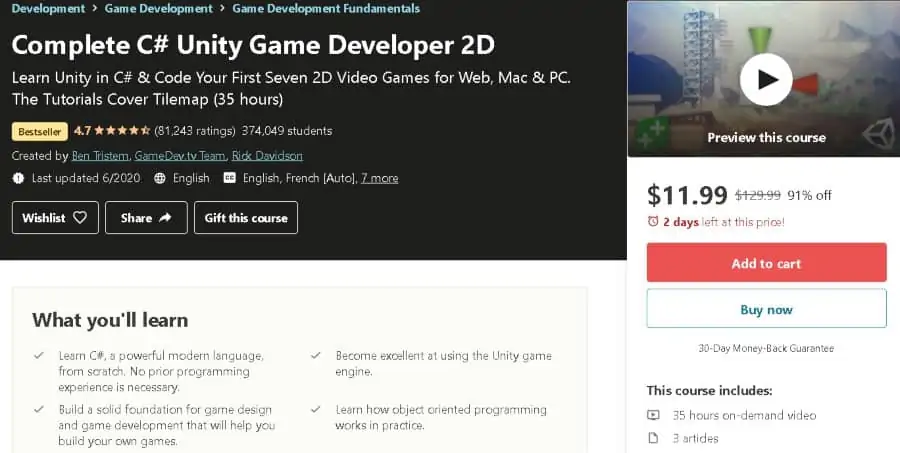
For those of you interested in getting into game development using the Unity engine, this beginner-level online C# course on Udemy will teach you everything needed to program 2D games in C#. With an average rating of 4.7 stars, more than 370,000 students have taken this bestselling course.
In this online course, you will be instructed by Ben Tristem, the founder of GameDev.tv, and Rick Davidson, an experienced game developer with 14+ years of professional experience. Between them, they have published 10+ courses on Udemy and taught more than 700,000 students.
Over the course of 35 hours of learning, you will go through a number of sections including the basics of coding in C#, making the basic elements of a game using C# in Unity, constructing the user interface for a game, placing various units, building interactions, and much more.
By the time you’re done with this online course, you’ll have created 4 exciting 2D games that you can share around in your network! For more courses on Unity, check out this article!
- Beginner level
- 35 hours long
- Taught by GameDev.tv Team
- Certificate of completion
- Full lifetime access
7. C# Development Fundamentals (Pluralsight)
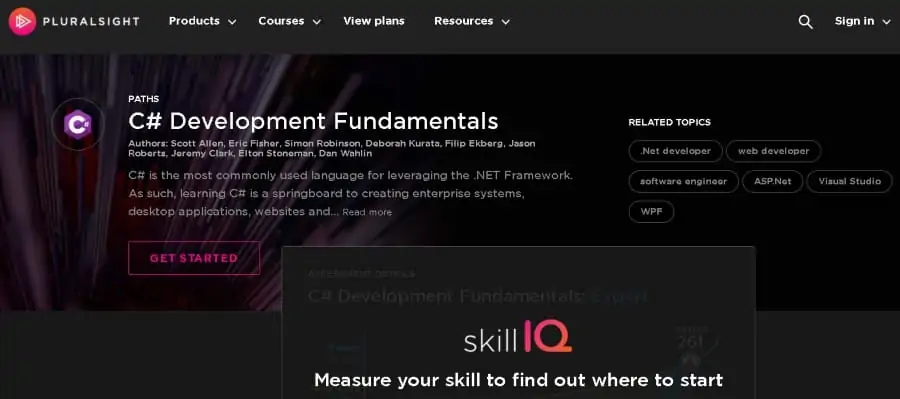
It takes a lot more than one course to truly master C# and explore all of its features and avenues, so check out this 18-course learning path on Pluralsight if you want a one-stop shop of C# resources. You will find beginner, intermediate, and advanced level online C# courses in this collection.
You will be provided with instructors for these online courses by Pluralsight. You can rest assured that you are learning from industry experts because Pluralsight carefully selects professionals who are not only competent but also know how to teach.
With a collection of 18 online courses ranging from ½ hour to 4 ½ hours long in length, you can be sure to find everything needed to become a complete C# developer. You will find topics like basic syntax and variables, using LINQ queries, dates and times in .NET, C# interfaces, and much more.
You will get a certificate of completion at the end of each online C# course in this collection, so get ready to impress potential employers with your learning endeavors!
- Beginner/intermediate/advanced level collection of 18 courses
- ½ hour to 4 ½ hours long courses
- Taught by industry experts picked by Pluralsight
- Certificates of completion
- Free 10-day trial of Pluralsight
8. Programming in C#: A comprehensive approach to C# Fundamentals (Coursera)
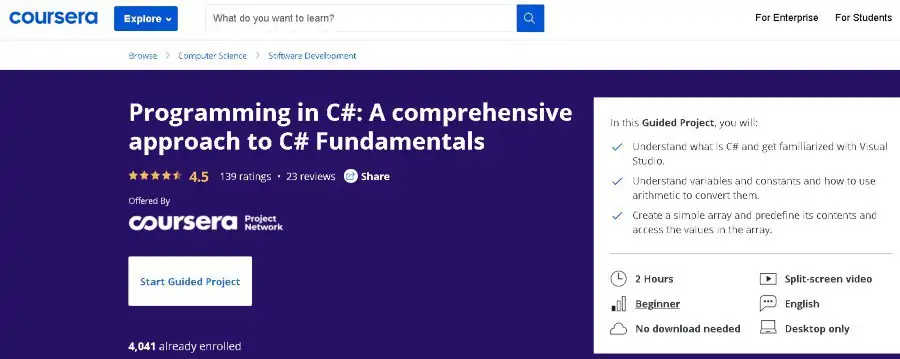
Some people learn best when they’re working on a project, so if you’re one of those people, you should checkout this beginner-level online C# guided project on Coursera. Taken by more than 4,000 students, this online guided project has an average rating of 4.5 stars.
Javier Cacao, a subject matter expert in C#, will be teaching you in this online course. Javier is experienced with rapid software development and has been working for Coursera’s Project Network to make such online courses available to learners.
In this 2 hours long online project, Javier will guide you as you build simple programs using C# and learn how to print to the console, work with numeric and character-based data, perform arithmetic operations, take user input, use Boolean logic, implement loops and methods, and much more.
You won’t need to install any kind of software to complete this online course – everything will be done directly in the web browser of your choice!
- Beginner level
- 2 hours long
- Taught by C# subject matter expert
- Certificate of completion
- Financial aid available
9. Complete C# Masterclass (Udemy)
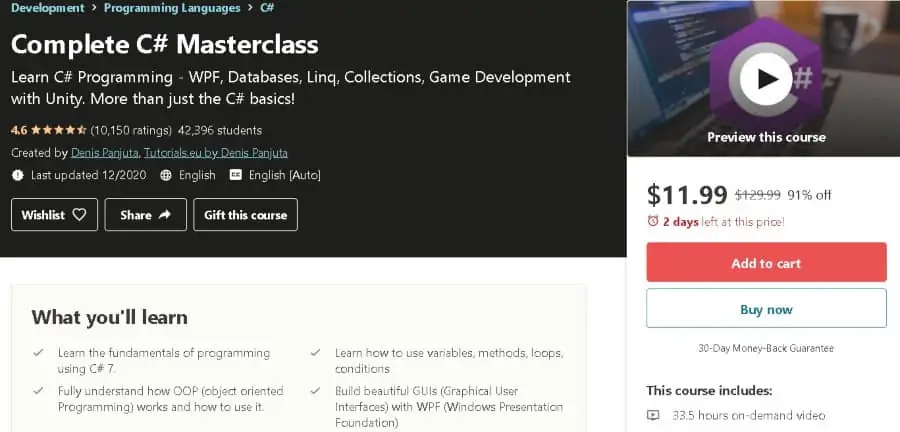
Next on my list is a beginner-level online C# course on Udemy that is ideal for those who like to dive deep into a topic and come out with an expertise in it. Taken by 42,000+ students, this online course will teach you everything a C# developer needs to know.
Your instructor for this online course will be Denis Panjuta, an engineer who received his degree from the University for Applied Science Konstanz in Germany. Denis has published over 30 online courses on Udemy, teaching more than 172,000 students.
Once you’re done with the 33 ½ hours of on-demand video lessons, you will know all about working with variables, methods, arrays, if statements, and loops in C#. You will also be able to implement classes and objects, leverage the power of inheritance, and much more.
If you’re worried about forgetting concepts with time, don’t worry – with full lifetime access from Udemy, you can come back whenever you like and review anything from the contents!
- Beginner level
- 33 ½ hours long
- Taught by an engineer from Germany
- Certificate of completion
- Full lifetime access
10. C# Programming for Unity Game Development Specialization (Coursera)
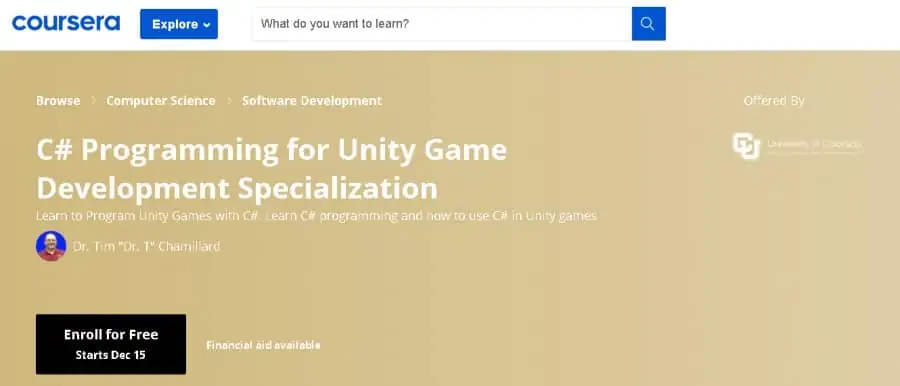
C# is the gateway language to learn for anyone who wants to get into game development using Unity. So if you’re looking to start a career as a game developer, you should consider getting enrolled in this beginner-level online C# specialization on Coursera.
In this series of online courses, you will be instructed by Dr. Tim “Dr. T” Chamillard, an associate professor of computer science at the University of Colorado. Dr. Tim is an expert in game development and has designed a special degree for game development enthusiasts at UoC.
Through 4 online courses that will take about 4 months to complete in total, you will get started with programming using C# by learning basics like variables and methods, before diving into Unity game development by going over data structures and design patterns for games, and much more.
If you’re unable to pay the monthly subscription fee for this specialization, you can apply for financial aid through Coursera and complete all the online courses for free!
- Beginner level specialization consisting of 4 courses
- 4 months long with 8 hours of work per week
- Taught by associate professor of computer science
- Certificate of completion
- Financial aid available
11. Learn C# (Codecademy)
If you prefer online courses that guide you gradually through all the concepts and flatten the learning curve, then you should checkout this beginner-level online C# course on Codecademy. More than 45 million students from around the world have taken online courses on this platform.
Industry experts hand-selected by Codecademy have developed this online course for you. You can be sure that you will be going through learning material that is accurate and up to date based on the latest developments in C#.
In this 30 hours long online C# course, you will start by making the trademark ‘Hello World’ program before diving into individual C# elements like data types, variables, logic and conditionals, methods, arrays, loops, classes, interfaces, references, and much more.
You’ll be working on some exciting portfolio projects to make you comfortable with coding using C# and building even bigger and better apps!
- Beginner level
- 30 hours long
- Developed by industry experts from Codecademy
- Certificate of completion
- Hands-on projects
12. Object-Oriented Programming with C# (LinkedIn Learning)
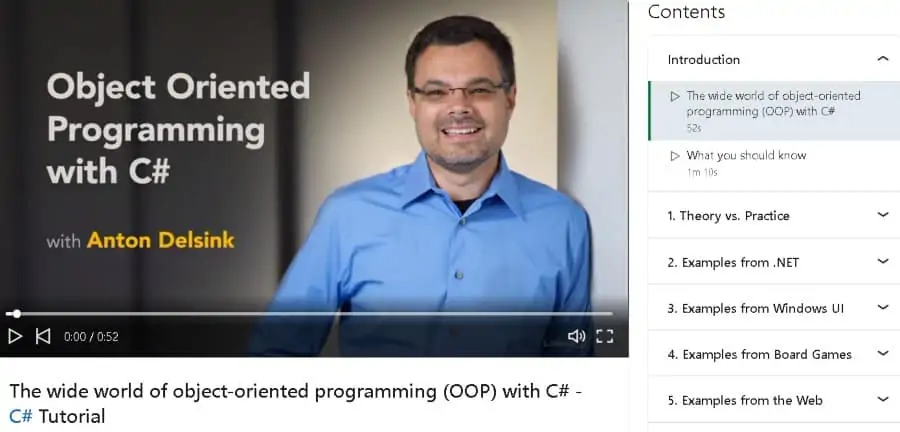
The final entry on my list is an intermediate-level online C# course on LinkedIn that is perfect for those who are already familiar with the basics of C# but want to dive deeper into object-oriented programming. This popular online course has been taken by over 29,000 students.
Anton Delsink, a full-stack developer and Microsoft Certified Trainer, will be teaching you in this online course. Anton is an expert in C#, having appeared onstage on events like Microsoft TechEd and SharePoint Saturday to share his knowledge.
Through 4 hours of video lessons in this online C# course, you will go through the basics of object-oriented programming in C# by learning about topics like making classes, using StreamReader to process text, using Windows Forms controls, leveraging inheritance, and much more.
You will get the opportunity to work on a hands-on project towards the end of this online course so that you can put your skills to the test!
- Intermediate level
- 4 hours long
- Taught by Microsoft Certified Trainer
- Certificate of completion
- Free access for new LinkedIn users
