
Learn How To Transform Data With 2024‘s Top 13+ Best Online Big Data Courses


In 2024, the world is rapidly coming to terms with the reality that data is an incredibly useful and precious commodity.
Because of this, I have collected a list of the best online Big Data courses and certifications in 2024 that will not only teach you tools like Hadoop, but will also guide you through the fundamentals of data science.
Below, you will find many online Big Data courses that will teach you how to structure your projects, apply machine learning models, and derive insights that lead to value-added decisions. Let’s get started!
Top 13+ Best Free Online Big Data Courses & Certifications 2024
1. Introduction to Big Data (Coursera)
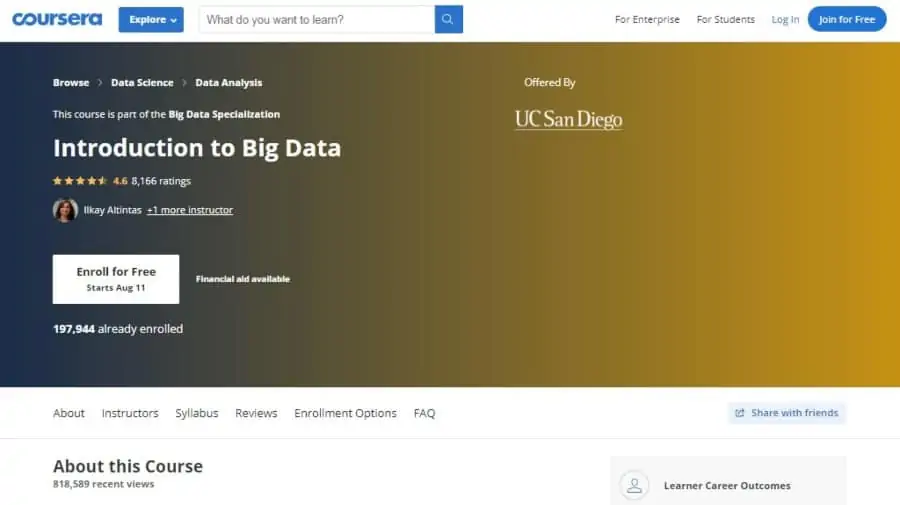
First on my list is an outstanding introductory course on Big Data which is part of a specialization program offered by the University of California San Diego through Coursera. Currently, the course has more than 195,000 students enrolled, and has a rating of 4.6!
Your instructors for this online course will be Ilkay Altintas, Chief Data Science Officer at the San Diego Supercomputer Center (SDSC), and Amarnath Gupta, Director of the Advanced Query Processing Lab at the SDSC. So for expert instructors, this course can’t be missed!
In this beginner-level 17 hour-long class, you will be introduced to Big Data starting with the current landscape surrounding its acquisition and management, and various problems which can be dealt with through data science, before you move on to learning Hadoop and running your own programs in it.
As this course is hosted on Coursera, students get access to all lessons for free, student communities, and extra resources. There is also a certification available for a small price. Overall, this is one of the best online Big Data courses!
- Beginner level
- 17 hours long
- Taught by veteran data scientists
- Financial aid available
- Certificate of completion
2. Big Data Fundamentals (edX)
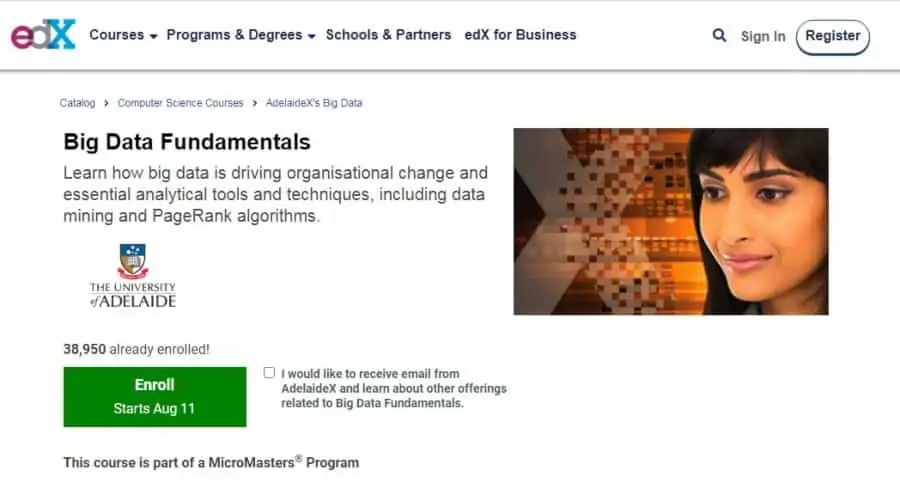
For those wanting to learn the basics of data mining and stream processing, this intermediate-level edX course on the fundamentals of Big Data is a great choice! You will also be joining 38,000 other students who have completed this online class.
As for your instructors of this online course, you will be taught by the University of Adelaide’s Computer Science faculty which consists of Frank Neumann, a professor, Aneta Neumann, a postgraduate researcher, Vahid Roostapour, a Ph.D. student, and Wanru Gao, a lecturer.
Over the span of 10 weeks, you will learn all the fundamentals of Big Data including topics like MapReduce and how it is applied, rate of occurrences of events, stream processing, PageRank algorithms, and random walk algorithms to name a few.
Currently, new students can audit the course contents for free, and get a verified certificate to share with your network at the end for a nominal fee! Overall, one of the top online Big Data courses in 2024!
- Intermediate level
- 10 weeks long with 10 effort hours per week
- Taught by faculty/researchers from the University of Adelaide
- Free access to course contents
- Certificate of completion
3. Big Data in the Age of AI (LinkedIn Learning)
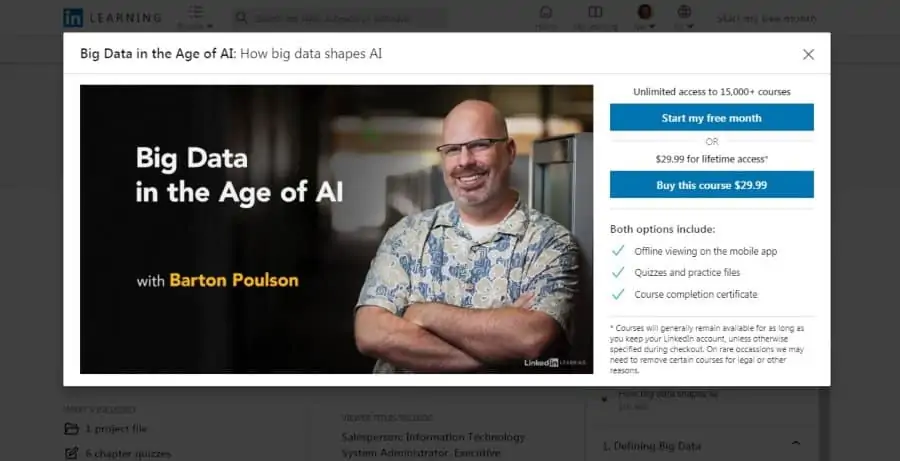
Big Data is the foundation that has enabled technologies like AI and machine learning to thrive, so if you want to get a nontechnical overview of Big Data, this online course is a fantastic introduction.
For this class, you will be taught by Barton Poulson, the founder of datalab.cc and associate professor of psychology at Utah Valley University. Barton has also published over 8 courses on LinkedIn Learning and is an expert in data analytics.
In this 2 hour online Big Data course, you will go over a variety of topics related to Big Data including its components, how it has grown over the years, its importance in big organizations, what factors contribute to its use in projects, why organizations should train personnel on big data, and industry trends to name a few.
Students who enroll in this course can gain 3.4 Continuing Professional Education (CPE) credits, along with a certificate of completion to share with your network! Not to mention a 1-month free trial!
- Beginner level
- 2 hours long
- Taught by data analytics expert
- 3.4 CPE credits available
- Certificate of completion
4. Learn Big Data: The Hadoop Ecosystem Masterclass (Udemy)
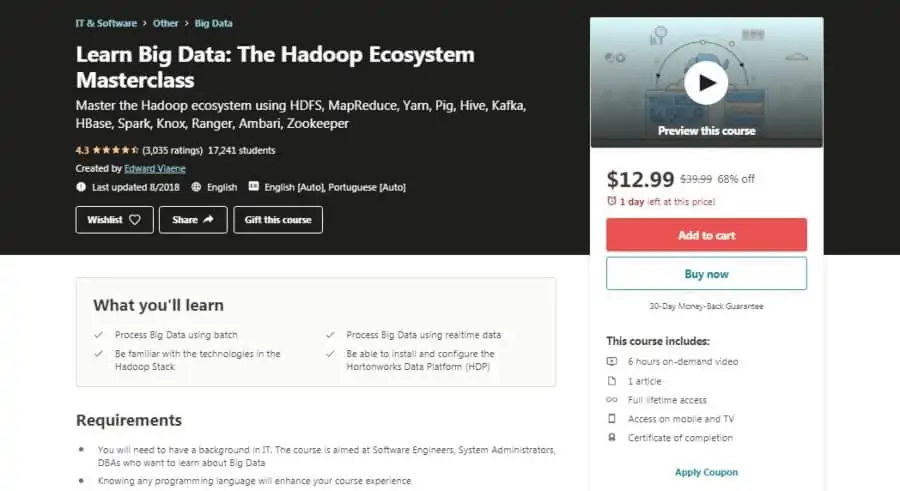
As the name suggests, this online Udemy course is perfect for those who have a background in IT and want to learn how to work with Big Data practically. You’ll also be joining 17,000 other students who have given this course a rating of 4.3 stars!
For this online training, you will be instructed by Edward Viaene, a full stack developer and systems administrator with more than 10 years of professional experience. Edward has also published 12 courses on Udemy and has helped over 150,000 students learn bid data and AI.
Through 6 hours of on-demand video tutorials, you will be introduced to the Hadoop ecosystem and Hortonworks Data Platform while also practicing with actual problems and data sets. Once completed, you will then learn to work with Pig, Apache Spark, Hive, Real-Time Processing, Kafka, and Storm to name a few.
You can get full lifetime access to this course for a limited-time discount of 50%, along with a verified certificate of completion at the end!
- Intermediate level
- 6 hours long
- Taught by DevOps engineer with 10+ years of experience
- Full lifetime access
- Taught by best selling teacher
- Certificate of completion
5. Big Data Analytics with Hadoop and Apache Spark (LinkedIn Learning)
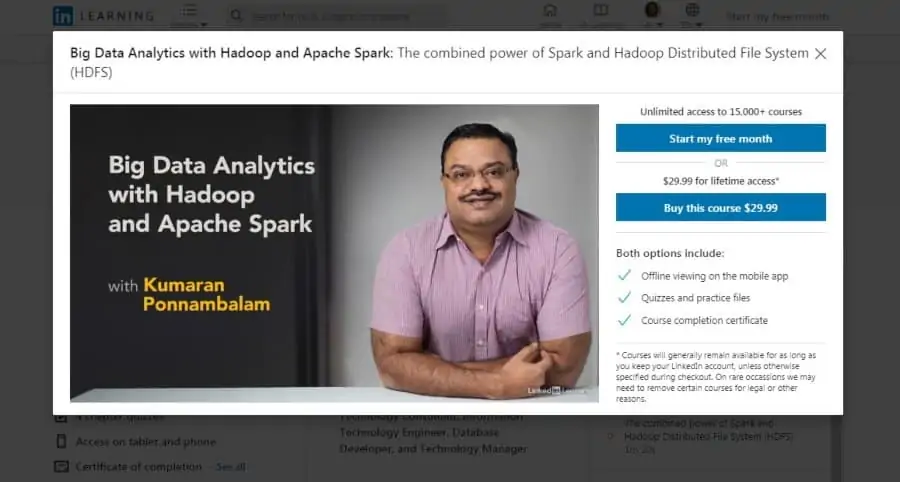
Next on my list is an intermediate-level course that is targeted towards those who are already comfortable with the basics of Hadoop/Apache Spark and want to push your learning further. Taken by more than 4,000 students on LinkedIn, this online course will help you take your Big Data Analytics career to the next level!
Kumaran Ponnambalam, a senior AI architect at Cisco who has over 20 years of professional experience working with data, will be teaching you in this Big Data course. Kumaran has also published over 8 courses on LinkedIn and has built several data-driven enterprise and cloud applications.
In this short 1 hour online course, Kumaran will take you through the features of the Hadoop Distributed File System (HDFS) and Spark, teaching you about data modeling, best practices, ingestion and extraction of data, and managing partitions to name a few.
You will be able to consolidate your learning by working on a hands-on project, and earn a verified certificate of completion at the end to share with your network!
- Intermediate level
- 1 hour long
- Taught by veteran data expert
- Certificate of completion
- Free access for new users
6. Big Data Specialization (Coursera)
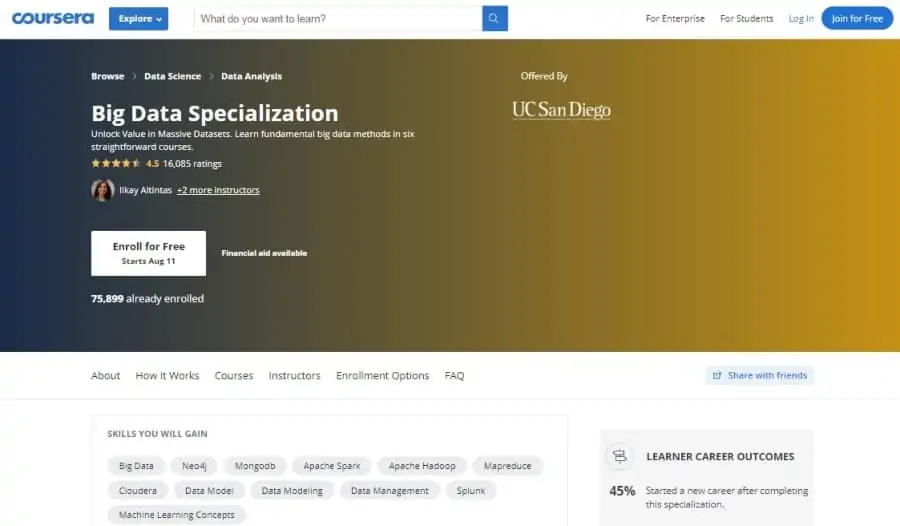
If you’re a complete beginner and want a program that will make you job-ready in the Big Data field, then this comprehensive Specialization on Coursera is what you should get enrolled in. More than 74,000 students have already gotten enrolled in this 6-course specialization.
You will have three instructors from the San Diego Supercomputer Center for this specialization: Ilkay Altintas, Chief Data Science Officer, Amarnath Gupta, Director of Advanced Query Processing Lab, and Mai Nguyen, Lead for Data Analytics.
Over the 8 months that it will take you to complete the 6 courses, you will acquire a wide range of skills that will make you ready to dive into real-world Big Data problems with topics including Neo4j, MongoDB, Apache Spark, Hadoop, Mapreduce, Cloudera, machine learning, data modeling and management, and much more.
You will be able to learn at your own pace due to flexible deadlines, and earn a certificate of completion at the end! Overall, this is hands down one of the best online Big Data courses that is taught by a world-class university!
- Beginner level
- 8 months long with 3 effort hours per week
- Taught by experts from UC San Diego
- Financial aid available
- Certificate of completion
7. Big Data Analytics (edX)
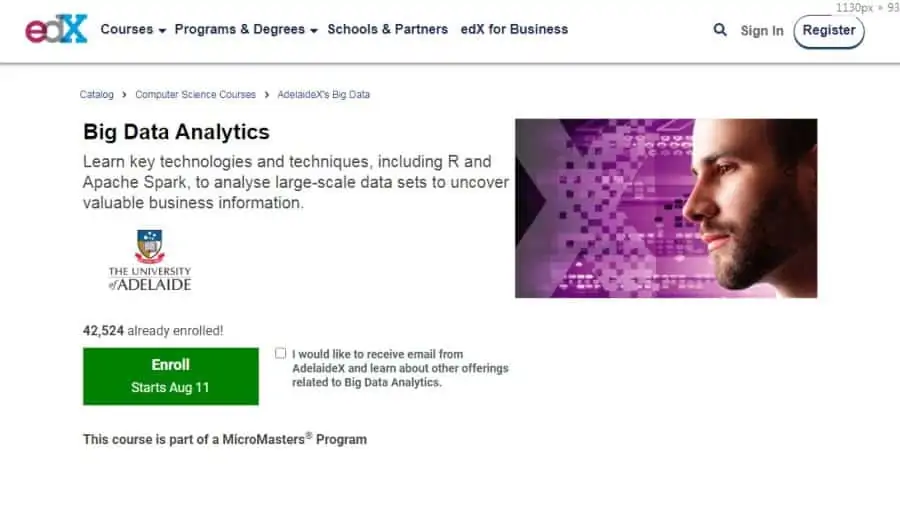
Part of the Big Data MicroMasters program on edX is this intermediate-level course that will bring you up to speed with the more programming- and mathematics-related aspects of Big Data analytics. Join over 42,000 other learners and get ready to tackle large scale data science problems.
As for your instructors, you will be taught in this online Big Data course by three faculty members from the University of Adelaide’s School of Computer Science: David Suter, Professor of CS, Lewis Mitchell, Lecturer in Applied Mathematics, and Simon Tuke, Lecturer in Statistics.
In the 10 weeks that it will take you to complete this course, you will learn a number of intermediate-level topics in the Big Data field including cloud-based analytics, statistical and probabilistic models, analysis of data needs, and problem space, and much more.
With edX, you have the freedom to learn completely at your own pace, and earn a verified certificate to share with your network once you’re done!
- Intermediate level
- 10 weeks long with 10 effort hours per week
- Taught by faculty from the University of Adelaide
- Certificate of completion
- Free access to course contents (without certificate)
8. The Ultimate Hands-On Hadoop – Tame your Big Data! (Udemy)
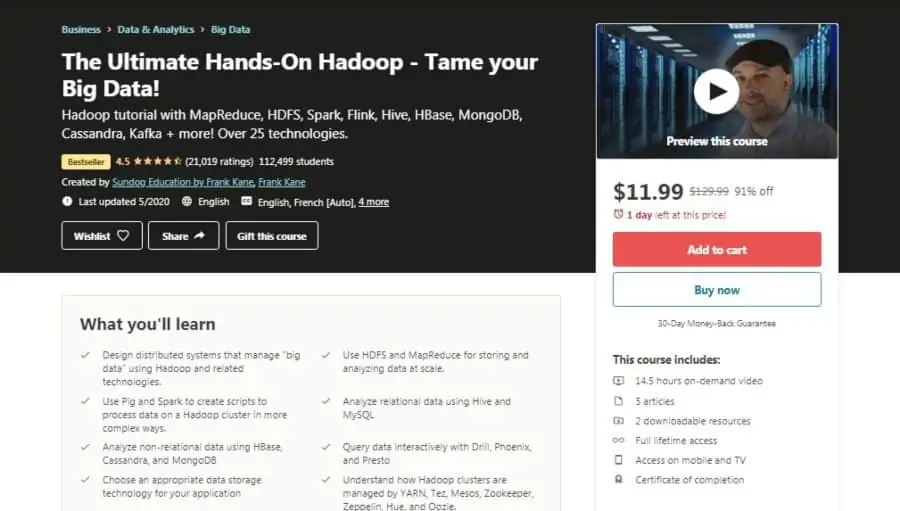
True to its name, this intermediate-level online course on Udemy is the right fit for you if you want to become skilled in using the entire Hadoop ecosystem and learn how everything integrates together. The course is a bestseller on the platform, with over 112,000 students and a rating of 4.5 stars.
In this online course, you will be instructed by Frank Kane, founder of Sundog Education who has spent 9 years working at Amazon and IMDb, and has 17 issued patents to his name. On Udemy, Frank has a rating of 4.5 stars and over 342,000 students.
Through 14 ½ hours of on-demand video lessons, you will learn to design distributed systems using Hadoop, use Pig and Spark to process data, work with HBase, Cassandra, and MongoDB, use Kafka, Sqoop, and Flume to publish data, analyze relational data using Hive and MySQL, and much more.
Udemy is offering you a limited-time discount of 86% off on the course fees for full lifetime access, along with a certificate of completion!
- Intermediate level
- 14 ½ hours long
- Taught by expert professional and innovator
- Limited-time discount of 86%
- Full lifetime access
- Certificate of completion
9. Data Engineering, Big Data, and Machine Learning on GCP Specialization (Coursera)
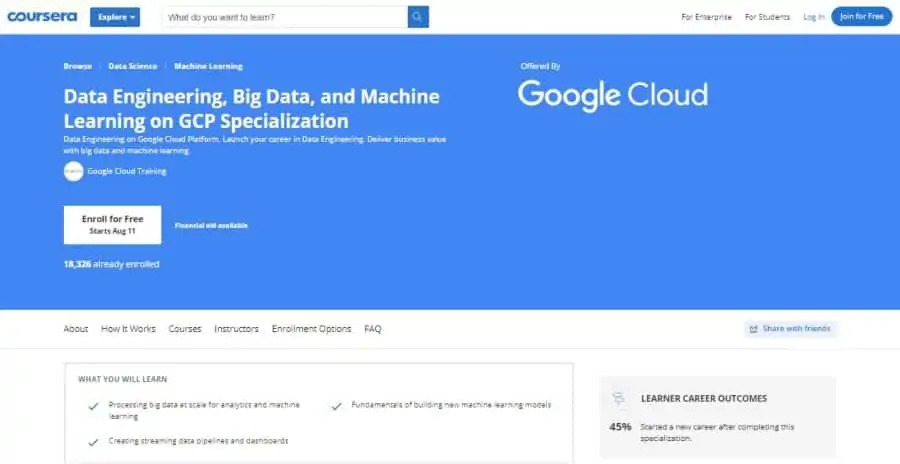
Brought to you by Google itself, this 5-course specialization program will make you a job-ready expert on using Google’s Cloud Platform (GCP) for Big Data, Data Engineering, and Machine Learning. Over 17,000 students have already gotten enrolled in this program.
Instructors for this course will be provided by Google Cloud Training, a pool of expert professionals curated by Google to impart education on using its GCP. It has over 230 courses on Coursera along with over 915,000 students.
In the 3 months that it will take you to complete the 5 intermediate-level courses, you will learn how to build data pipelines on GCP, shift your Hadoop work to the platform, process streaming and batch data, discover useful business insights, apply machine learning APIs on datasets, and much more.
You can apply for financial aid if you are unable to pay the full fees for the courses, and also earn a certificate of completion at the end! Overall, this is one of the best online Big Data courses taught by nonother that Google!
- Intermediate level
- 3 months long with 5 effort hours per week
- Taught by Google Cloud Training
- Financial aid available
- Certificate of completion
10. Big Data and Education (edX)
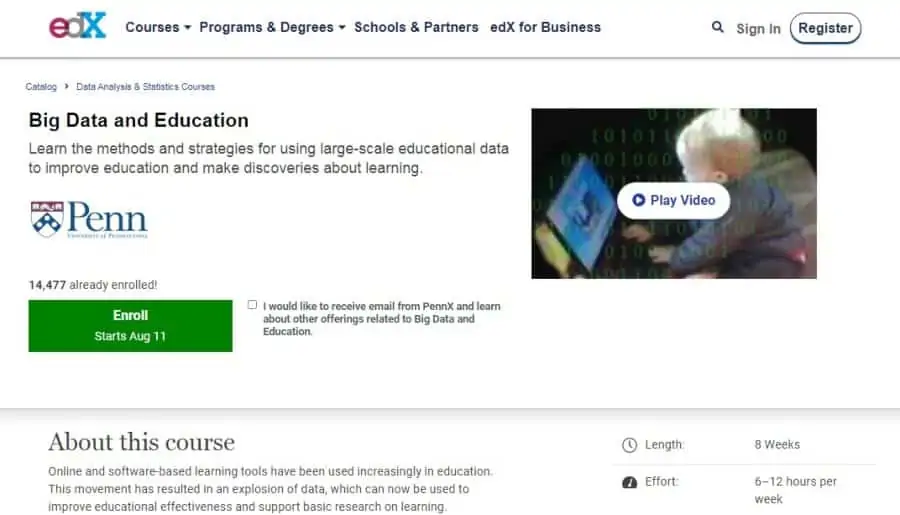
The introduction of software and online tutoring in education has created a huge wealth of data ripe for analysis. If you’re interested in improving the quality of education by finding actionable insights from all this data, this advanced-level online class on edX is the perfect choice for you.
Ryan Baker, an Associate Professor at the University of Pennsylvania, will be your instructor for this course. Ryan heads the Penn Center for Learning Analytics as the Director, and is the President of the International Educational Data Mining Society.
Over a course of 2 months in this course, you will learn practical skills in educational data analytics including the key methods for collecting data, applying Python’s built-in machine learning library, using standard tools such as RapidMiner, and much more.
With edX, you can access the course contents for free and pay a nominal fee to upgrade and earn a verified certificate that you can share with your network!
- Advanced level
- 8 weeks long with 9 effort hours per week
- Taught by expert in educational data mining
- Free audit of course contents
- Certificate of completion
11. Introduction to Data Science – Specialization (Coursera)
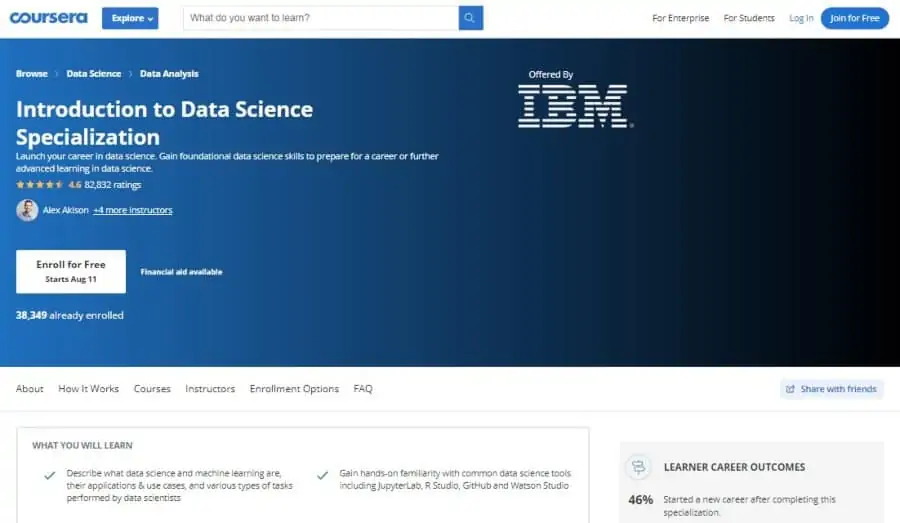
It can be confusing to figure out how to get started with data science and what to learn if you’re aiming to pursue a career in this rich and in-demand field. If that is your predicament, then you should get yourself enrolled in this 4.6-stars rated and 4-course specialization offered by IBM through Coursera.
Instructors from IBM will be teaching you in this online course which consists of 5 IBM employees namely Alex Aklson, Ph.D., Polong Lin, Romeo Kienzler, Rav Ahuja, and Svetlana Levitan, who are experts in data science and have over 1,000,000 students combined on Coursera.
Through 4 months of intense study in this course, you will become job-ready by studying topics like Relational Database Management System (RDBMS), cloud databases, using Python for data science, the basics of SQL databases, and much more.
Aside from a certificate of completion given by Coursera, you will receive a digital badge from IBM for completing this specialization! Overall, this is one of the best online Big Data courses taught by nonother than IBM!
- Beginner level
- 4 months long with 4 effort hours per week
- Taught by expert IBM data scientists
- Certificate of completion
- Digital badge from IBM
- Financial aid available
12. University of Adelaide MicroMasters Program in Big Data (edX)
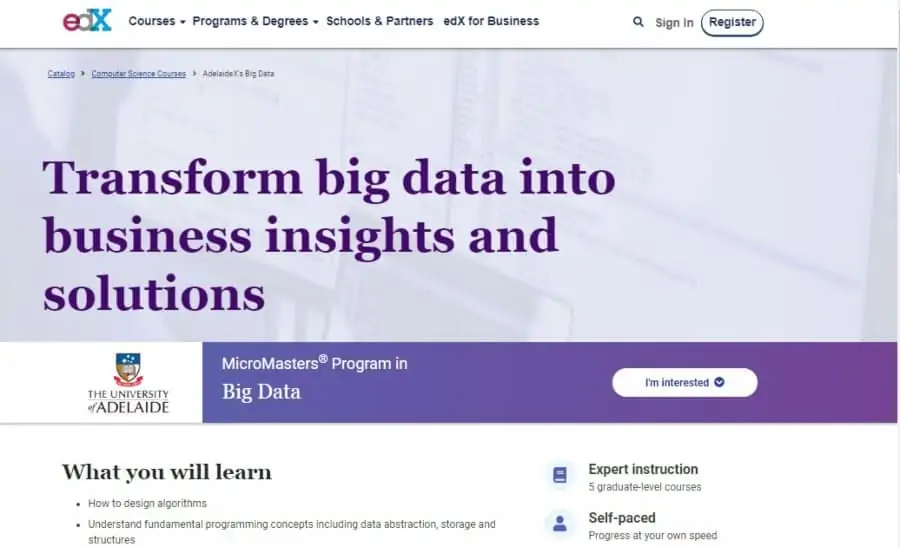
Next on my list is a MicroMasters program prepared by the University of Adelaide that is suited to all of you who have a good programming background and now want to learn advanced skills in Big Data. With 4 courses and a capstone project, the program will directly land you interviews at top companies looking for data scientists.
You will be taught throughout this program by a team of 15 faculty members from the University of Adelaide which includes lecturers, postgraduate researchers, and professors, all of whom are experts in data science and Big Data.
Over the course of a year of intense learning, you will learn how to design algorithms, work with data abstraction, storage, and structures, use decomposition, pattern recognition, and abstraction, make algorithms for Big Data, understand important mathematical concepts, use tools like Java and R, and much more.
Not only will you have full control over the pace of your learning, you will also earn a University of Adelaide-recognized certificate for completing this MicroMasters program! To learn more, you can also see my posts on SQL and Python.
- Advanced level
- 4 courses + 1 project for 1 year
- Taught by experts from University of Adelaide
- MicroMasters Program certificate
- Gain 12 credits applicable to University of Adelaide’s Masters in Data Science degree
13. Advanced-Data Science with IBM Specialization (Coursera)
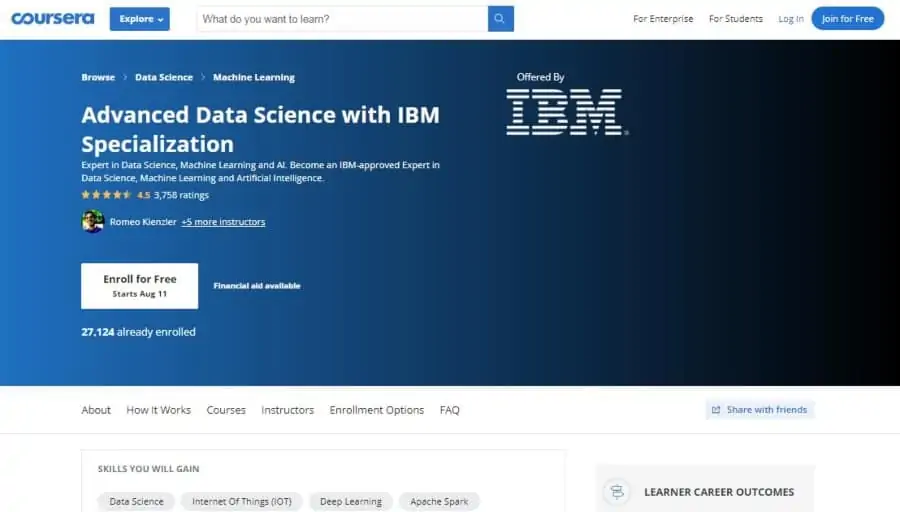
The final entry on my list is an advanced-level specialization in data science that is designed for those among you who are already in the industry and want to truly master your craft. With 26,000+ students enrolled already, this IBM-developed program has a rating of 4.5 stars.
As for your instructors, you will be taught in this course by a hand-vetted team of IBM employees and experts ranging from data scientists and software engineers, to deep learning experts. Rest assured, you will be receiving a world-class education from top-quality educators.
In the 4 months that it will take you to complete this 4-course specialization, you will develop a deep understanding of parallel data processing, visualization, and exploration, advanced machine learning, and AI, the underlying mathematics behind it all, popular packages like TensorFlow and Keras, and much more.
You can complete the courses on your own schedule with flexible deadlines, and earn a certificate of completion at the end to prove your mastery! Overall, one of the best online Big Data courses for those looking to specialize in data science.
- Advanced level
- 3 courses + 1 project in 4 months
- Taught by experts from IBM
- Financial aid available
- Certificate of completion
