
Learn How To Become A Logistics Pro With 2024‘s 11 Best Online Supply Chain Management Courses
![Best Online Supply Chain Management Courses Learn How To Become A Logistics Pro With [year]'s 11 Best Online Supply Chain Management Courses](https://skillscouter.com/wp-content/uploads/2020/07/Best-Online-Supply-Chain-Management-Courses.webp)
If you’re looking to launch a career in the supply chain management field, or just want to improve your understanding to perform better in your logistics role, you’ve come to the right place!
After extensive research, I have gathered some of the best online supply chain management courses in 2024. These courses will teach you the fundamentals of SCM and give you the logistics training need to succeed to today’s Amazon Prime environment.
You will also be learning directly from experts in the industry, working with on hands-on assignments, and earning certificates of completion. Let’s get started!
Top 11 Best Online Supply Chain Management Courses 2024
1. Supply Chain Foundations (LinkedIn Learning)
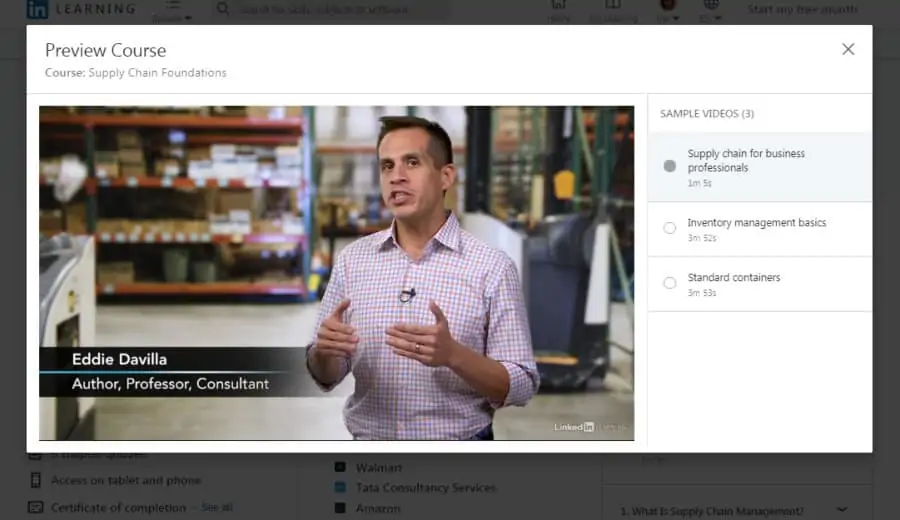
For those looking for an introduction into supply chain management (SCM), this beginner-level course offered by LinkedIn Learning is a great place to start! This class will also give you a broad overview of SCM, and bring you up to speed with the latest global issues and challenges in the industry.
Your instructor for this online course is Eddie Davila from Arizona State University, who is the principal lecturer and associate chair for the Supply Chain Management program in the college’s W.P. Carey School of Business.
In this 1 ½ hour-long course, you will become comfortable with identifying the parts of a supply chain, understand the key drivers of successful SCM, learn concepts such as inventory management, supplier selection, product distribution, and supply chain integration to name a few.
Students will also be eligible to receive 2.6 Continuing Professional Education (CPE) credits by completing this course, along with a shareable certificate of completion! There is also a 1-month free trial to take advantage of! Overall, one of the best online supply chain management courses!
- Beginner level
- 1 ½ hour long
- Taught by renowned supply chain expert
- 2.6 CPE credits
- Certificate of completion
2. Implementing Supply Chain Management (LinkedIn Learning)
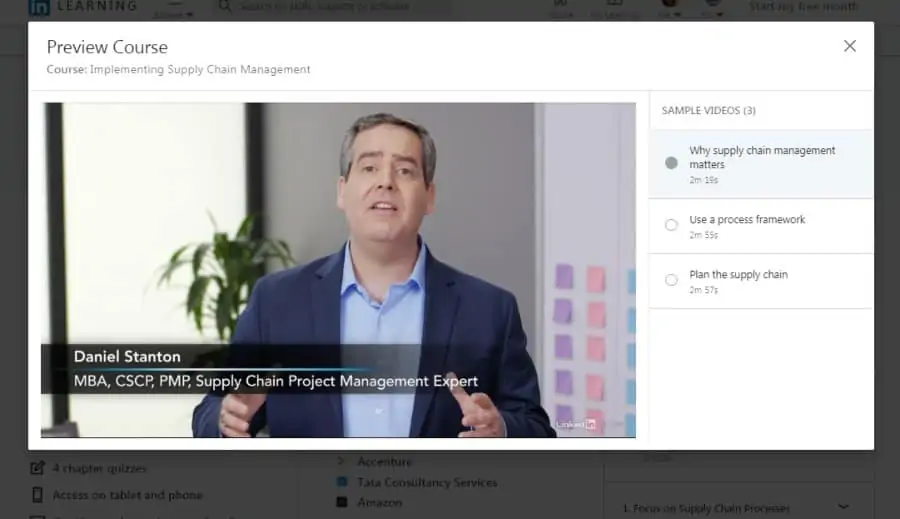
If you’re already familiar with the basics of supply chains, but want to implement an actionable plan, this intermediate-level course is a fantastic place to start. Over 43,000 students have completed this training which comes highly rated for those wanting to establish supply chain management practices in an organization.
For this online supply chain management course, you will be taught by Daniel Stanton, who is the author of the best-selling book Supply Chain Management for Dummies, has a Master’s in Logistics Engineering from MIT, and is a Certified Supply Chain Professional (CSCP).
During 1 ½ hour of video lessons, you will explore topics such as the source inputs in a SC, the role of returning products, how to calculate total costs, the importance of flexibility and innovation, selecting the right technology, collaborating externally, and much more!
By completing this online course, you will also gain a verified certificate of completion along with 2.4 Continuing Professional Education (CPE) credits! Overall, a great introduction to SCM.
- Intermediate level
- 1 ½ hour long
- Taught by Certified Supply Chain Professional
- 2.4 CPE credits
- Certificate of completion
3. Supply Chain Fundamentals (edX)
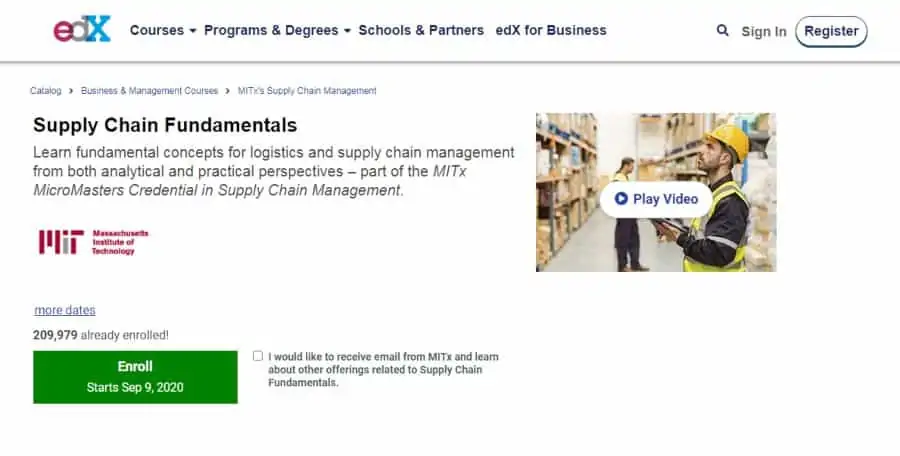
For those of you who are more mathematically-inclined and want to get into the analytic aspects of supply chains, this intermediate-level edX course can’t be missed. With over 200,000 students enrolled, this is the first module from the MITx MicroMasters Credential in Supply Chain Management.
Dr. Chris Caplice will be your instructor for this online course who earned his Ph.D. in Transportation and Logistics in 1996 from MIT. He is also the Director of the MITx program that this course is a part of, not to mention the Chief Scientist the supply chain consulting firm called Chainalytics.
In the 13 weeks that it will approximately take you to complete this course, you will become capable of managing risk and uncertainty in SCs, segmenting customers, products, and channels to design the optimal strategy for each, designing and implementing the best forecasting methodology, and inventory replenishment policy to name a few.
Students will receive a printable certificate of completion after finishing this online course that you can share with your network, and be ready to tackle the next class in the MicroMasters program! Overall, one of the best online supply chain management courses in 2024!
- Intermediate level
- 13 weeks long with 12 effort hours per week
- Taught by MIT Professor
- Certificate of completion
- Part of MITx MicroMasters program
4. Operations and Supply Chain Management (Udemy)
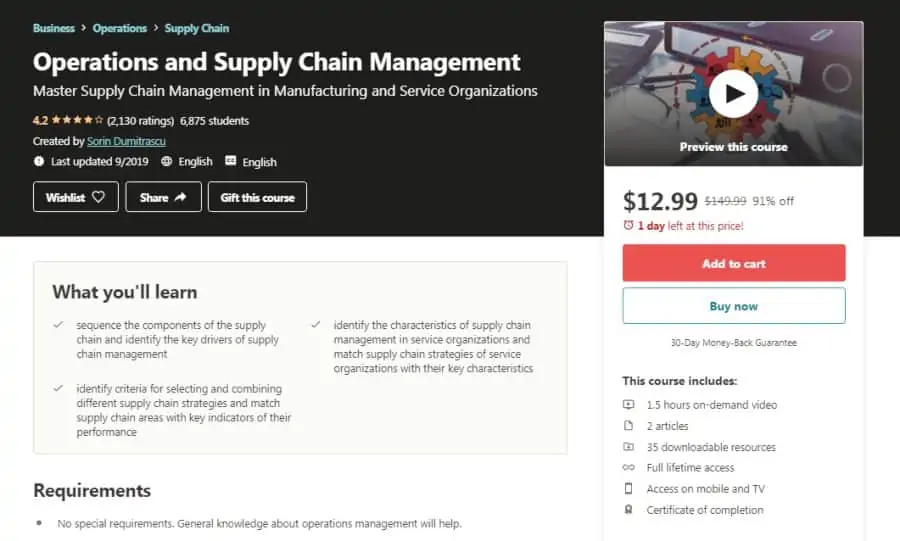
Next on my list is a supply chain management primer that may be best suited for those seeking a refresher course or an introduction into SCM. Students will also get to learn strategies and measures to rapidly improve value-addition across a company’s supply chain.
As for your instructor, you will be taught by Sorin Dumitrascu, a certified trainer and project manager with 10+ years of experience who has an average rating of 4.2 on Udemy. Sorin also has 104 published courses that have attracted over 135,000 students and counting!
In this 1 ½ hour online class, you will learn to sequence the parts of a supply chain, understand the most important factors that drive it, figure out the best strategies for different kinds of organizations, learn to combine various strategies to multiply value, and much more.
Being hosted on Udemy, this online supply chain management course offers lifetime access, downloadable resources, class projects, and a certificate of completion!
- Intermediate level
- 1 ½ hour
- Taught by 4.2 star-rated instructor
- Certificate of completion
- 30-day money-back guarantee
5. Blockchain in Supply Chain Management (Udemy)
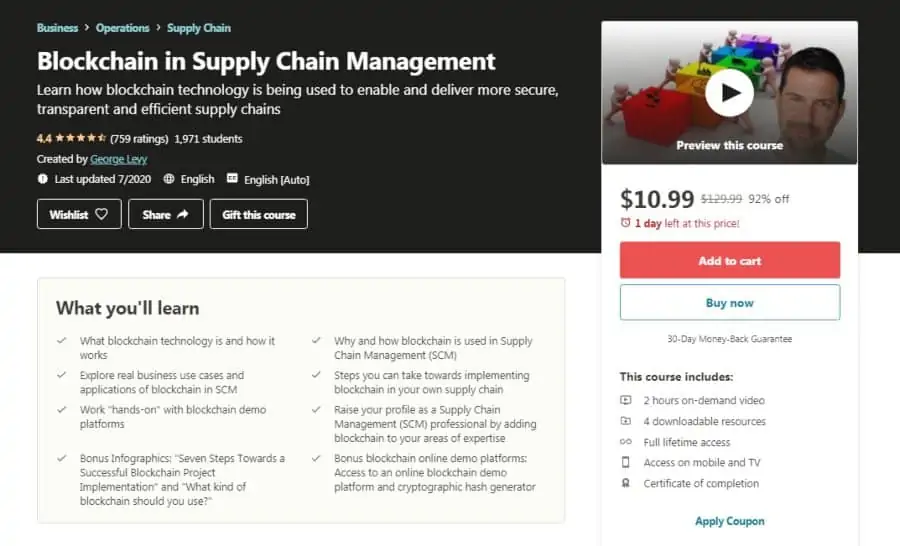
Blockchain is being hailed as the technology of the future that will revolutionize supply chains and make them more reliable and efficient. So if you are looking to get the first movers advantage and add this valuable skill to your arsenal, this Blockchain in SCM course is tailored to your needs.
George Levy, a certified instructor on Blockchain from the Blockchain Institute of Technology (BIT), will be teaching you in this online course. George is also the Chief Learning Officer at BIT with more than 71,000 students on Udemy and an instructor rating of 4.5 stars.
During 2 hours of on-demand video lessons in this beginner-level course, you will go through all the basics of Blockchain and supply chains including what the technology is and how it works, why it is a great fit for supply chains, hands-on demos with Blockchain platforms, the areas where Blockchain adds the most value, the different kinds of it available, and much more.
With Udemy, you can take advantage of a limited-time discount of 92% on the course to get full lifetime access along with a certificate of completion that you will receive at the end!
- Beginner level
- 2 hours long
- Taught by certified Blockchain instructor
- Full lifetime access
- Limited-time discount of 92%
- Certificate of completion
6. The Business of Logistics in Supply Chain Management (Udemy)
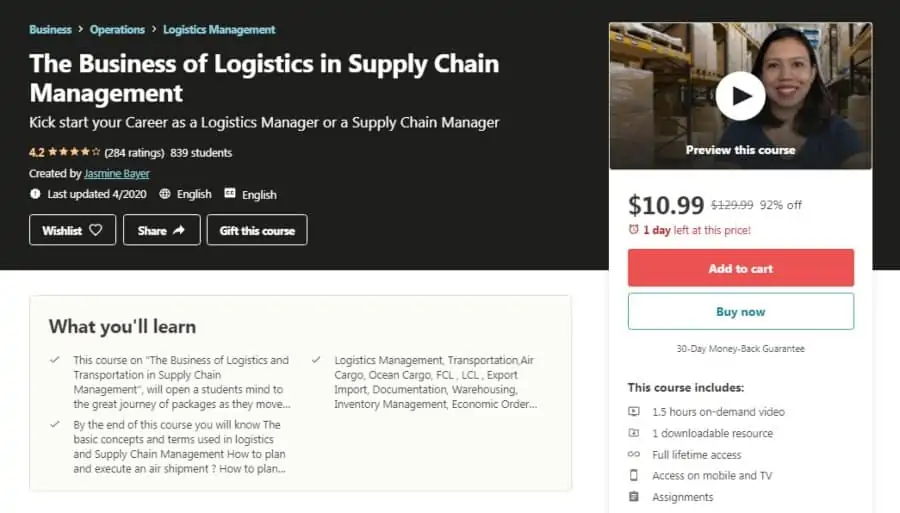
Handling how goods are transported from one place to another is a crucial part of Supply Chain Management. So, if you want to dive into the world of logistics and learn how to optimize the delivery and procurement of goods for your company, this class is a great place to start!
For this online supply chain management course, you will be instructed by Jasmine Bayer, a NET Certified Instructor who holds a Master’s degree in International Business and has over 10 years of experience working in big companies like UPS and FedEx in supply chain and business development roles.
Through 1 ½ hour of beginner-level lessons, you will learn all the basics of logistics such as air cargo management, ocean cargo management, shipment scheduling, containerization, cost estimation, logistics planning, export-import procedures, inventory management, and much more.
You can also benefit from a certificate of completion on Udemy after completing the course, along with full lifetime access to the course for a limited-time discount of 86%!
If you are looking to get Udemy courses on sale all year round, you can see my guide here on how to do that!
- Beginner level
- 1 ½ hour long
- Taught by NET Certified Instructor
- Full lifetime access
- Certificate of completion
- Limited-time discount of 86%
7. Supply Chain Principles (Coursera)
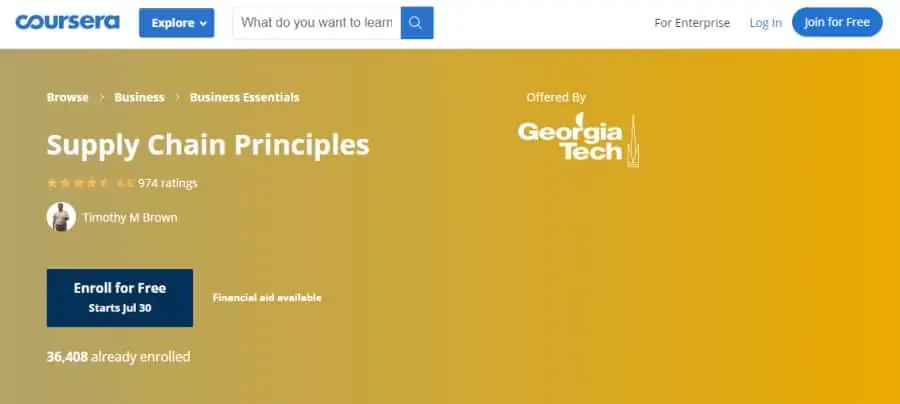
For those of you who are allergic to math and yet want to invest a good amount of time mastering the principles of SCM, this 4.6-star rated course is definitely the right choice. The course is offered by the Georgia Institute of Technology through Coursera and will help you turbocharge your career.
Your instructor for this online course will be Timothy M Brown, managing director of the Supply Chain and Logistics Institute of Georgia Tech who holds an M.S. in Business Administration and is a renowned expert of SC strategy, operations outsourcing, and program management. Timothy has an instructor rating of 4.3 on Coursera along with over 35,000 students.
In this extensive beginner-level 15 hours long course, you will cover a wide range of topics including a general overview of supply chains, graphics that promote the Integrated SC model, various kinds of industry-specific SCs, career path opportunities in Supply Chain Management, emerging and upcoming trends, and much more.
With Coursera, you can apply for financial aid if you are unable to pay the full fee for the course, and earn a shareable certificate of completion at the end! Overall, this is one of the best online supply chain management courses taught by a leading university.
- Beginner level
- 15 hours long
- Taught by expert of Supply Chains
- Financial aid available
- Certificate of completion
8. Introduction to Supply Chain Management – Revised 2018 (Alison)
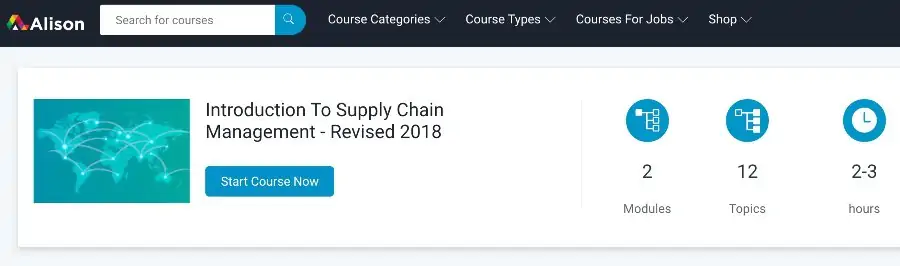
If you’re looking for a short course on the fundamentals of supply chain management, then this beginner-level course on Alison is best suited for your needs. While this course is free, it will also prepare you to pursue a career in this field. This online course has over 29,000 enrolled students and an average rating of 3.9 out of 5 stars.
The National Programme on Technology Enhanced Learning (NPTEL) of India will be providing you with instructors for the course. NPTEL recruits top professors from India’s best management schools to prepare full lessons so you can be sure that you will be learning from the most knowledgeable in the field.
Through 3 hours-long video lessons, you will go through and learn a wide range of topics including the representation of the individual components of a SC, integrated SC models, best practices in modern SCM, best strategies for material transport, national and international flows, and much more.
The biggest advantage you get through this Alison course is that you can complete this course for free and receive a certificate of completion at the end!
- Beginner-level
- 3 hours long
- Taught by top Indian professors
- Free of cost
- Certificate of completion
9. Simple & Easy – Basics of Supply Chain Management [BSCM] (Udemy)
![Simple & Easy – Basics of Supply Chain Management [BSCM]](https://skillscouter.com/wp-content/uploads/2020/07/Simple-Easy-–-Basics-of-Supply-Chain-Management-BSCM.webp "Simple & Easy – Basics of Supply Chain Management [BSCM]")
Next on my list is a course on Udemy that is tailored to your requirements if you want to become job-ready for the supply chain management field. This online class also eliminates all extra and unnecessary concepts and will save you a lot of time and energy.
Your instructors for this course will be provided by the Aadini Supply Chain School, a company formed by experienced professionals who have worked with some of the top Fortune 100 companies and have over 4,000 students on Udemy along with a 4-star rating.
In this 2 hours long beginner-level course, you will learn all the essential topics needed to excel in a supply job including a solid understanding of logistics and the supply chain function, the importance of warehouse management, facilities, processes, and operations, how to design, refine, plan, and execute various processes, how to maintain, measure, and control inventory stores and costs, and much more.
With Udemy, you can gain full lifetime access to this course so that you can complete it whenever you want, and earn a certificate of completion at the end!
- Beginner level
- 2 hours long
- Produced by Aadini Supply Chain School
- Full lifetime access
- Certificate of completion
10. Logistics Foundations (LinkedIn Learning)
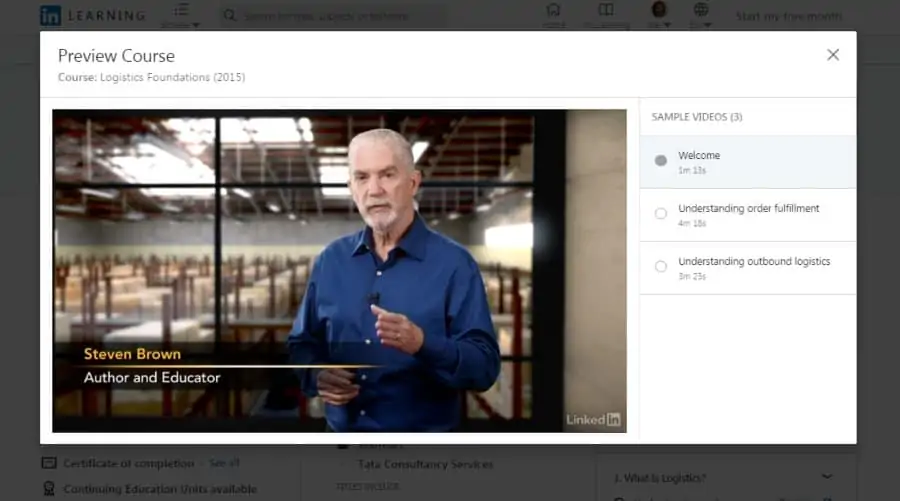
You may be looking for a course that will help you grasp the fundamentals of logistics in an easy-to-understand manner and a short amount of time. If so, this LinkedIn course that offers Continuing Professional Education (CPE) credits and is taken by over 39,000 other students is exactly what you have been searching for.
As for your instructor, you will be taught by Steven Brown, a Certified Supply Chain Professional (CSCP) with over 30 years of experience in business and 16 years of experience teaching supply chain management courses to undergraduate and graduate students at the Arizona State University.
Through this 1 ¾ hour online supply chain management course, you will learn a wide range of topics related to logistics including order fulfillment, inbound and outbound logistics, various transportation options, the bullwhip effect, customer requirements, obstacles to coordinate, and much more.
You will receive 3 CPE credits along with 1.5 Professional Development Units (PDUs) from the Project Management Institute (PMI) for completing this course!
- Beginner level
- 1 ¾ hour long
- Taught by Certified Supply Chain Professional
- 3 CPE credits
- 1.5 PDUs from PMI
- Certificate of completion
11. Supply Chain Management Specialization (Coursera)
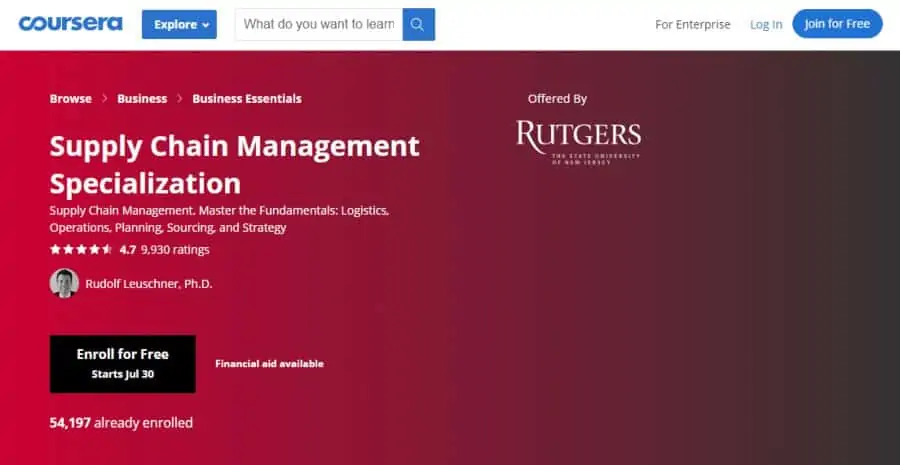
The final entry on my list is a heavyweight specialization in Supply Chain Management on Coursera. This is perfect for you if you are serious about a career-switch or launching a full-fledged career in the SCM field, and want immersive learning instead of short introductory courses.
Your teacher for this course will be Rudolf Leuschner, Ph.D., who is the Associate Professor of Supply Chain Management at the Rutgers Business School, and has more than 10 courses on Coursera with over 105,000 students enrolled.
In the approximately 6 months that it will take you to complete this beginner-level specialization, you will first go through 4 courses that will teach you all the aspects of SCM including forecasting, logistics, lean six sigma, risk management, warehouse management, inventory, demand planning, and much more. In the final course, you will get the opportunity to work on a real-life business case to apply your learned knowledge.
You can apply for financial aid if you are unable to pay the full fees for the courses, learn at your own schedule with flexible deadlines, and earn a certificate of completion at the end! Overall, this is hands down one of the best online supply chain management courses taught a Ph.D. instructor.
For more information, you can see my other guide here on online management courses!
- Beginner level
- 6 months long with 3 effort hours per week
- Taught by associate professor of supply chain at Rutgers
- Work on a real-life business case
- Financial aid available
- Certificate of completion
