
Top 11+ FREE Best Online SketchUp Courses, Classes & Training


If you have a passion for architecture or want to design your next DIY project, then learning SketchUp is a great place to start.
While SketchUp is an intuitive drafting and 3D design tool, users can still benefit from undertaking one of the many online courses available.
Because of this, I have rounded up some of the best online SketchUp courses that anyone can take from the comfort of their own home. Let’s begin!
Top 11 Best Online SketchUp Courses, Classes & Training 2024 [Free + Paid]
1. Sketchup For Beginners – How To Create Your First 3D House (Skillshare)
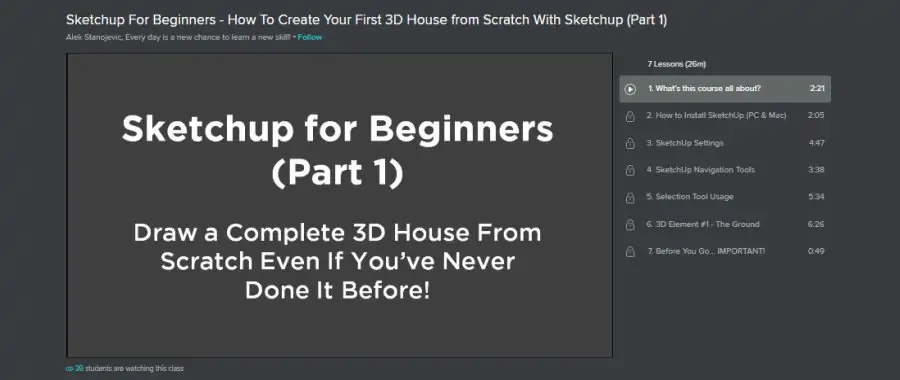
Mastering SketchUp can seem complicated for beginners. However, this first part of a 3-part course offers the basics skills of SketchUp for students to build on and has very practical structured classes.
It teaches students how to install SketchUp which then follows by familiarizing students with the software’s interface. It also walks students through using the selection tool of the program, placing walls, doors, windows, and elements.
During this process, the instructor (taught by Alek Stanojevic) also shows students how to build a real-world 3D model using the software.
Overall, this is one of the best online SketchUp courses to get a solid understanding of architectural software. Also by being hosted on Skillshare, users can take this course for FREE when activating the 1-month free trial (cancel anytime).
- Shows students how to install the SketchUp software
- Presents the interface of the software with its multiple tools
- Teaches students how to use the selection tool
- Includes a lesson on creating the first 3D element of a house
- Part of a complete house-planning course
- Adhered to by over 2.000 students
Activate Free Skillshare Trial
2. SketchUp Architect From 2D plans to 3D models (Skillshare)
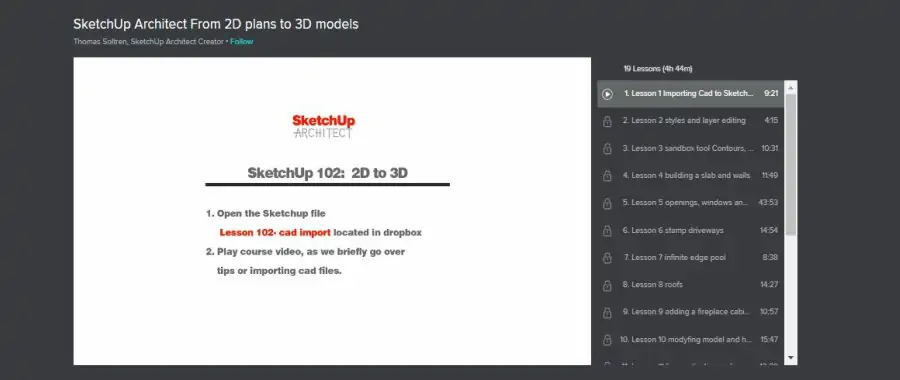
Up next on my list is a comprehensive 4-hour course that teaches students how to build a 3D model from a 2D plan. By the end of the course, students will know how to create their 3D homes from regular sketches.
The course starts with a lesson on how to important into SketchUp from CAD. Styles and layers of editing are covered in the second lesson. Sandbox tools and contours are detailed next. Lesson number 4 teaches students how to build slabs and the walls of the house. All openings such as windows and doors are detailed in the following lesson.
Driveways are detailed in their lesson. The same attention to detail is given to infinite pools which also enjoy a separate lesson. Roofs enjoy a long 14-minute lesson. Adding a fireplace is also included in the course. Modifying models and heating surfaces follow this lesson. Lessons on fences and landscaping follow. Creating a standard pool is also detailed by the course.
Twilight lighting has its lesson towards the end of the course. Saving all the images is important all of this work is detailed in the last lesson which also takes a look at rendering a nearby environment.
- Shows a real example of transforming 3D sketches from 2D plans
- Presented by a SketchUp Architect creator
- Split into 19 manageable lessons
- All steps are described at beginner level
- Suitable for future architects
- The course is useful for those building a new home
Activate FREE Skillshare Trial
3. Master SketchUp – A Definitive Guide From Infinite Skills (Udemy)
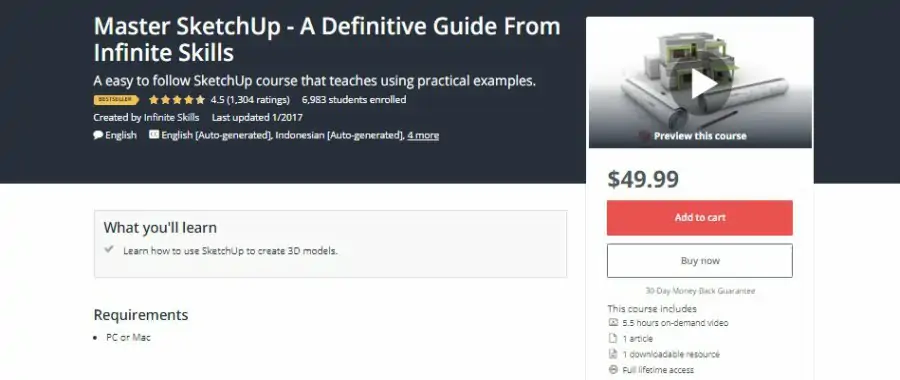
This Udemy course teaches using practical examples. With over 5 hours of training, it dives deeper into SketchUp, one of the most popular programs for 3D home plans. This course is split into 10 modules which are then detailed in multiple sub-lessons.3
The introductory module allows students to set up their toolbar properly. In the second module, students are shown how basic tools work. This includes the circle tool and the polygon tool. In the third module, students learn about creating different types of roofs.
From the 4th module onwards, lessons get a bit technical. Students learn how to measure walls and create openings such as doors. Proper model organizing such as layering for visibility is covered in the 5th module.
In the 6th module, students start to import and edit textures. The ceiling enjoys its module next. Various types of staircases are detailed in the following module. The course continues with fireplaces and mantle columns. The kitchen space and model furniture have their lessons. Exporting options including the creation of photorealistic rendering concludes the course.
- Goes into detail on all major areas of the rendering
- Includes over 5 hours of training
- Adds downloadable resource
- The course offers a certificate of completion
- Enjoyed by thousands of enrolled students
- Created by an e-learning Canadian company
4. SketchUp BootCamp: Creating Interiors with SketchUp (Udemy)
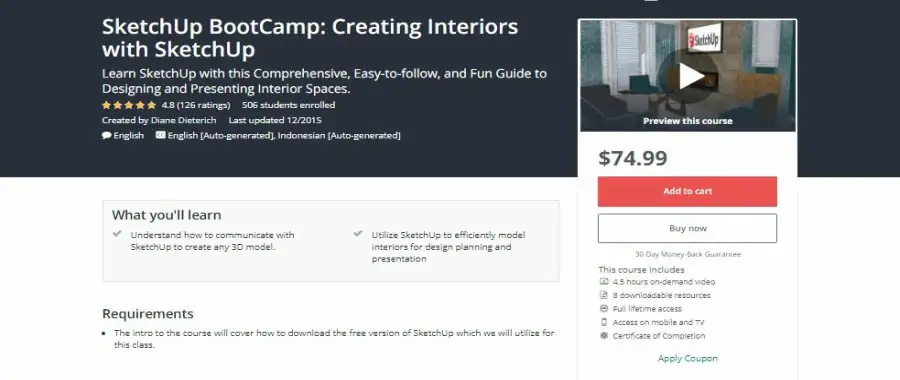
The course aims to be one of the few fun methods of learning SketchUp. It covers the basics of the software together with instructions on the best practices. Presented in videos totaling more than 4 hours, the training course is mainly addressed to those planning to get into the design or for those who want to plan their new home themselves.
Step-by-step instructions characterize the program. Students also get to experiment with mini-projects along the way. At the end of the course, all students can create a building floorplan and work with groups or layers.
They will also know how to work with dynamic components and create sections and elevation. Special attention is given to kitchen designs. As a special addition, the course offers information on working with shadows.
- Presented by a certified SketchUp instructor
- Splits the 4.5 hours of training into short video presentations
- Includes 8 downloadable resources for extra information
- Hosted by Udemy’s on-demand learning platform
- Offers a certificate of completion
- All steps are based on the free SketchUp version
5. SketchUp Weekly (LinkedIn Learning)
Hosted on Lynda.com, this extensive course has more than 14.000 views. It is useful for architecture students, CAD, and SketchUp users. Its advanced learning techniques are presented in short lessons which total overall 6 hours of learning.
The first module is dedicated to cleaning up CAD with a few useful extensions. The following module is dedicated to modeling walls and using math for precise forms. Controlling softening and smoothing is next. Photographic entourages and creating depth of field effects with fog are presented in 2 short 15-minutes lessons.
Animating section planes and mastering arrays are presented next. Using a tape measure is also presented in the course. Creating stairs is covered with a separate lesson. Fredo6’s Bezier Spline is presented next. From controlling objects to animating sections, the tools are presented to their full potential.
Other tools are also covered towards the end of the course. SketchUp and Revit are used together via IFC. Sandbox tools and the FredoScale are presented at the end.
- Leverages SketchUp extensions
- Shares best practices on the SketchUp toolset
- Improves CAD drawings
- Uses math to model precise forms
- Suitable for intermediates
- Presented by a specialized CAD and 3D trainer
6. SketchUp for Architecture (LinkedIn Learning)
Following a typical residential building project, the course is aimed specifically at architects. It teaches students how to transform drawings into 3D presentations. Such presentations are the final versions of the 3D models clients get to see.
With over 5 hours of training, the course already has more than 37.000 views. At the end of the course, students can adjust typical SketchUp settings and install plugins. They create components and import CAD drawings.
Modeling a house is the project which puts all of this theory into practice. Students add walls, doors, and windows. They create textures and complete the home with a roof. The interior of the home is modeled next. Before going into exporting the files, students are given landscaping tips.
- Split into 10 modules totaling more than 5 hours of training
- Popular on Lynda.com with 37.000 views
- Presented by an international architecture lecturer
- Includes exercises for students
- Introduces a geolocation module
- Covers interior furnishings
7. Google SketchUp for 3D Modelling (Alison)
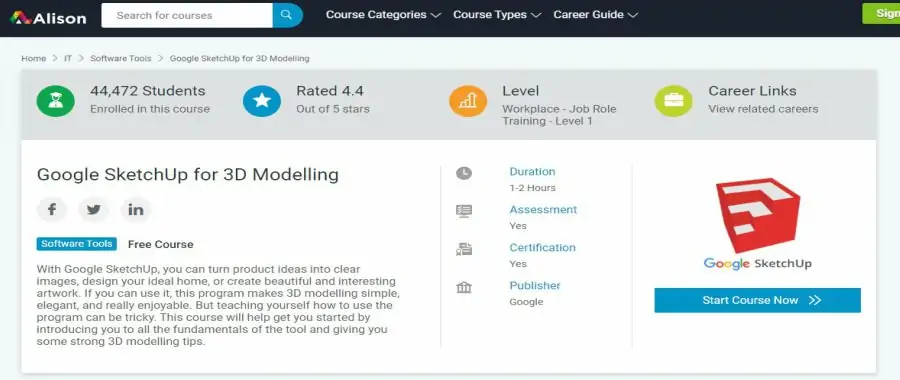
Google SketchUp is a free version of the 3D modeling program and it is specifically made for architects and civil engineers. At the end of the course, enrolled students know how to use their tools and measures accurately. They know how to use different views of the model. Students also learn how to change various components if needed.
There’s a certificate of completion awarded at the end of the course. But for this certificate to be awarded, students need to score 80% or higher in each assignment. Unlike most similar courses, the Google SketchUp for 3D modeling lasts 1 to 2 hours.
Since its being organized by Google, it already boasts more than 44.000 students. It is one of the shortest methods of learning how to transform an image into a 3D model.
- Strongly based on personal assignments
- Completed by more than 44.000 students
- Awards a Google certificate at the end of the course
- Teaches basic SketchUp tools
- Presents the transformation of an image into a model
- A framed certificate is included with free shipping
8. Design your Room Using Sketchup (Udemy)
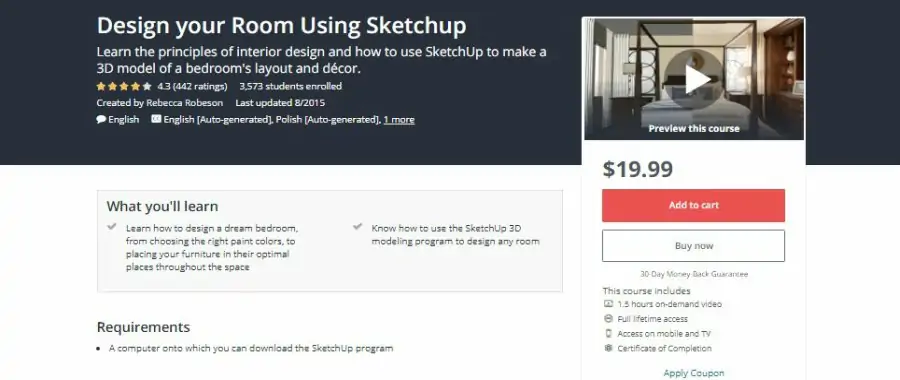
This introductory SketchUp course simplified the learning process for students. It only focuses on creating the perfect room instead of describing the entire modeling of a residential building.
Even so, the course goes over a few of the most popular tools of the software and how they are put into practice. It sets up navigation, it shows students how to use these tools. Building walls and a room is presented in a separate interior design lesson.
After the room is built, students are taken over a few decoration tips. They learn how to add lighting, colors, windows, and floors. These lessons are useful in bringing the room to life. A few technical skills are mastered at the end of the course. Flooring and window measurements are covered from this perspective. A final assignment concludes the course.
- Based on a short 1.5-hour presentation
- Allows lifetime course access through Udemy
- Teaches students how to model a room from scratch
- Offers a certificate of completion
- Includes a final assignment
- Presented by Rebeca Robeson, an interior designer, and YouTuber
9. SketchUp to LayOut (Udemy)
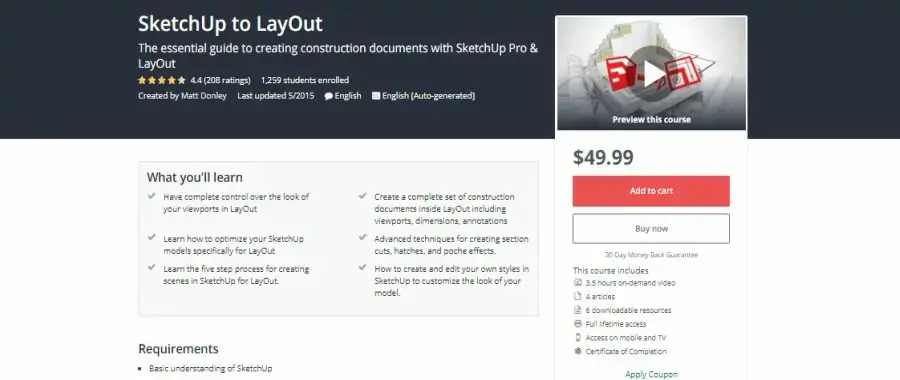
With 3.5 hours of video presentations, the course represents one of the options students and future architects have to master SketchUp. Using LayOut, it offers a better perspective mastering viewpoint.
At the end of the course, students know how to specifically optimize models for LayOut. They learn this with simple step-by-step instructions. Students also learn how to create a complete set of documents inside the LayOut.
A few advanced techniques are covered as well. They include creating section cuts, hatches, and effects. It also teaches students how to create personal styles right inside SketchUp.
- Includes 16 modules with 61 lectures
- Presented by a uniquely-experienced carpenter
- Includes 6 downloadable learning resources
- Dedicates 30 minutes of learning on project reviews
- Presents advanced techniques such as using the SectionCutFace plugin
- Teaches students how to use annotations
10. Learning SketchUp Free (Lynda/ LinkedIn Learning)
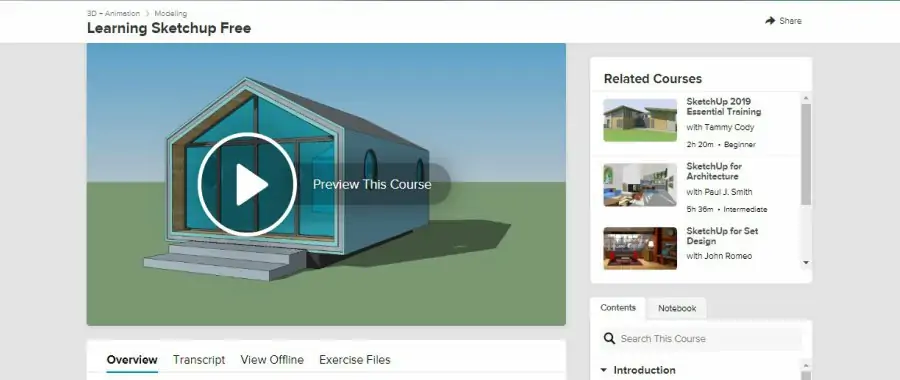
This course teaches students how to use SketchUp Free. This online-based software is a free version of the SketchUp pro and the presenter shows students the main differences between these two versions.
The program interface is presented logically so that students can make the most of it at any time. Drawing and working with basic components is described next. Manipulating objects in an organized way is another theme covered in the course.
Materials and textures are swiftly covered by this course. Furthermore, importing and exporting the final model is something students get to learn.
- Short course duration of 2 hours
- Presented by an animation director with clients such as Disney
- Sets up the basics of the free version of SketchUp
- Includes 7 modules with short lessons organized by topic
- Offers crucial tips on how to keep workflow organized
- Includes guidance on exercise and individual learning
11. SketchUp 101 (SketchUp for Interior Designers)

This beginner-orientated course takes 3D work back to basics. It teaches students how to download SketchUp and navigate its toolbar. A drawing module with 10 lessons is presented next.
This module is specifically interesting in learning basic geometry, push/pull principles, tape measuring, or editing groups. While the course is not as comprehensive as others, it aims to introduce beginner students to the world of SketchUp.
The guided learning is presented patiently by an interior designer. Based in California, Tammy has been designing for over 7 years and the tips on using SketchUp are rooted in her real-world experience.
- Teaches SketchUp with no previous experience required
- Offers a swift presentation of the navigation panel
- Presents basic drawing tools such as selection and the eraser tool
- Shows how to undo actions and start over
- Offers pointers on the axis alignment
- Allows enrolled students to complete the course at a personal pace
Visit Courses.sketchupforinteriordesigners.com
Are Online SketchUp Courses Worth It?
Sketchup has been inspiring architects for years. The two versions of the software include a downloadable option as well as an online-based option. But it can seem complicated to start using such complex software.
Future or current architects can always benefit from learning more about their 3D modeling. This is the main reason why SketchUp courses, classes, and training are such a powerful resource. They offered guided learning and the perspective of mastering the software at a personal pace.
SketchUp course can cover specifics such as designing a simple room. But they can also go in-depth and teach students how to model an entire home with landscaping. The following courses approach SketchUp learning from various perspectives.
