
Learn How To Help People Find Their Path With 2024‘s Top 11 Best Online Life Coaching Courses

If you are seeking out the best online life coaching courses so you can help people reach their full potential, you’re in the right place!
In this guide, I have rounded up some of the top life coaching courses and certificates to get you accredited and helping clients to achieve their goals.
Keep reading to find which of these expert-led, highly-recommended courses will be the best fit for you! Let’s get started!
Top 11 Best Online Life Coaching Courses & Certificates 2024
1. Life Coaching Certificate Course (Beginner to Advanced) (Udemy)
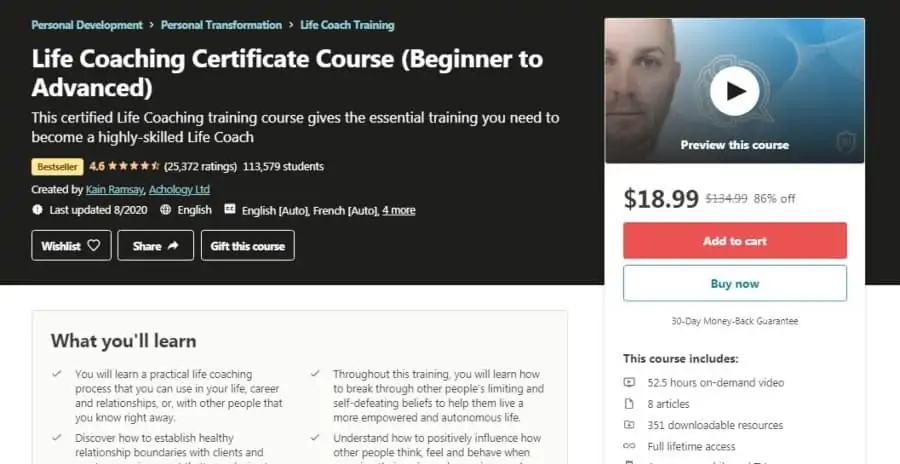
To become a certified life coach, you will need some specific training and education to allow yourself to pass the certification process, which is exactly what this course aims to achieve!
Students will be instructed by best-selling author and psychology tutor Kain Ramsay in conjunction with Achology Ltd from The Academy of Modern Applied Psychology. Between them, these two instructors bring decades of practical experience and have given almost 1 million students the skills to become certified in their fields.
In total, this comprehensive online course includes 52 ½ hours of on-demand videos designed to be accessed over a period of about 6-8 weeks, starting from beginner level and advancing all the way to higher-level learning.
Course modules are varied, spanning the basics of life coaching, emotional IQ, core beliefs, human behavior, communication skills, working with clients, business development, and a question and answer session.
In addition to preparing you for taking your certifications, this course includes lots of extra resources that can be downloaded, lifetime access to course materials, and a certificate of completion. Overall, this is a great all-level life coaching course taught by industry experts!
- Beginner to advanced level
- 52 ½ hours completed in 6 to 8 weeks
- Taught by psychology experts
- Preparation for professional certification
- Downloadable resources
- Certificate of completion
2. Life Mastery: Achieving Happiness and Success (LinkedIn Learning)
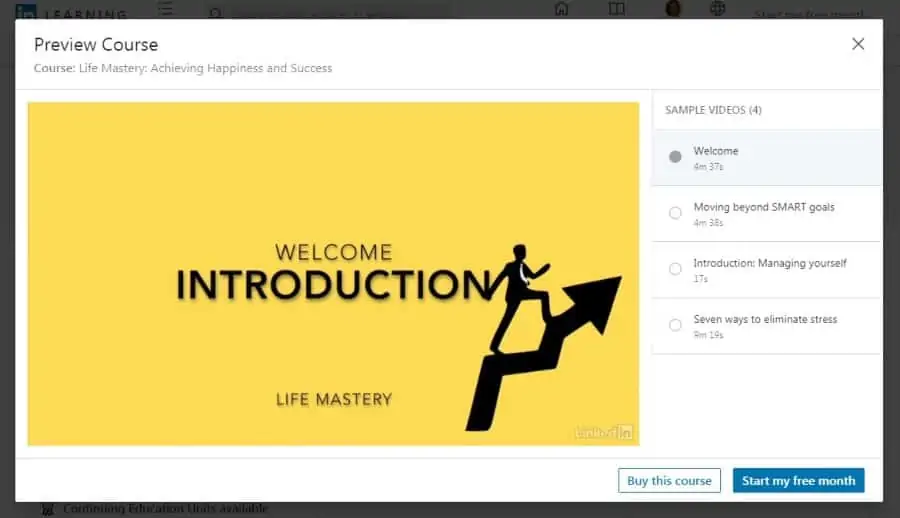
Next on my list is a great course that is designed to assist students to reach their life coaching goals and help others achieve their own success. Included in the class are some great practical tips, techniques, and skills that can be used in business or personal life.
Corporate management trainer and lecturer Chris Croft will be your instructor for this class who has trained over 6 million students on the LinkedIn Learning platform!
Included in the 3-hours of video lessons are topics on how to establish goals, deciding what’s important, managing yourself, getting organized, positive attitude, being assertive, influencing others, and making it all stick.
As with many courses from LinkedIn Learning, this course comes with continuing education credit, downloadable resources, and a certificate of completion.
- All levels
- 3 hours on-demand video
- Corporate trainer as an instructor
- Downloadable resources
- CPE credit
- Certificate of completion
3. Professional Life Coach Certification & Guide (Accredited) (Udemy)
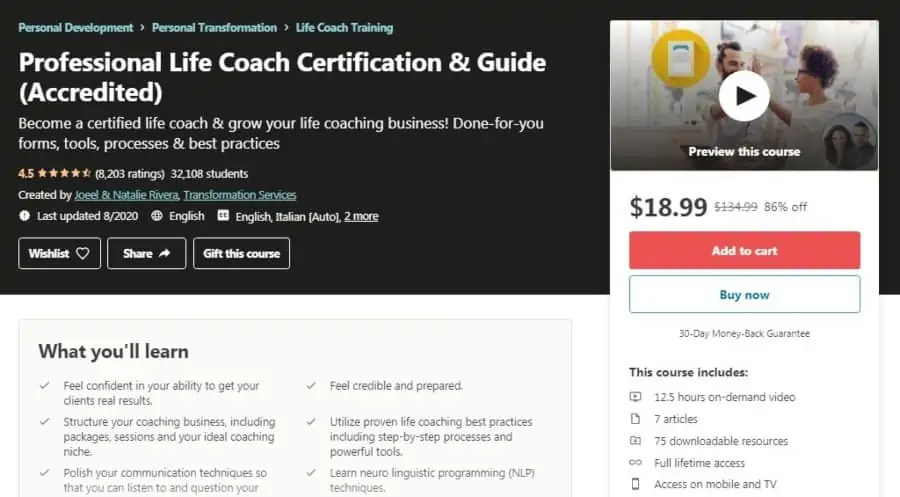
Transformation Academy provides students of this course with their own certification as a life coach and CPE credits so you can become a paid professional life coach after successfully completing this course.
Taught by Transformation Services lecturers from the International Academy of Life Coaching & Entrepreneurship, you’ll join the ranks of more than 300,000 program graduates worldwide.
Suitable for all levels, this course provides students with around 12 ½ hours of on-demand video with class modules covering self-awareness, communication techniques, setting goals, tools and techniques, neuro-linguistic programming, how to structure a life coaching business, best practices, and emotional quotient.
Being hosted on Udemy, students get access to all class materials, lifetime access to the course, and a printable certificate of completion at the end. Overall, one of the best online life coaching courses in 2024!
- All levels
- 12 ½ hours on-demand video
- Professional life coaches as trainers
- Professional certification from the school
- CPE credit
- Certificate of completion
4. Life Coach Certification Online (Inlp Center)
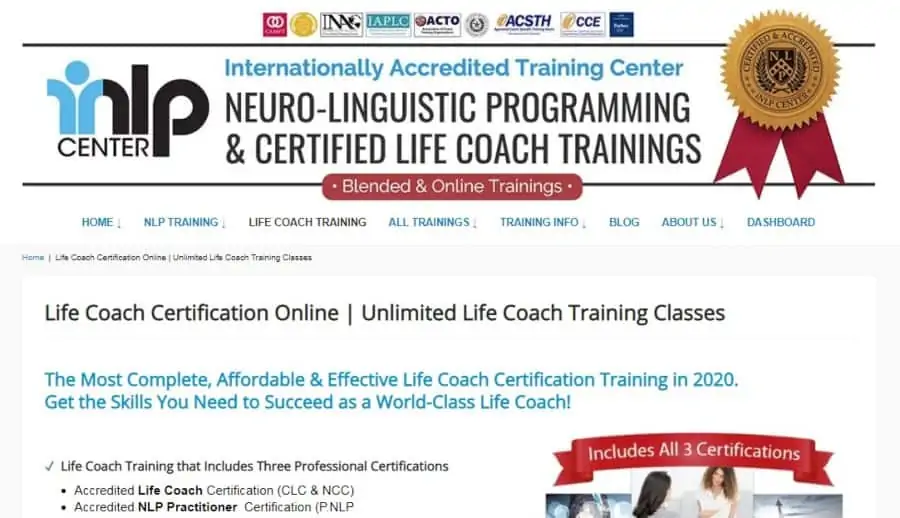
Take your life coaching to the next level through the INLP Center’s internationally-accredited training course on life coaching and neuro-linguistic programming, which is essential for understanding human behavior.
INLP offers various certifications so you can find the one best suited for you: Life Coach Certification (CLC & NCC), NLP Practitioner Certification (P.NLP), and NLP Master Certification (M.NLP), in addition to a course on marketing.
In over 150 hours of multi-disciplinary self-paced study combined with optional classroom interaction, students will be guided through modules on the structure of a life coaching session, information gathering, NLP application, communication, goal setting, integration, and the wrap-up phase of coaching.
After completing the course, you’ll be able to gain various different certifications for allowing you to practice professionally as a certified life coach or even an NLP Master!
- All levels
- 150 hours of self-paced study
- Taught by professional and master coaches
- Classroom modules available
- Certifications accredited worldwide
- Extra resources available
5. Life Purpose Life Coach Certification (Accredited) (Udemy)
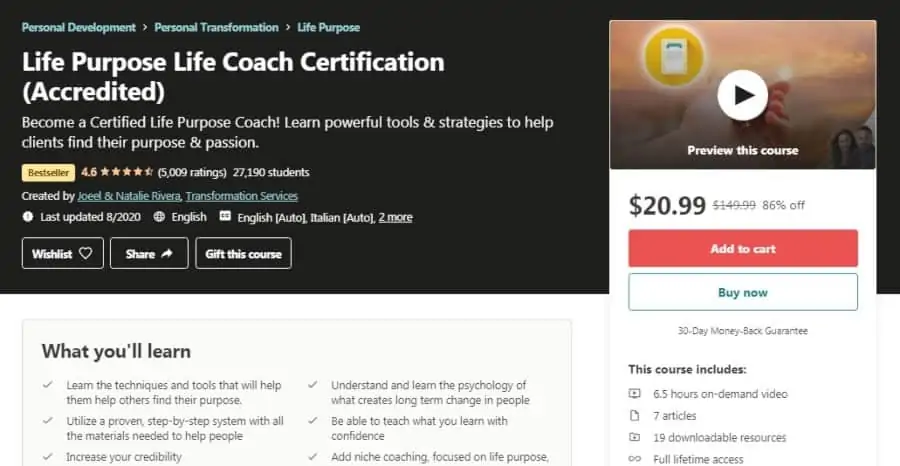
Next on my list is a fantastic online multi-disciplinary course that also provides students with an accredited certification from the Transformation Academy. Once completed, students should feel confident to get their life coaching practice off the ground and help clients find purpose in their lives.
For this course, you will be taught by experienced instructors from Transformation Services and the International Academy of Life Coaching & Entrepreneurship, and join their 300,000+ global graduates.
Throughout its 6 ½ hours of on-demand video, students will learn how to discover purpose, eliminating limiting beliefs, creating a manifesto, implementation, and how to request an official life coaching certification.
In addition to their own certification, this course includes downloadable resources, lifetime access, and a certificate of completion!
- All levels
- 6 ½ hours on-demand video
- Taught by accredited instructors
- Certification from the Academy
- Downloadable resources
- Certificate of completion
6. Designing The Life You Want: 4 Exercises for Clarity and Motivation (Skillshare)
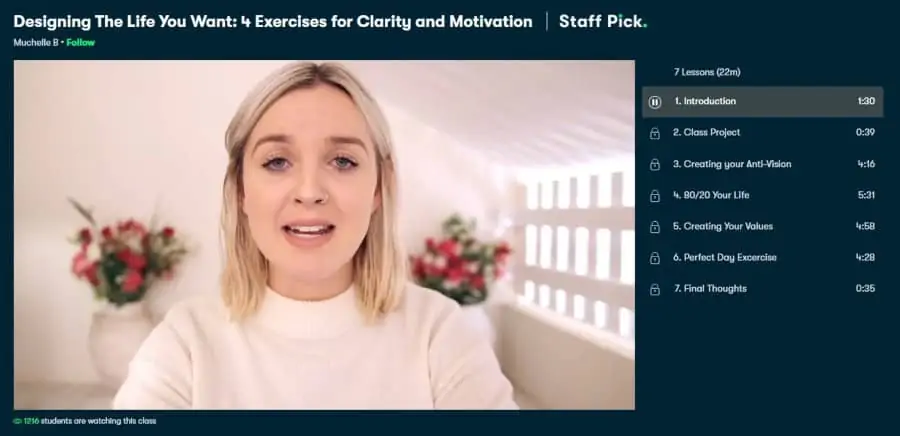
As a highly-rated staff pick from Skillshare, this course is just what you need if you’re seeking life coaching motivation from a qualified teacher.
Michelle B is your instructor for this online class who has the motivational skills necessary to lift you up and get you back on track to achieving your goals.
In this bite-sized half-hour on-demand video class, you’ll cover topics including anti-vision, creating values, the 80/20 split, day mind-training exercises, and work on a collaborative class project.
Also included in this bite sizes class are workbooks, class projects, class discussion, a 1-month free trial, and access to 29,000+ other Skillshare classes!
- All levels
- ½ hour on-demand video
- Taught by expert motivator
- Class projects
- Class discussion
- Downloadable workbook
Activate FREE Skillshare Trial
7. Life Coach Training Course: Introduction to Life Coaching (Udemy)
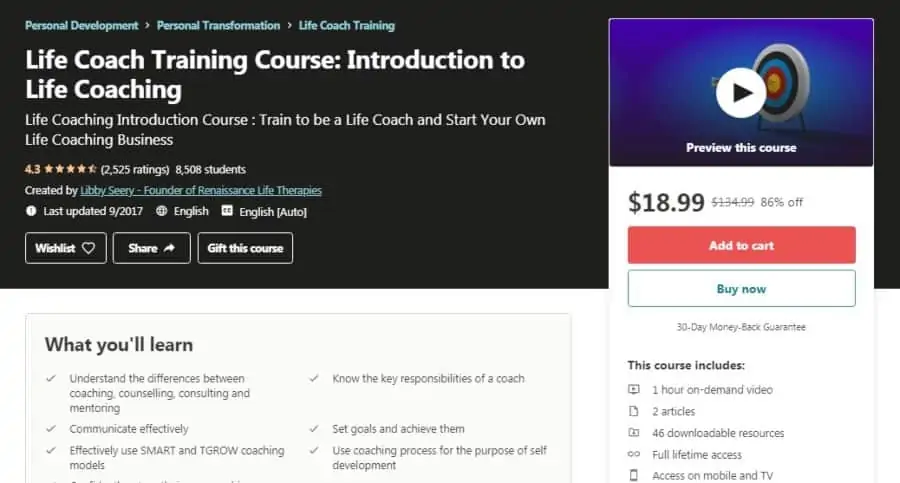
Offering a life coaching certification, this online course equips students with the fundamentals needed to start a life coaching career. You will also be joining 8,000+ other students who have already completed this highly rated course!
Your instructor will be Libby Seery, founder of Renaissance Life Therapies, psychotherapist, and noted author of psychology and self-help literature.
In one compact hour of on-demand video, students are guided through modules covering the basics of life coaching, coaching models, communication, assertiveness, administration of the business, and tons more!
Beginner level instruction is provided, as are downloadable resources, lifetime access, and a certificate of completion. After completion of this course, you will be able to decide to proceed further and get your own life coaching certification.
- Beginner level
- 1-hour on-demand video
- Taught by a psychotherapist
- Part of a larger series of courses for certification
- Downloadable resources
- Certificate of completion
8. Applied Positive Psychology Coaching (APPC) Skills Certification (The Flourishing Center)
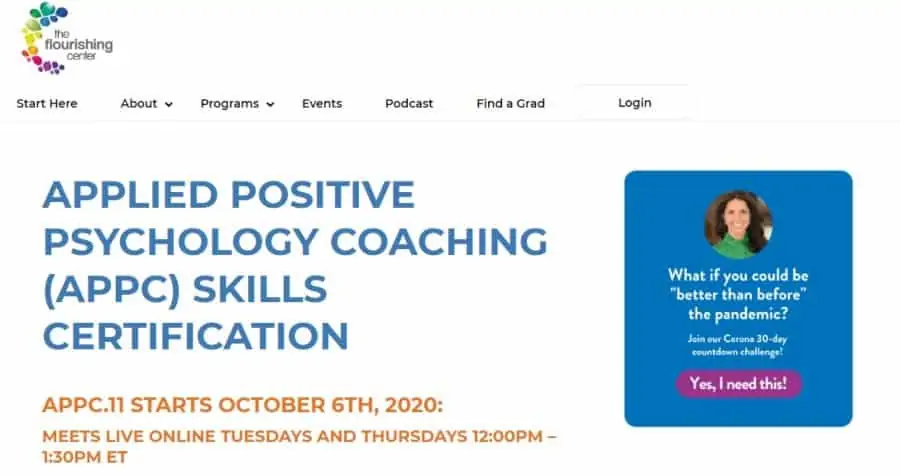
Part of a comprehensive series of certifications for life coaches and accredited applied psychology professionals, this intensive 20-week, 175-hour long training program will start your life coaching journey off on the right foot by becoming a fully certified coach.
Designed and taught by the Flourishing Center and their crew of certified coaches, trainers, and psychologists, students receive the benefit of multiple perspectives and decades of experience. The Flourishing Center is also approved by the American Psychological Association as a provider of continuing education for psychologists.
Over its 20 weeks, this course includes class modules covering coaching keys, agendas, business basics, consultation, code of ethics, and moving beyond the certification. Included in the course are extra resources, access to free quizzes and online activities, class discussions, class projects, and a certification.
As mentioned, this course is hosted by the Flourishing Centre and is a highly-recommended online course taught by industry experts to start you on your life coaching journey!
- All levels
- 17 hours over 20 weeks
- Taught by a team of coaches, trainers, and psychologists
- Access to free activities
- Downloadable resources
- Certification from the school
Visit Theflourishingcenter.com
9. Strategic Life Coaching Practitioner Cert (ACCREDITED) (Udemy)
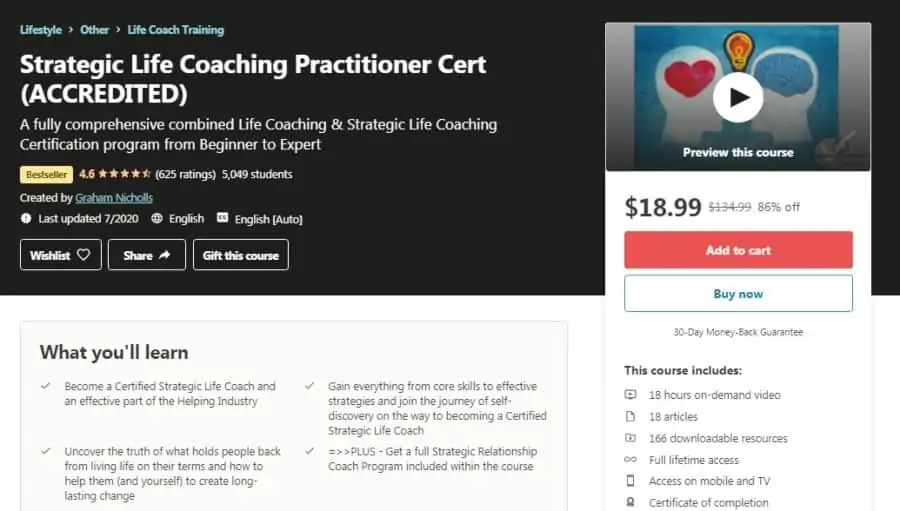
Next on my list is a comprehensive Strategic Life Coaching Certification course to take you from beginner to certified life coach in just 18 hours of self-paced on-demand video instruction!
Your expert instructor is a life coach trainer, author, and expert in human occupational psychotherapy, Graham Nicholls, who is also a best-selling author with over 15 years of experience as an accredited life coach instructor.
Modules included in this life coaching course include an introduction to strategic life coaching practitioner certification, core skills, aligning clients, behaviors, beliefs and limiting beliefs, behavioral needs, getting your business started, and questions and answers.
Udemy courses include lifetime access, downloadable resources, extra articles, and a certificate of completion, this course also enables you to apply for certification as an accredited life coach.
- All levels
- 18 hours on-demand video
- Taught by an experienced psychotherapist
- Downloadable resources
- Lifetime access
- Leads to life coaching certification
10. The Institute for Life Coach Training (Life Coach Training)
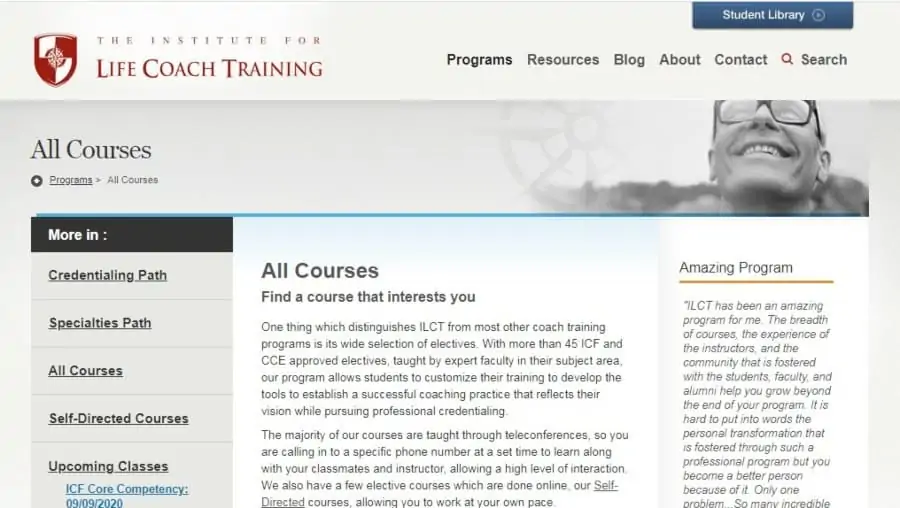
With a wide range of courses and certifications available, the Institute for Life Coaching Training allows students to tailor their learning to exactly the right type of life coach for their personal or professional needs.
Your course instructors are licensed life coaching professionals and accredited teachers with years of experience and rock-solid credentials. Whatever your life coaching approach, the Institute has the teachers and courses you need to hone your skills.
In this life coaching course, upcoming classes include ICF core competency, mentor coaching, Christian coaches, wellness inventory certification, money coaching, job search coaching, coaching ethics, executive coaching, dispute resolution, and grief counseling.
You can find this course over at Life Coach Training’s online learning platform, which gives all of their students downloadable resources, class projects, and certifications direct from the institute. Overall, a great course to get started as a life coach!
- All levels
- Multi week courses
- Taught by trained and certified professionals
- Multiple classes available
- Downloadable resources
- Certifications direct from the institute
11. Coach Training World (Coach Training World)
Keen to become a board-certified coach? Coach Training World has a variety of courses and tools you need to get trained and certified. At the end of your multi-week life coaching courses, you can become fully certified as a life coach!
All of your instructors are fully certified and accredited professionals themselves with years of practical experience for you to benefit from.
You will be guided through the certification process, including a coach training program, coaching experience hours, and the BCC (board-certified coach) application.
This online course is hosted by Coach Training World on their online class platform, giving you downloadable resources, class projects, practical experience, and certification as a life coach. For anyone at any level looking to become a life coach, this would be a good course to add to your repertoire.
For more lessons, check out my guide on NLP and CBT.
- All levels
- Multi week courses
- Taught by certified professionals
- Class projects
- Downloadable resources
- Coach certification application after the course
