
How To Think Clearly With The Top 11 Best Online Critical Thinking Courses & Classes [Free Guide]


Looking for a game-changer in the way you think about the world around you? Well, you’re exactly where you need to be to get started!
In this guide, I cover some of the best online critical thinking courses for developing your skills. With courses ranging from under an hour in length to 16-week programs, there’s something for everyone.
Also, all of these online courses will equip you with the tools and techniques you need to become a great critical thinker, so let’s get into them!
Top 11 Best Online Critical Thinking Courses & Classes 2024
1. How to Think Differently & Critically (Skillshare)
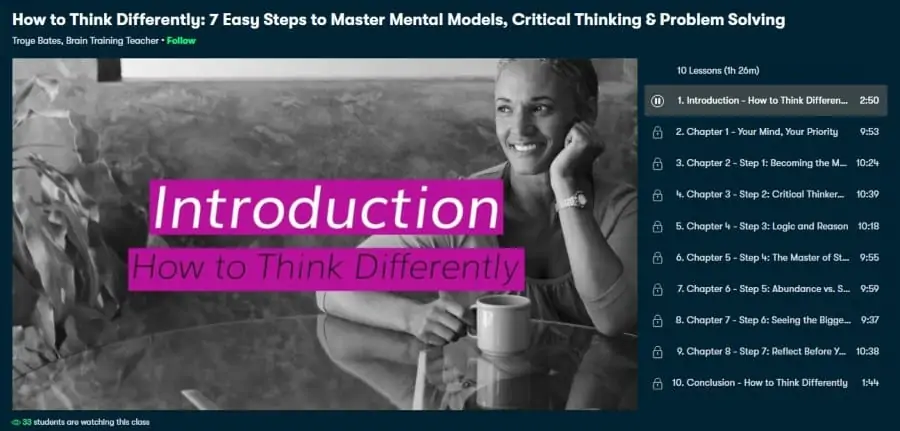
In 7 easy steps, this online critical thinking course, for beginners and advanced thinkers alike, will help you see the world differently by examining different perspectives and using logic and critical reasoning to expand your mind.
Troye Bates is your instructor for this course online class, who writes a popular online blog on brain-training, and began teaching several years ago, sparked by his passion for enhancing our mental capabilities.
Through the 7-step process, students learn how to become a mental master of critical thinking, logic, and reasoning, strategy, abundance, big-picture thinking, reflecting before they act, and tons more!
Global online learning platform Skillshare is where you will find this online course. There are over 29,000 other courses available on the platform and you even get a 1-month free trial! Overall, this is one of the best critical thinking classes you can find online!
- 10 video lessons
- 1 hour and 26 minutes of content
- 271 students have taken the course
- Suited to all levels
Activate FREE Skillshare Trial
2. Critical Thinking: How to Find Out What Really Works (Skillshare)
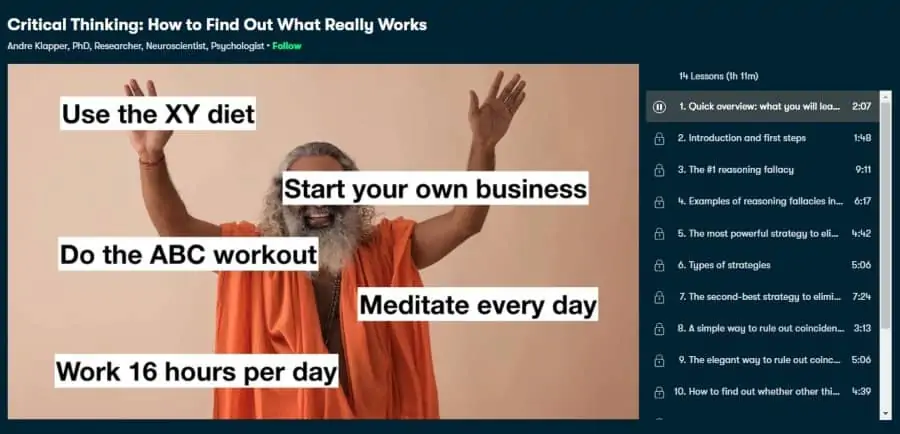
Keen to level-up your critical thinking skills at work, school, or in day-to-day life? Critical thinking is an essential life skill, and this online course teaches you key strategies to make better life decisions.
Andre Klapper, Ph.D., is your teacher, who is a researcher, psychologist, and neuroscientist with decades of experience in working with the mind and understanding cognitive processes. This is also 1 of 9 courses Andre currently has on Skillshare.
Spread across 14 lessons over 1-hour, students will learn the reasoning fallacy, everyday examples, how to eliminate alternative explanations, how to rule out coincidences, how to draw conclusions efficiently, the scientific thinking blueprint, and tons more!
Currently, you can find this online course hosted on the global online learning platform, Skillshare. There are over 29,000 other courses available on the platform, plus you get a 1-month free trial as a new user! Overall, this is a great introductory class to enroll in.
- 14 video lessons
- 1 hour and 11 minutes
- 211 students have taken the course
- Suited to beginners
Activate FREE Skillshare Trial
3. Welcome to critical thinking (LinkedIn Learning)
Learn how to make more thoughtful and effective decisions in every area of your life with this online critical-thinking course designed to challenge and expand your current level of thinking. Clocking in at an hour, this introductory critical thinking course is just the right length to get some learning in on your commute or while out for a run!
Leading this online course is Mike Figliuolo, the Managing Director of Thought LEADERS LLC, and an author at LinkedIn Learning. Mike is also a nationally renowned speaker, blogger, author, and teacher.
Throughout the course’s one-hour running time, students explore a series of techniques to assist with developing critical thinking skills by sharing how to redefine problems and use specific strategies such as the ‘5 Whys’, the ‘7 So Whats’, and the 80/20 rule.
You can find this online critical thinking course hosted on LinkedIn Learning, offering over 150,000 courses on a range of topics, all available to students worldwide! The expert teaching and quality content make this a not-to-miss online course!
- Approx. 1 hour of content
- Downloadable on Apple and GooglePlay for offline learning
- 312,745 people have viewed the course
- Suited to all levels
4. Critical Thinking In The Workplace (Skillshare)
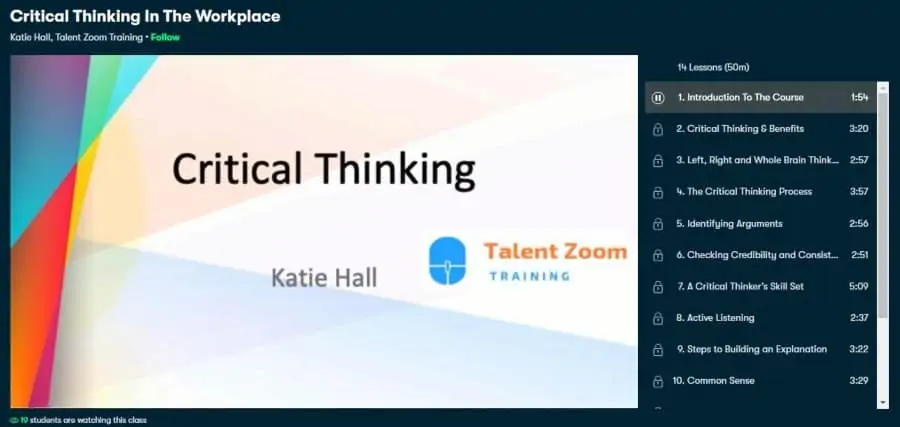
Next up on my list is a critical-thinking course designed specifically for the workplace. Whether you’re looking to enhance your own skills, or you’re a manager or CEO aiming to increase staff productivity, this short 50-minute course is highly recommended.
Katie Hall is your instructor, a representative of Talent Zoom, which is a company that helps businesses identify their unique workplace talents. Katie also has 3 courses on Skillshare and is dedicated to helping people succeed in their professional lives.
Some of the many topics covered in this online critical thinking course include the foundations of critical thinking, as well as understanding left, right, whole-brain thinking, consistency of ideas, building an explanation, active listening, and tons more!
For those interested, this online course is hosted on the global online learning platform, Skillshare. There are over 29,000 other courses available on the platform, plus a 1-month free trial! Overall, this is one of the best online critical thinking classes out there!
- 14 video lessons
- 50 minutes of content
- 429 students have taken the course
- Suited to all levels
- 2 downloadable resources
Activate FREE Skillshare Trial
5. Critical Thinking for Better Judgment and Decision-Making (Skillshare)
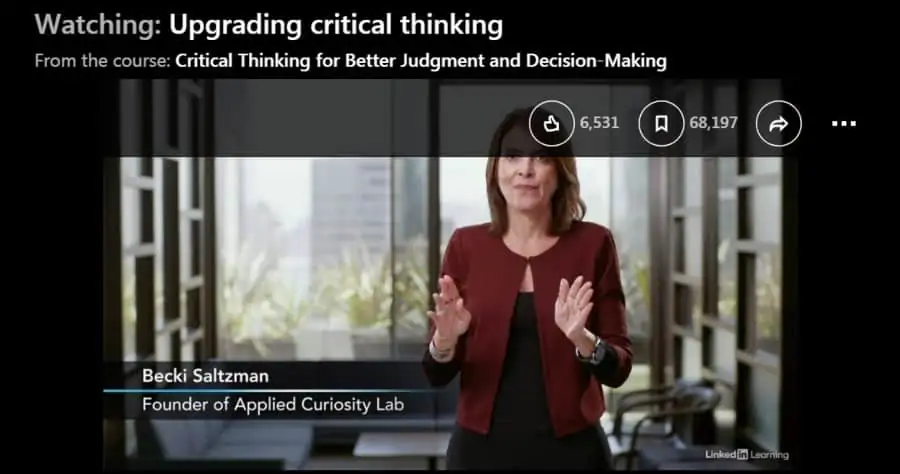
Did you know that having solid critical-thinking skills leads to better decision-making and a higher quality of life as a result? This online course empowers you to make the right decisions for your life by teaching you objective and rational analysis techniques to apply to any situation you might find yourself in.
Taught by Becki Saltzman, this class is expertly led in short-format video lectures. Becki is an author, speaker, and founder of the Applied Curiosity Lab. She is focused on teaching skills to companies to improve their operations, and how their teams innovate, tackle challenges, and respond to change.
Each module of this critical thinking course covers topics such as the foundational aspect of critical thinking, how to minimize bad judgment, improving vision quality, and creating a culture of curiosity.
Hosted on LinkedIn Learning, you can access this course and then choose from more than 150,000 others taught by industry experts once you’ve completed it! Definitely a recommended short class that you can access from anywhere.
- Approx. 55 minutes of content
- Downloadable on Apple and GooglePlay for offline learning
- 78,641 people have viewed the course
- Suited to advanced level
Activate FREE Skillshare Trial
6. Master Cognitive Biases and Improve Your Critical Thinking (Udemy)
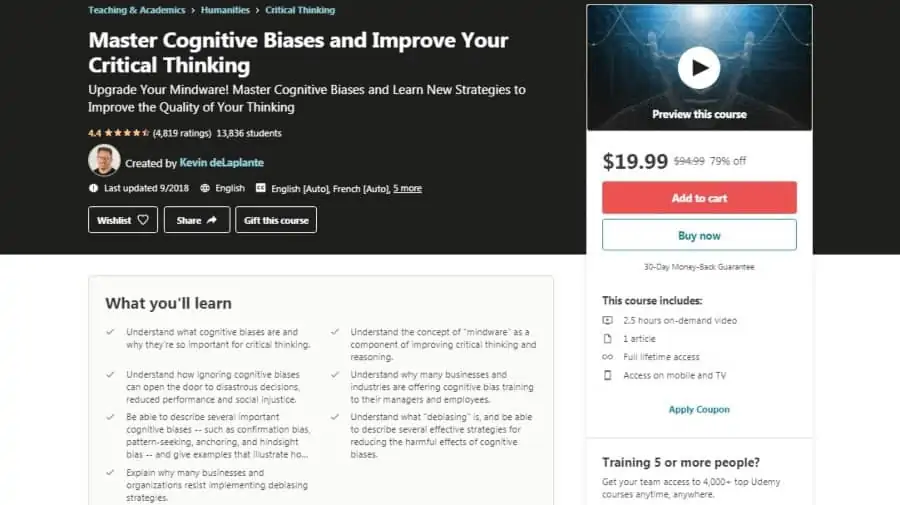
My next standout pick is an online critical-thinking course to fast-track your mental upgrade. Master your understanding of cognitive biases and learn the most effective strategies to improve the quality of your thinking in just under 2.5 hours!
Kevin DeLaplante Ph.D. is your course instructor, who is a philosopher and the founder of the Critical Thinker Academy. Kevin has taught more than 62,000 students in his 4 online courses on Udemy and works with groups, universities, and in 1-1 coaching for improving critical thinking.
In over 50 von-demand video lectures, students are guided through an explanation of cognitive bias is and how it relates to critical thinking. Lessons include confirmation bias, pattern-seeking, hindsight bias, and the anchoring effect, ending with some helpful strategies for debasing ideas.
Udemy is where you can access this critical thinking course, a great online course platform that offers its students over 150,000 on-demand online courses from beginner to advanced level!
- 50 video lectures
- 2 hours and 26 minutes of content
- Lifetime access
- Certificate of Completion
- 4.4/5 from 4,812 ratings
- 13,803 students have taken the course
7. Teaching Critical Thinking through Art with the National Gallery of Art (edX)
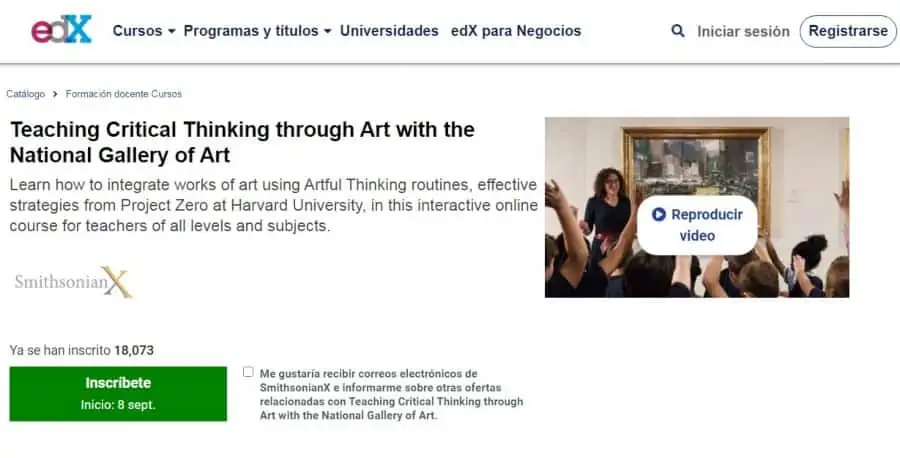
Are you an artist or an art enthusiast? Next up is a specialist online course examining critical thinking through an artistic lens. You’ll learn how to strengthen your thinking and facilitate meaningful conversations by applying artistic critical-thinking techniques.
As for your instructor, this online critical thinking course is offered by The Smithsonian Institute with Julie Carmean, the Museum Educator and Coordinator of Professional Development at The National Gallery of Art in Washington, United States, as your leading you.
Through 4 content units, which will take up to 20 hours to complete via self-paced learning, students investigate thinking routines, observing and describing tactics, reasoning with evidence, and questioning and investigating, receiving downloadable artful thinking lesson plans as a bonus!
You can find this online critical thinking course can be found on the nonprofit education platform edX, founded by Harvard and MIT, and offering courses form the leading worldwide universities to more than 20 million students! This particular course is one of the best online critical thinking classes I’ve found.
- 18,073 students have enrolled
- Takes 16 weeks to complete
- 3-4 hours a week of work
- Self-paced
- Great for all levels
8. Master your Decision-Making, and Critical Thinking Skills (Udemy)
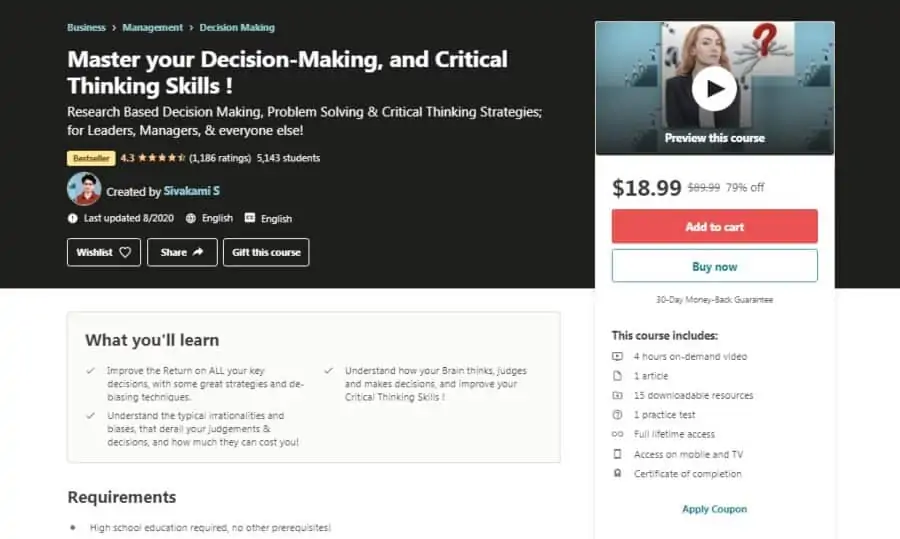
Are you looking for a comprehensive online course to improve your decision-making? You can work towards mastering good decision-making in this 4-hour online critical-thinking course that comes highly recommended with a 4.4/5 rating!
Your course instructor is Sivakami S, an experienced business leader and research/doctoral scholar who has taught over 20,000 students in his 12 online courses on Udemy. With nearly 2 decades of experience, she has led many initiatives in large corporations such as Verizon and Microsoft.
Spanning 45 video lectures presented in just over 4 hours, students learn how humans think, judge, and decide key cognitive biases, irrationality versus rationality, de-biasing techniques, logical fallacies, and so much more.
Head to Udemy to check this course out, a global online learning platform that offers more than 150,000 on-demand courses on a whole range of topics no matter your level! Overall, this online course is a great deep-dive into critical-thinking!.
- 45 video lectures
- 4 hours and 3 minutes of content
- 4.4/5 from 1,183 ratings
- 5,129 students have taken the course
- 15 downloadable resources
- Lifetime access
9. Philosophy and Critical Thinking (edX)
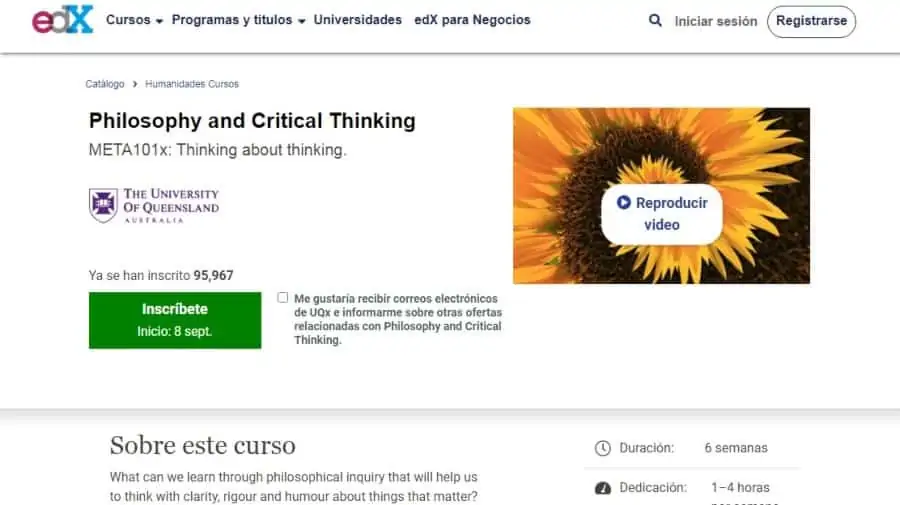
Another online critical thinking course that I’m excited to show you is a totally free, university-led offering for anyone who wants to improve their critical thinking skills. Over a period of 6 weeks, students learn how to use philosophical inquiry to improve your personal and professional decision-making.
Two instructors share the teaching of this online course, Professor Deborah Brown and Dr. Peter Ellerton, both lecturers and Directors of the University of Queensland Critical Thinking Project who
Students are led through critical thinking content that teaches them how to identify, analyze, and construct cogent arguments, and how to think of solutions to the central philosophical problems. There is also an option to add a verified certificate for an extra fee, for students looking for this proof of completion of the course.
edX hosts this online critical thinking course, offering more than 20 million students incredible access to online courses at leading universities across the globe. Plus, as a nonprofit, it’s totally free! Overall, a high-quality course for anyone wanting to develop critical thinking.
- 95,967 students have enrolled
- 6 weeks long
- 1-4 hours of work per week
- Self-paced
- Suited to all levels
10. Critical Thinking (Udemy)
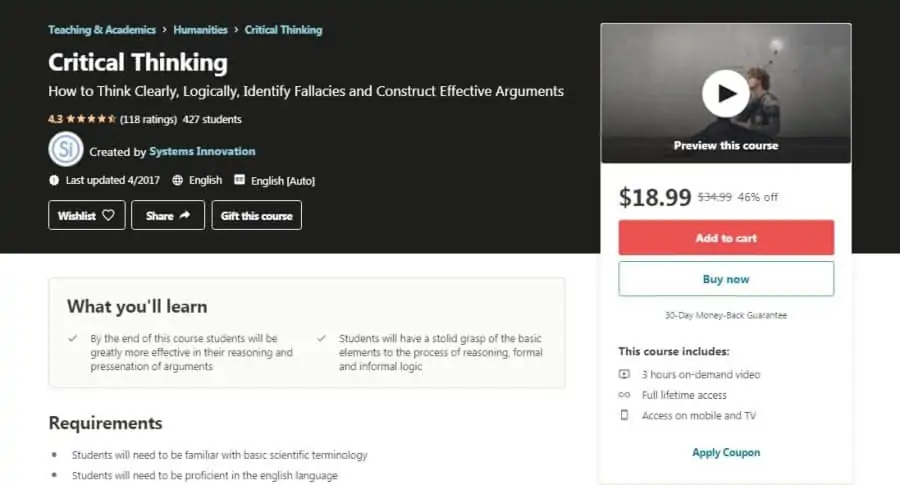
If you’re keen to study an online critical thinking course that’s both broad and detailed, this could be the one for you! In just 3 hours, you’ll have a greater grasp of logic and reasoning to apply to every area of your life.
Presented by Joss Colchester of Systems Innovation, an eLearning platform that is focused on complex systems and system change, this course is an entry into this subject. This course is led in an accessible way, making complex ideas feel easy to understand.
Joss takes students through course content covering cognition, including evolutionary psychology, as well as informal and formal logic examples and explanations, the different types of reasoning, the elements of reasoning, and argumentation rules and strategies.
One of the best online critical thinking courses around, you can find it on Udemy, which offers its students over 150,000 on-demand online courses on critical thinking and more, from beginner to advanced level!
- 21 video lectures
- 3 hours and 5 minutes of content
- Lifetime access
- 4.3/5 from 118 ratings
- 427 students have taken the course
11. Introduction to Critical Thinking (Udemy)
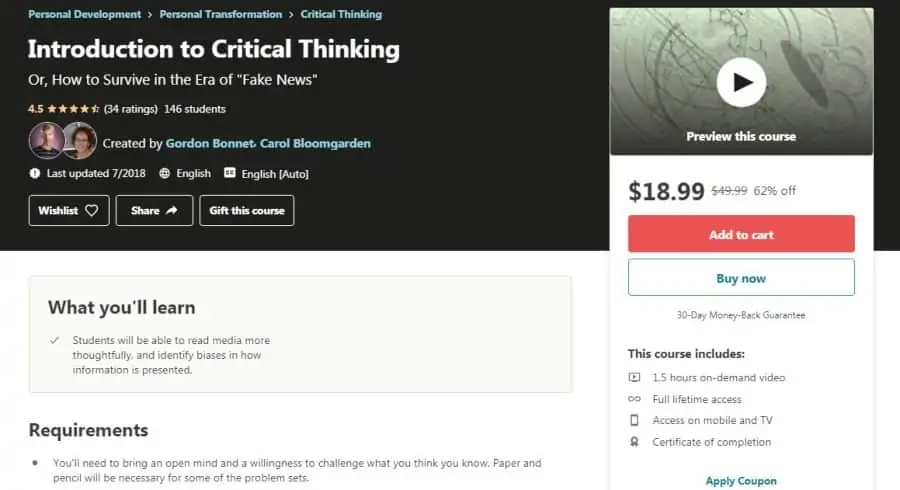
If you’re a critical-thinking newbie looking to get your decision-making off to a good start, this is a brilliant beginner’s course to help you process information and make thoughtful decisions.
Teaching duo Gorden Bonnet and Carol Bloomgarden are your instructors. Golden is the author of the blog Skeptophilio, which looks at science and media through a skeptical lens. He is also a novelist and teacher of critical thinking, and various other science topics. Carol is Gorden’s wife, and she is responsible for the video production and graphic design at Skeptophilia. They both lead this course with patience and passion.
Throughout 39 on-demand video lectures, students will explore the fundamentals of critical thinking, skepticism, learn how to recognize fallacies in the media, identify questionable statistics, construct arguments, and know when scientific terms are not being used correctly.
Udemy is where you will find this critical thinking hosted, a great online course platform which offers its students over 150,000 on-demand online courses from beginner to advanced level!
Udemy was founded in 2010 and has risen to the forefront of online learning in just a decade, to become the leader in skill-based and professional online education. To learn more, also check out my other posts on NLP and CBT!
- 39 video lectures
- 1 hour and 19 minutes of content
- Course: Introduction to Critical Thinking
- 4.5/5 from 34 ratings
- 46 students have taken the course
- Lifetime access
