
Learn How To Administer IT Networks With 2024‘s Top 11 Best Online Computer Networking Courses

If you’re looking to launch a career in IT or want to be the ‘mastermind’ behind all the computers in your organization, you’ve come to the right place!
After extensive research, I have compiled a list of the best online computer networking courses and certificates in 2024 that will teach you topics like network topologies, devices, IP addresses, and more!
With all of these online courses, you will also receive certificates of completion and will get the chance to learn from leading industry professionals. Let’s get started!
Top 11 Best Online Computer Networking Courses & Certificates 2024
1. Introduction to Computer Networks for Non-Techies (Udemy)
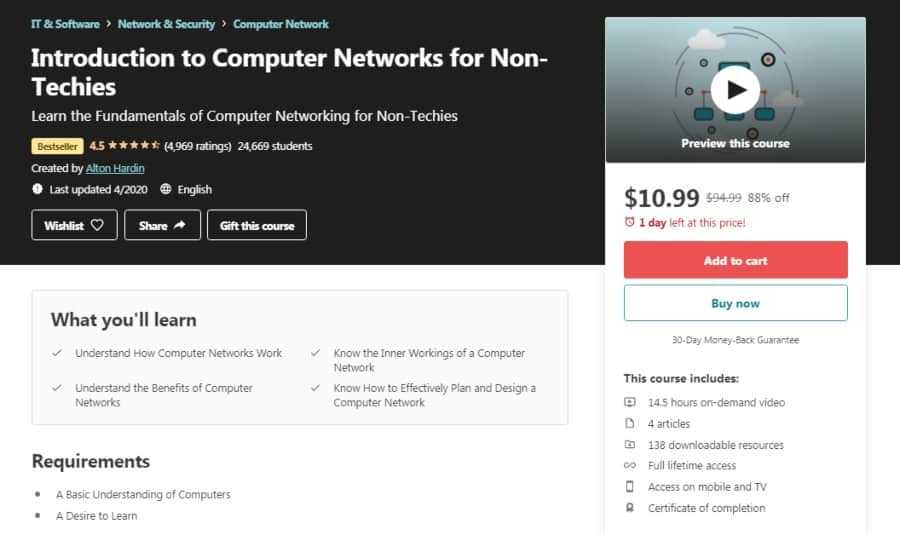
First on my list is a bestseller course on Udemy that is great for those who have zero knowledge about computer networks and want to learn all the fundamentals. With over 24,000 students enrolled and a rating of 4.5 stars, this course may help you launch a career in IT.
Your instructor for this online class will be Alton Hardin, an IT professional who has a Master’s degree in IT Network Management, along with numerous other IT-related certifications such as the CISSP and ITIL. So you’ll be in capable hands.
In this beginner-level 14 ½ hours long course, you will learn a wide range of computer networking topics including topologies, IP addressing and subnetting, wireless networking, network security, network planning/design, switches, routers, OSI, and TCP/IP models to name a few.
Currently, Udemy is giving full lifetime access to this course for a limited-time discount of 80% along with a certificate of completion! There are also 138 downloadable resources included! Overall, one of the best online computer networking courses!
- Beginner level
- 14 ½ hours long
- Taught by highly-rated IT professional
- Full lifetime access
- Limited-time discount of 80%
- Certificate of completion
2. Networking Foundations: Networking Basics (LinkedIn Learning)
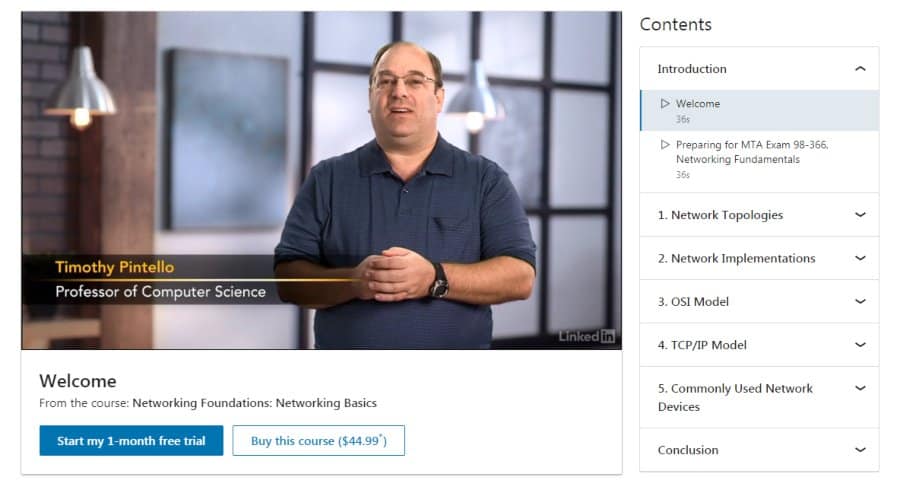
For those who want to spend a little time exploring the basics of Computer Networking before diving deep into the subject, this LinkedIn Learning course is a great introduction. While this is a beginner-level course, it has been taken by over 144,000 other students who were also considering their options with computer networks.
Timothy Pintello, an associate professor at the School of Computer Science of the Daytona State College will be teaching you in this online course. Timothy has years of experience working as an IT analyst/systems administrator and is the author of the book Introduction to Networking with Network+.
During 1 ¾ hour of learning in this course, you will be introduced to several basic topics such as mesh, bus, and ring topologies, client-server and peer-to-peer connections, differences between the internet, intranet, and extranet, traits of the TCP/IP protocol suite, and much more.
Students who complete this course will receive 3 Continuing Professional Education (CPE) credits along with a shareable certificate of completion! There is also a 1-month free trial to take advantage of.
- Beginner level
- 1 ¾ hour long
- Taught by expert IT professor
- 3 CPE credits
- Certificate of completion
3. Computer Networking by Georgia Tech (Udacity)
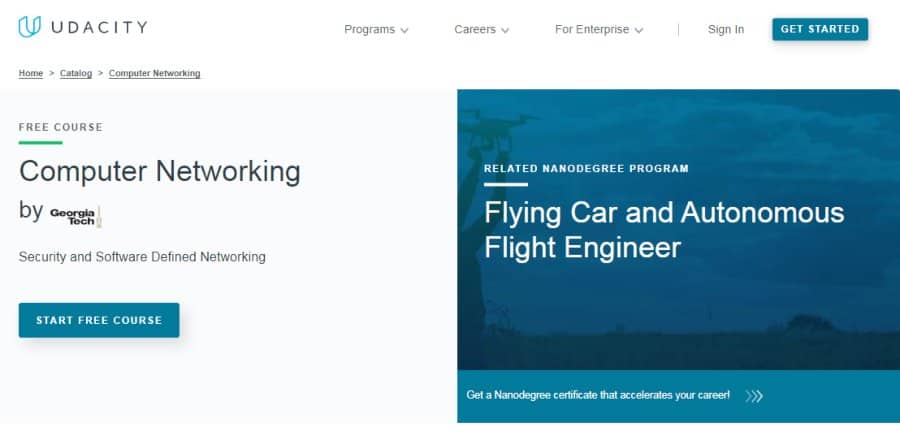
For those of you who understand computer networking basics and are looking for a structured dive into advanced topics, this intermediate-level course on Udacity is what you should go for. It will make you comfortable with topics like Software-Defined Networking (SDN) and Content Distribution.
Udacity will be providing you with instructors for this online computer networking course, including Nick Feamster, Neubauer Professor in the Department of Computer Science at the University of Chicago, and Joshua Valdez, a full-stack software engineer working at Gem.
In the 3 months that it will approximately take you to complete this intermediate-level course, you will learn about design principles, implementation, and objectives of a network, several routing algorithms such as distance vector and link-state, controlling resources and distributing content, dealing with SDNs, and much more.
You can take this course for free on Udacity, and learn at your own pace while learning from industry pros and through interactive quizzes!
- Intermediate level
- Approximately 3 months to complete
- Taught by experienced Udacity instructors
- Free enrollment
- Self-paced learning
USE CODE UPSKILL21 FOR AN EXTRA 50% OFF ANY OF THE NANODEGREE COURSES.
4. Computer Networks For Beginners | IT Networking Fundamentals (Skillshare)
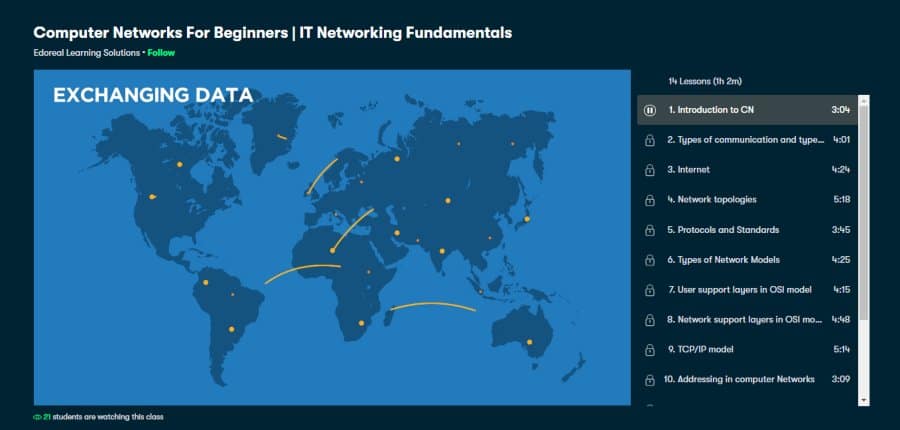
Next on my list is a short and digestible introduction to computer networks that are targeted towards beginners who want to dip their toes into networking. This may also be suitable if you have basic hardware knowledge and want to explore the field of IT to enhance your career prospects.
For this online course, you will be led by Edoreal Learning Solutions, which is a visual and social learning startup based out of India, that focuses on providing a world-class education to everyone. They also have a strong emphasis on delivering easy-to-understand and up-to-date industry trends.
In this beginner-level 1-hour course, you will be introduced to computer networks and taught about topics such as LANs and WANs, subnets, layers, and models, the OSI model, the TCP/IP protocol, multiplexing, fiber optic cables, and much more.
With Skillshare, you can benefit from a helpful student community and a free 1-month trial of Skillshare Premium to access hundreds of courses similar to this one! Overall, one of the best online computer networking courses for those who want a brief introduction to the topic.
- Beginner level
- 1 hour long
- Produced by education startup from India
- Helpful and active student community
- Free 1-month trial of Skillshare Premium
Activate FREE Skillshare Trial
5. The Bits and Bytes of Computer Networking (Coursera)
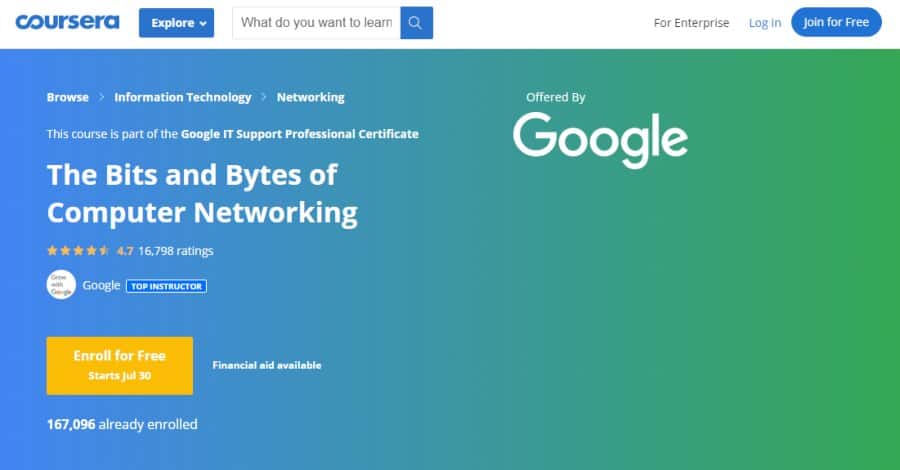
If you’re looking for an immersive learning experience in computer networking from one of the biggest companies in the world, this online course developed by Google can’t be missed. You will also be joining 164,000 other students who have already benefited from these lessons.
As for your instructors, you will be taught by some of the best experts from Google who have years of experience in computer networking. So for a course that is sure to stand out on a resume or CV, this is an unmissable opportunity.
Through this beginner-to-advanced course that spans 33 hours in total, you will be taught a broad range of topics including the five-layer model of computer networks, standard protocols involved with TCP/IP communications, useful troubleshooting tools, network services like DNS and DHCP, cloud computing, and much more.
Coursera is currently offering a 7-day free trial for this course where you can see whether it’s right for you. If you do decide to continue, there is also a verified certificate of completion at the end!
- Beginner-to-advanced level
- 33 hours long
- Taught by instructors from Google
- Financial aid available
- Certificate of completion
6. Computer Networks Security from Scratch to Advanced (Udemy)
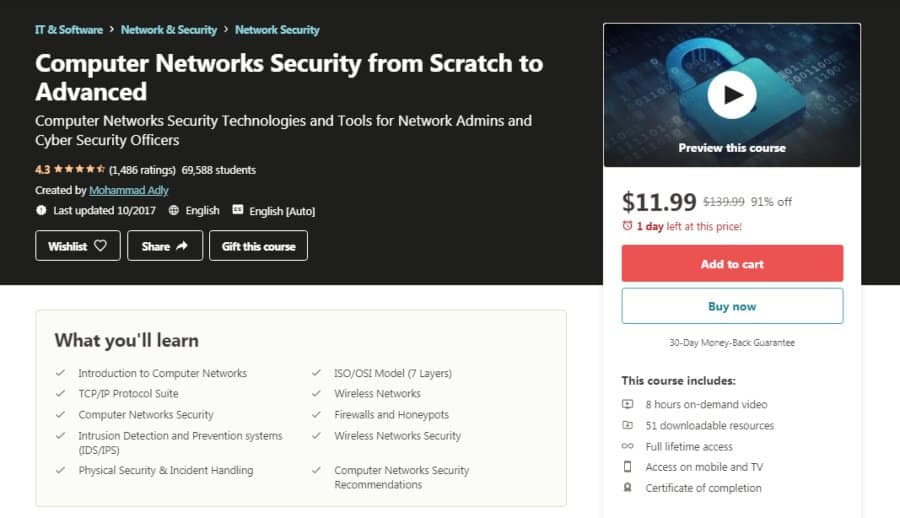
For those of you who are concerned about the security of computer networks in an organization, this beginner-level course will steer you in the right direction. Taken by over 69,000 students, it will enable you to add the essential skill of security administration to your CV and potentially bolster your career.
Your teacher for this online computer networking course will be Mohammad Adly, who has a Ph.D. in Computer Networks from Menoufiya University and has many research publications in reputed IT journals. Mohammad also has a 4.2-star rating on Udemy along with 93,000+ students.
In this 8 hour long course, you will be taught what is needed to become an IT security professional, with topics including TCP/IP Protocol suite, network security basics, Intrusion Detection and Prevention Systems (IDS/IPS), physical security, and incident handling, firewalls and honeypots, and much more!
Students can take advantage of a limited-time 84% discount offered on this course, along with a certificate of completion that they will receive at the end!
- Beginner level
- 8 hours long
- Taught by Computer Networks Ph.D.
- Limited-time 84% discount
- Certificate of completion
- Full lifetime access
7. Cisco Networking Foundations (LinkedIn Learning)
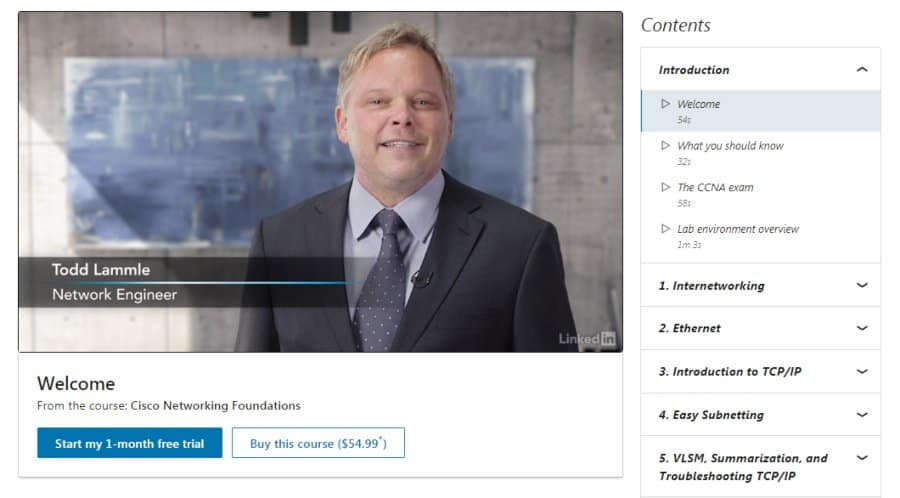
Cisco is a leading computer networks company that offers widely respected certifications. So If you’re looking to earn the CCENT (Cisco Certified Entry Networking Technician) certification to make your CV stand out, this LinkedIn Learning course is designed to help you achieve exactly that.
In this class, you will be instructed by Todd Lammle, a networking engineer with more than 30 years of experience in companies like Cisco and Toshiba. He also has all of Cisco’s certifications under his belt and is the author of CCNA: Cisco Certified Network Associate Study Guide.
In this intermediate-level 5 hours-long course, you will become acquainted with networking from the perspective of Cisco. This includes topics that cover Ethernet connections, frameworks, easy subnetting, Cisco IOS, Cisco networks and devices, IP routing, layer 2 switching, and IPv6 to name a few.
Not only will you receive a certificate of completion at the end of this course, but you will also be ready to appear for the CCENT exam! Overall, one of the best online computer networking courses taught by a Cisco certified engineer!
- Intermediate level
- 5 hours long
- Taught by Cisco-certified networking engineer
- Certificate of completion
- Free access for new LinkedIn users
8. IT Networking Fundamentals for Complete Beginners (Udemy)
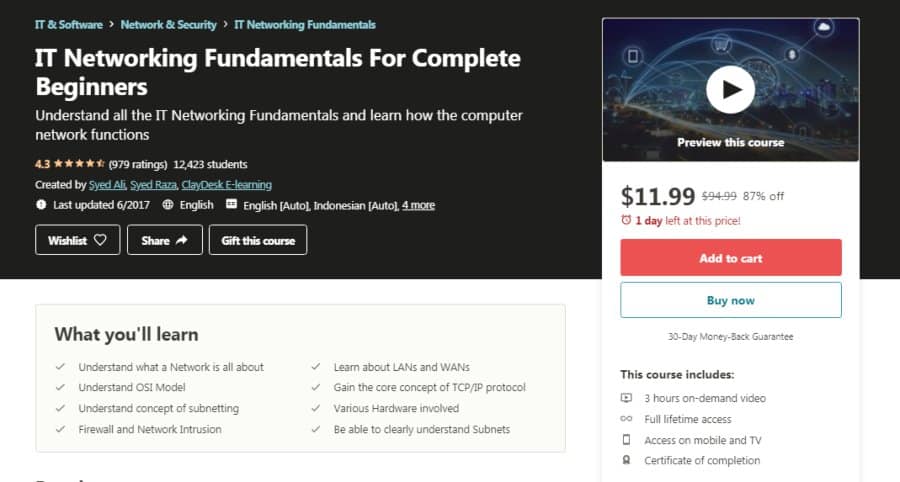
Up next on my list is an introduction to the fundamentals of IT networking on Udemy that has an average rating of 4.3 stars. This online course is the perfect choice for you if you want to get up to speed with the basics of IT and start building your career in this highly in-demand field.
You will have two instructors for this course: Syed Ali, who is a technology enthusiast with 4 Amazon Web Services certifications and over 270,000 students on Udemy; and Syed Raza, CEO of ClayDesk E-learning who has over 20 years of professional experience and over 349,000 students on Udemy.
Through this beginner-level 3 hour course, you will learn several networking basics including network architectures, OSI models, subnetting, firewall and network intrusion, client-server models, LANs and WANs, TCP/IP protocols, various hardware, and much more.
You can avail free web hosting offered by ClayDesk to students of this course for a full year, along with a certificate of completion offered by Udemy!
- Beginner level
- 3 hours long
- Taught by top Udemy instructors
- Free one-year web hosting service by ClayDesk
- Certificate of completion
- Full lifetime access
9. Computer Communications Specialization (Coursera)
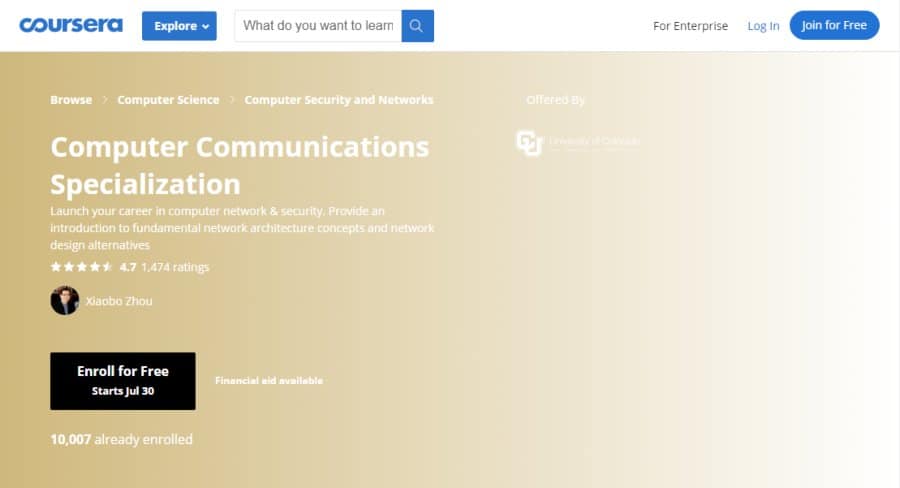
Brought to you by the University of Colorado, this specialization consists of 4 intensive computer communications courses on Coursera. These will turn you from a complete beginner in computer networks and communications into a career-ready professional who can proudly add this skill to his CV.
As for your instructor, you will be taught in this course by Xiaobo Zhou, who is a Professor of Computer Science at the University of Colorado, heads the Distributed, Sustainable, and Cloud Computing Systems (DISCO) lab, and has over 37,000 students on Coursera.
Through 5 months of intense learning in this intermediate-level specialization, you will take online courses that will teach you everything related to computer networks including architectures, design principles for protocols, programming skills in TCP/IP, asynchronous point-to-point links, more complex architectures, and much more.
With Coursera, you can benefit from flexible deadlines to learn at your own pace, apply for financial aid, and earn a certificate of completion at the end!
- Intermediate level
- Specialization consisting of 4 courses
- Approximately 5 months long with 3 effort hours per week
- Taught by Expert professor of computer networks
- Financial aid available
- Certificate of completion
10. Computer Fundamentals: Networking (Pluralsight)
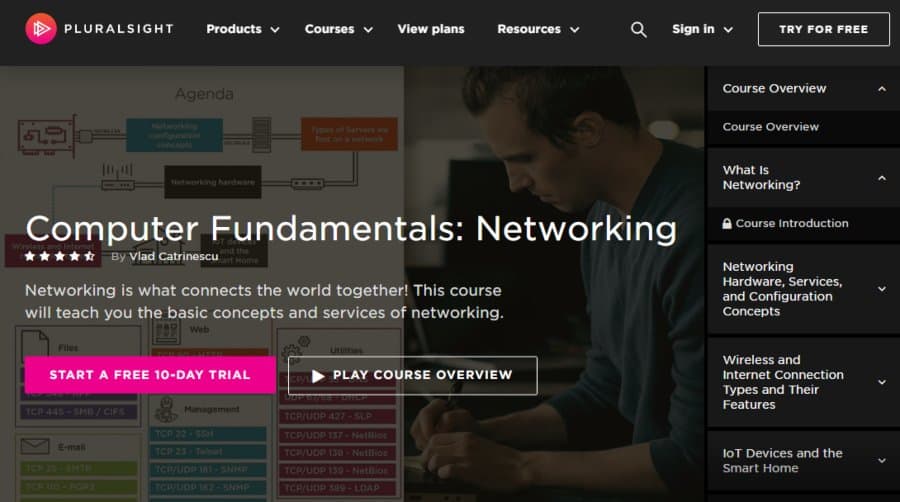
If you’re someone who needs to set up a simple home or small-office network of computers and connected devices, this Pluralsight course is the right fit for you. It will help you understand networking basics without going into extra, unnecessary topics that do not lead you to your goal.
You will be instructed in this online course by Vlad Catrinescu, a senior IT professional hand-vetted by Pluralsight for quality education and accurate information, who is a Microsoft Certified Trainer and recipient of Microsoft’s Most Valuable Professional (MVP) award.
In this beginner-level 2 ¼ hours long course, Vlad will teach you all the basic concepts of computer networking that will enable you to design and configure a network at home or in a small office, with topics including network architecture, hardware, types of network and internet connections, and much more.
You can benefit from a free trial offered by Pluralsight in which you can access hundreds of courses on the platform and learn from top industry professionals! Overall, one of the best online computer networking courses led by a Microsoft certified trainer.
For more information, you can also see my posts on Python and C++!
- Beginner level
- 2 ¼ hours long
- Taught by Microsoft Certified Trainer
- Learn to configure a home network
- Free trial by Pluralsight
11. Fundamentals of Computer Network Security – Specialization (Coursera)
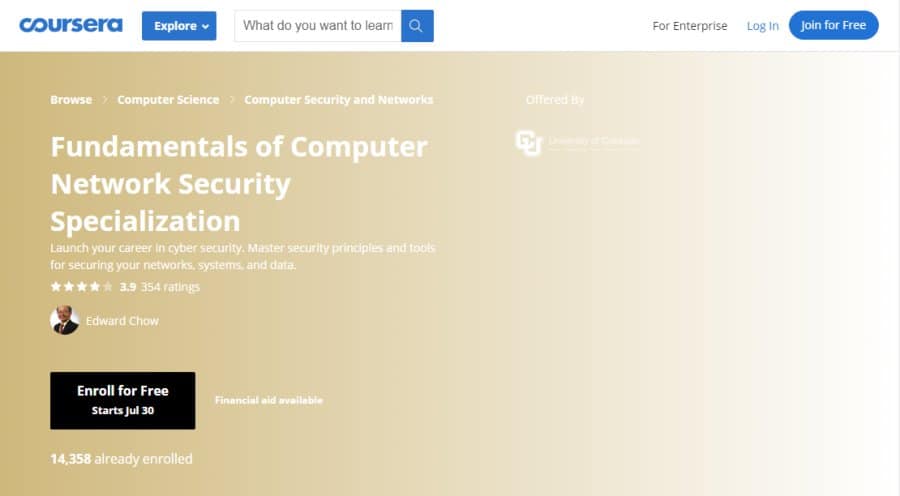
The final entry on my list is a specialization on Coursera consisting of 4 intermediate-level courses about computer network security. You should definitely try this out if you want to upgrade your skillset and move up the ladder by mastering network security design and implementation.
Dr. Chinghua Edward Chow, Professor of Computer Science at the University of Colorado, will be your instructor for this course. Dr. Chow has a Ph.D. in CS from the University of Texas at Austin and has published 8 courses on Coursera with over 55,000 students enrolled in them.
In the 4 months that it will take you to complete this specialization, you will go through some basic and advanced topics of network security including design and analysis of secure systems, basic cryptography and Crypto API, hacking and patching web applications, penetration testing, firewall and IDS, and much more.
Coursera offers you the option to apply for financial aid if you are unable to pay the full fees for the courses. You will also receive a certificate of completion at the end!
- Intermediate level
- Specialization consisting of 4 courses
- Approximately 4 months long with 4 effort hours per week
- Taught by veteran computer science professor
- Financial aid available
- Certificate of completion
