
Learn How To Code Well With 2024‘s Top 13 Best Online C++ Courses & Certificates
If you are looking for the best free online C++ courses in 2024, you’re in the right place!
In this guide, I cover a wide range of online C++ courses/ certificates that will teach you one of the most popular and in-demand programming languages in the industry.
Once you have a sound understanding of C++, this will enable you to start building games, software applications, operating systems, and databases by making use of algorithms, data structures, and object-oriented programming. Let’s get started!
Top 13+ Free Best Online C++ Courses & Certificates 2024
1. C++ Essential Training (LinkedIn Learning)
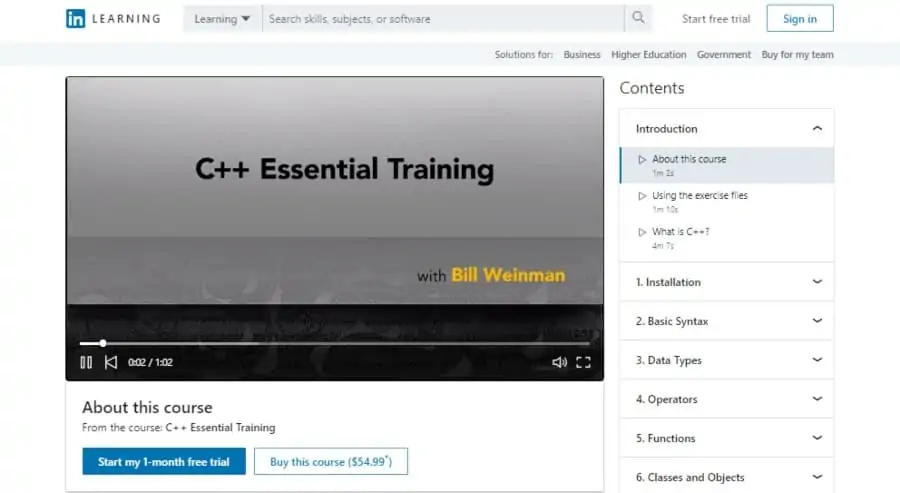
First on my list is an outstanding online course offered by LinkedIn Learning that is ideal for complete beginners, or even those with some previous experience in C++. You’ll also be joining 59,000 other students who have already taken this course and increased their C++ skills.
Your instructor for this course is Bill Weinman, who is an expert C++ programmer, entrepreneur, tech advocate, and has been teaching programming for decades. So if you are looking to learn from one of the best, this is an invaluable resource.
Through this 5 ½ hour-long course, Bill will reveal all the basics of C++ including statements and expressions, conditionals, variables, functions, loops, and then move on to much more advanced topics such as classes and objects, data structures, and using the Standard Template Library.
New students can take this LinkedIn Learning course for free when taking advantage of their 1-month free trial. Once complete, you will also receive a verified certificate of completion! Overall, this is one of the best online C++ courses!
- Beginner-to-intermediate
- 5 ½ hours long
- Veteran instructor
- Certificate of completion
- Free access for new users
- 59,000 students have completed this course
2. Become a C++ Developer (Udacity)
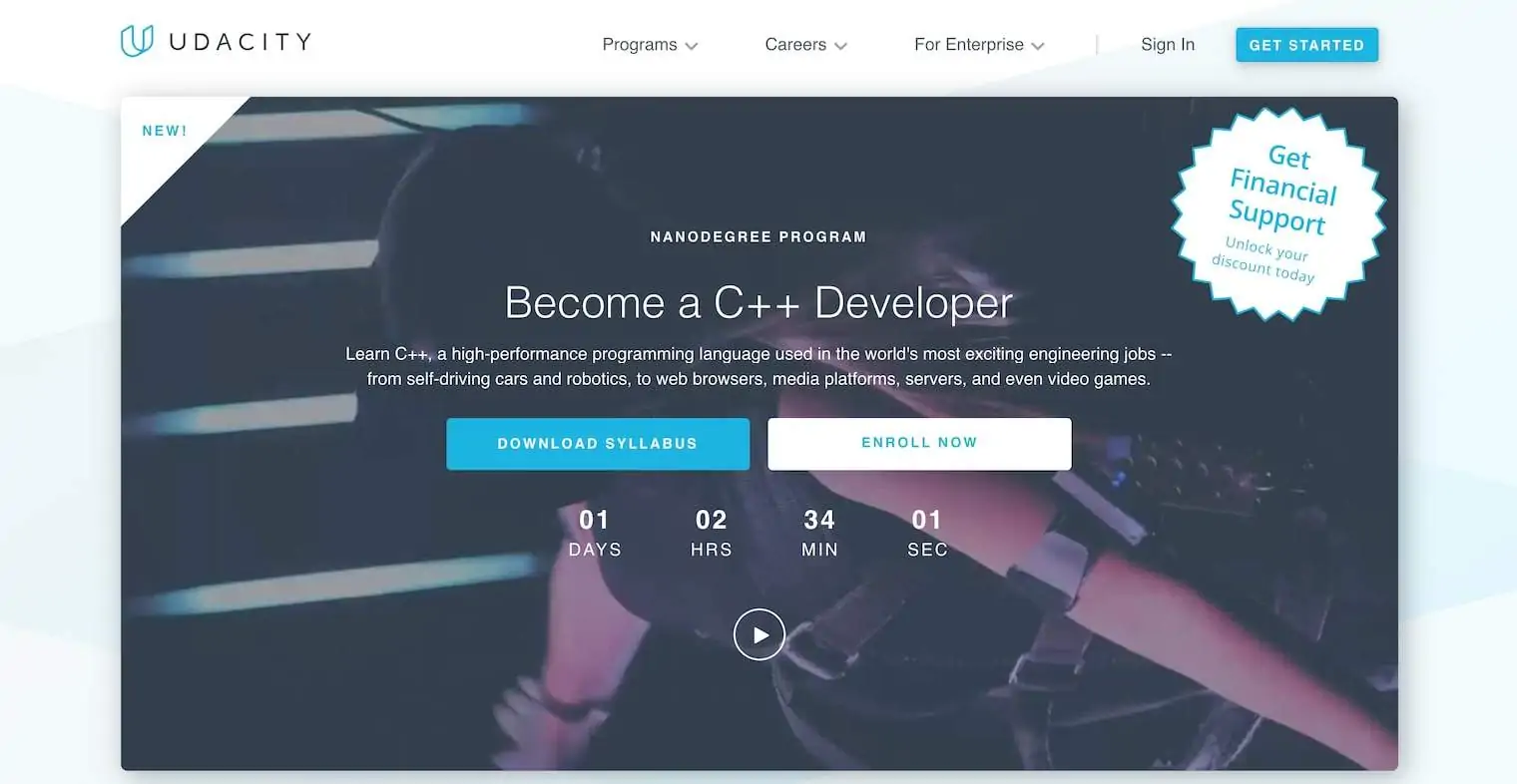
Next on my list of online C++ courses is Udacity’s nano-degree program which is best suited for those of you who know the basics of coding but want to acquire the skills to start doing high-performance programming – making video games, operating systems, robotics software, and coding self-driving cars. With an average rating of 4.5 stars, this program promises to deliver the highest quality.
You will be learning with some highly qualified programmers from Udacity: Stephen Welch, who has a Ph.D. in mathematics and is a C++ Content Developer; and Andreas Haja, who is a professor of engineering in Germany, and is enthusiastic about autonomous vehicles.
On average, it will take you about 4 months to get through this entirely online program which is comprised of 5 hands-on projects around which the curriculum is built. You will be learning all the skills needed to build a route planner, create a process monitor for your device, make a set of smart pointers, make an exciting traffic simulator, and finally build your own C++ application.
You can even benefit from personal career coaching services and technical mentor support from Udacity!
- Intermediate level
- 4 months to complete on average
- Highly qualified instructors
- 5 real-world projects
- Personal career coaching
- Technical mentor support
USE CODE UPSKILL21 FOR AN EXTRA 50% OFF ANY OF THE UDACITY NANODEGREE COURSES.
3. Learning C++ (LinkedIn Learning)
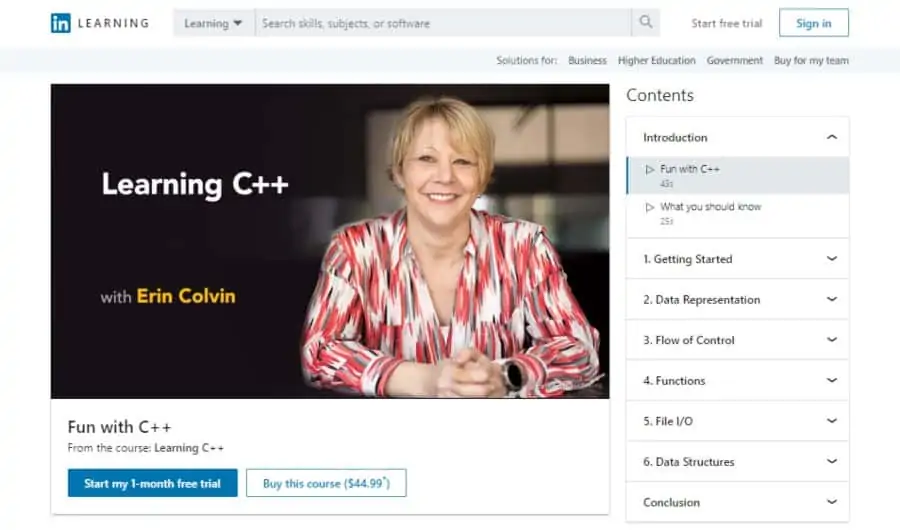
Next on my list is an introductory foundation course that covers the basics of C++ in an engaging and fun way. So if you are an aspiring programmer, or looking to make your own application, this course will give you the building blocks to do so.
Dr. Erin Colvin, who has a doctorate in Computer Science and works as Senior Software Engineer at MITRE, will be teaching you in this course. Dr. Colvin has also co-written a book about Information Retrieval using Fuzzy Logic and is a Certified Ethical Hacker.
Over the 2 ½ hours, you will be introduced to all the basics of C++ including setting up your coding environment, creating your first simple program, working with variables and arrays, managing flow control with conditionals and loops, defining functions, using data structures, and much more.
There are also many practice questions to consolidate your learning, along with a verified certificate of completion waiting for you at the end! Not to mention the 1-month free trial to take advantage of!
- Beginner level
- 2 ½ hours long
- Taught by Certified Ethical Hacker
- Certificate of completion
- Free access for new users
4. C++ Tutorial for Complete Beginners (Udemy)
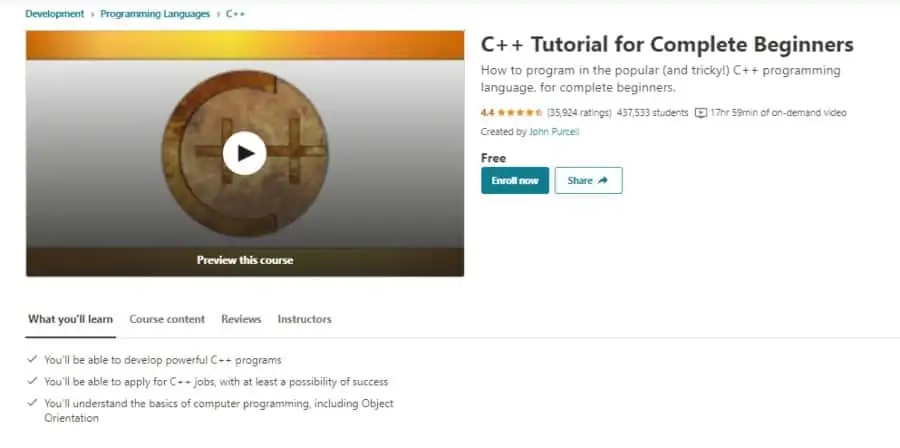
Next on my list is a comprehensive 18-hour beginner-level online course that covers the basics of the C++ programming language. With more than 435,000 students enrolled, this 4.4 star-rated course is among the most popular in the industry!
As for your instructor, you will be taught by John Purcell, a Software Development Trainer who has more than 14 years of experience working as a software developer for companies like AT&T. John also has more than 2 million students on Udemy and over 150,000 reviews.
During the 18 hours of this entry-level online class, you will start with setting up your IDE, learning the basic syntax, understanding subroutines, before going on to more advanced topics such as object-oriented programming, pointers and memory, inheritance, and much more.
Surprisingly, this C++ course is entirely free! However, if you want a certificate of completion, and engagement with the instructor, you will have to pay a small fee. Overall, this is one of the most in-depth and thorough online C++ courses!
If you are looking to get Udemy courses on sale all year round, you should check out my guide here on how to do that!
- Beginner level
- 18 hours long
- Taught by professional with 14+ years of experience
- Certificate of completion
- Q&A with instructor
5. Beginning C++ Programming – From Beginner to Beyond (Udemy)
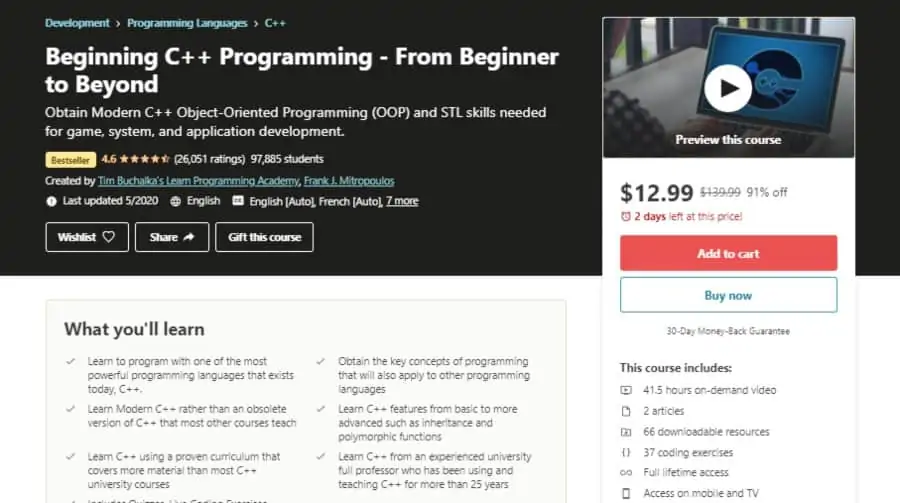
If you have the time, this 41 ½ C++ beginner-to-advanced Udemy course might be the perfect fit for you. In total, 97,000 students enrolled in this class and it has an average rating of 4.6 stars.
For this online C++ course, you will be instructed by Frank J. Mitropoulos, Ph.D., an experienced computer scientist and educator who has more than 30 years of experience practicing and teaching information technology and computer science. Motorola, IBM, and GE are also just a few names from the list of big companies in which he has taught professional seminars.
With a staggering 41 ½ hours of on-demand video lessons, this course will take you through a proven curriculum of C++ which includes everything from the basics including syntax, variables, loops, functions, and conditionals, all the way to more advanced topics such as STL and Object-Oriented Programming.
Udemy is offering a limited-time discount of 92% for this course which will give you full lifetime access to course materials, along with a certificate of completion, 37 coding exercises, 66 downloadable resources, and mobile viewing. Overall, this is one of the best online C++ courses that takes you from beginner to pro!
- Beginner-to-advanced
- 41 ½ hours long
- Instructor with 30+ years of experience
- Full lifetime access
- Limited time discount of 92%
- Certificate of completion
6. C++ for C Programmers, Part A (Coursera)
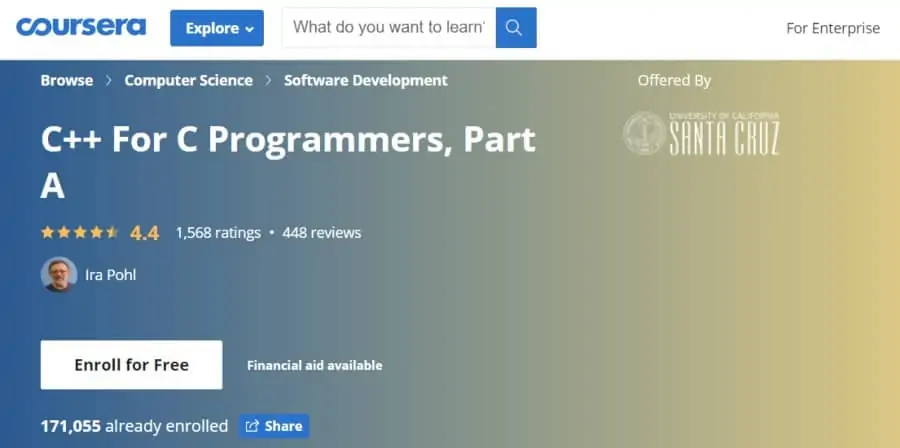
Many programmers who are already proficient in C are now noticing the value of learning C++ because of its wide usage. So if you are among that group and want to branch off and learn C++ also, this Coursera course is tailored to your needs. You will also be joining 171,000 other students who have completed this course.
Professor Ira Pohl of the University of California, Santa Cruz, will be taking you through this online course and acquainting you with the intricacies of C++. Professor Ira also teaches Computer Science and is a fellow of the Association for Computing Machinery (ACM).
As you work through the 16 hour-long course, you will learn about converting programs from C to C++, understanding C++ functions, generics, classes, object-oriented programming, dealing with constructors of various kinds, working with container classes, and much more.
Being hosted on Coursera, this course is run all year round, thanks to the nature of eLearning, and is completely free to enroll in. There is also a verified certificate from the University of Santa Cruz once completed.
- Advanced level
- 16 hours long
- Highly experienced Ph.D. instructor
- Financial aid available
- Certificate of completion
7. Advanced C++ (edX)
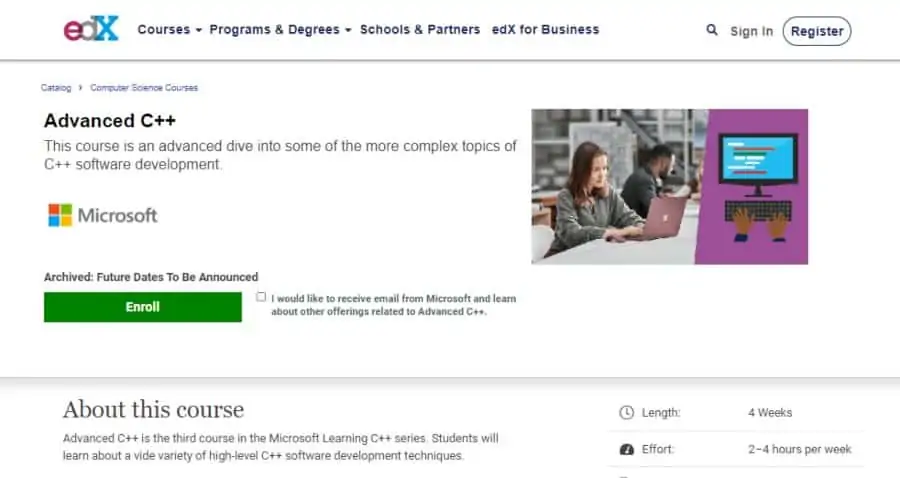
Moving onto my nick pick is Microsoft’s Learning series in Advanced C++, which is a comprehensive course perfectly suited for those who already have a strong understanding of OOP. So if you want to dive deeper into the more complex topics of C++ software development, this is a phenomenal starting point!
Your instructor for this online C++ course will be Adrian Leven, who is a content developer at Microsoft Learning and has a Computer Science degree from Stanford University.
You will be able to complete the course in 4 weeks with 4 effort hours per week and will learn all about advanced C++ mechanics, exceptions, object iterators, templates, classes, design patterns, and much more.
edX allows you to access the course contents for free, or pay a small fee to get a verified certificate of completion at the end!
- Advanced level
- Complete in 4 weeks with 4 effort hours/week
- Instructor from Microsoft
- Free access to course contents
- Certificate of completion
8. C++: From Beginner to Expert (Udemy)
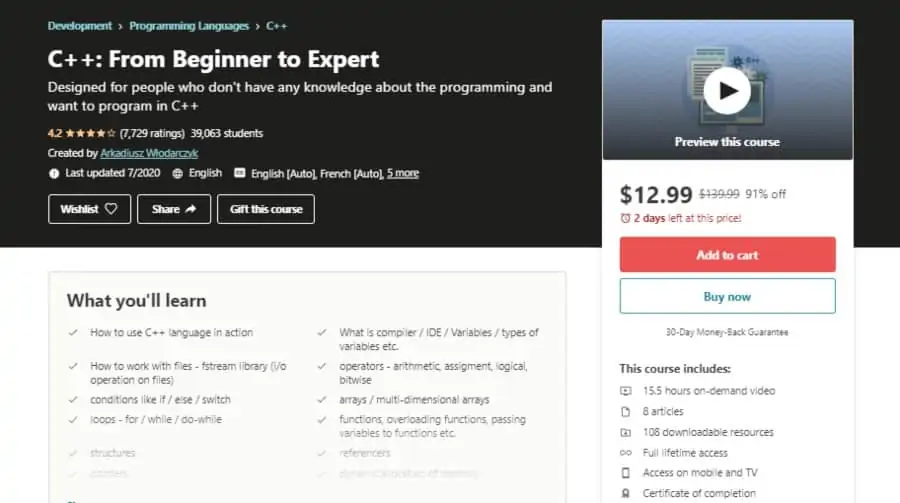
The next pick on my list is a C++ course on Udemy which is the right fit for you if you are looking to get deep into C++ programming while managing a tight schedule successfully. With almost 39,000 students enrolled, this course has an average rating of 4.3 stars.
As for your teacher, you will be instructed by Arkadiusz Włodarczyk, an expert in programming with over 10 years of experience. More than 230,000 students have taken his Udemy courses to date, and that is a testament to the quality of his teaching.
Through this 15 ½ hour-long beginner-to-intermediate level course, you will learn everything from working with conditionals, files, structures, loops, and functions, to more complex topics like pointers, exceptions, classes, STL, and much more.
You can grab this course at a 93% discount for a limited time and gain full lifetime access to it. You will also receive a certificate of completion! Overall, this is one of the best online C++ courses for those who want a comprehensive introduction to the topic.
- Beginner-to-intermediate
- 15 ½ hours long
- Instructor with 10+ years of experience
- Full lifetime access
- Limited-time 93% discount
- Certificate of completion
9. Level Up Your C++ Skills (Pluralsight)
For those in search of a one-stop-shop for C++ courses ranging from beginner to advanced-level courses all compiled in one place, this collection by Pluralsight is the place to head towards. With 18 courses on offer, you will find more than enough in this collection to make you into a C++ expert.
Instructors for these online courses are provided by Pluralsight itself, which chooses only the most expert professionals who know how to teach effectively to put up courses on the Pluralsight website. Rest assured, someone has already taken care that everything is of top quality.
With this collection that contains a hefty 59 hours of lesson videos, you will find courses that teach the fundamentals involving basic syntax, operators, variables, conditionals, loops, and functions. On the intermediate level, you can learn about exceptions, object-oriented programming, and STL. And on the advanced side, you will be able to deep dive into various design patterns to write beautiful code.
With Pluralsight, you can benefit from always being up to date with industry trends, and also avail yourself to a limited-time 33% discount on their annual and premium plans!
- Beginner/Intermediate/Advanced
- 18 courses comprising of 59 hours of content
- Industry experts and qualified instructors
- 33% discount on annual and premium plans
- Loads of hands-on practice
10. Learn C++ (Codecademy)
Do you find yourself thinking about what resources the employees of companies like Google, Facebook, and IBM would use to brush up their skills in a programming language such as C++? I have found the answer for you: they all go to Codecademy. If you want to join the league of 45,000,000+ learners and get a good grip on all the fundamentals of C++, this is where you should be heading.
Codecademy recruits educators who have a solid understanding of their craft and know how to communicate it effectively to a large audience, so you can be sure that this offering will give you learning of the highest quality. Sonny Li, Mariel Frank, and Jared Langel from the Codecademy team have collaborated to develop this course.
Working through 8 sections that contain up to 20 hours of content, you will learn and apply topics like variables, conditionals, logic, loops, vectors, functions, classes, objects, pointers, and much more. In short, everything that constitutes a strong foundation.
You’ll get the exciting opportunity to apply your skills to real-life projects that will help you understand the real-world applications of this powerful language!
- Beginner level
- 20 hours long
- Hand-vetted and experienced instructors
- Projects based on real life
- No prerequisites
11. C++ Design Patterns: Creational (LinkedIn Learning)
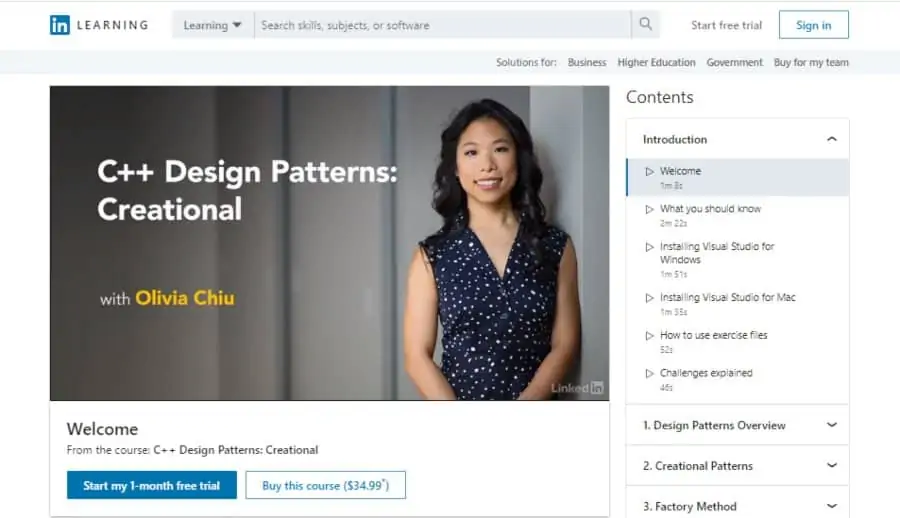
How you structure your C++ code when you are developing applications and software makes a difference in the efficiency and reliability of your products, and so if you have already learned to program in C++ but are looking for a guide on design patterns, this beginner-level free online course is for you.
Your instructor for this class will be Olivia Stone, a programmer, and engineer with a Bachelor’s degree from Queen University and a Master’s degree from McGill University. She has experience working at National Instruments as a developer for several years and has a passion for educating.
In this 2 ½ hour-long course, you will learn everything about creational design patterns in C++ including the basic concepts, running design patterns, implementing them, extending them, comparing various creational patterns, and much more.
With LinkedIn Learning, you’ll have the opportunity to earn a certificate of completion at the end and even access the course for free if you are a new user! Overall, this is one of the best online C++ courses with an included certificate of completion!
- Beginner level
- 2 ½ hours long
- Experienced instructor
- Certificate of completion
- Free access for new users
12. C++ Game Programming (LinkedIn Learning)
Everybody likes to play well-made games, but are you one of those who wants to get to the back-end and be able to build your own games from scratch? If so, this free online C++ course, which is the first in a two-part series, will help you through all the C++ skills you need to learn to start off on the journey of game development.
You will be taught by John Horton, who is a coding and gaming enthusiast and has written several technology books such as Beginning C++ Game Programming. He is also the founder of Game Code School that helps beginners start making games of their own.
In this 6 hour long beginner-level course on game programming in C++, you will learn all about creating the game loop, making decisions, moving game objects, pausing and restarting, adding sound effects, implementing the HUD, and much more.
So join over 59,000 students who are already enrolled in this course and get a certificate of completion at the end to showcase your newly acquired skills!
13. Object-Oriented Data Structures in C++ (Coursera)
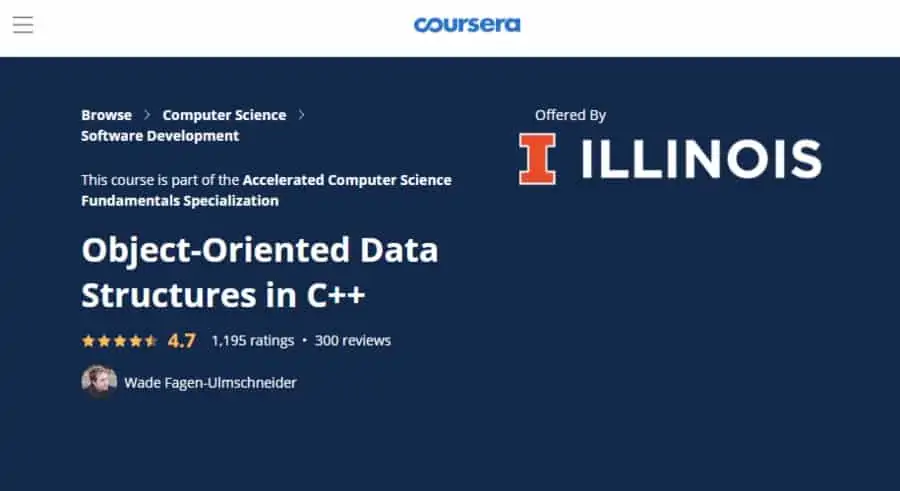
Knowing how to build complex and efficient data structures using C++ is a skill that will go a long way for your career, and so if you want to master this aspect of programming using C++, you should definitely check out this intermediate-level course that has an average rating of 4.7 stars.
In this free online C++ course, you will be instructed by Wade Fagen-Ulmschneider, a Teaching Assistant Professor at the University of Illinois at Urbana Champaign who received the Collins Award for Innovative Teaching in 2017 and has been teaching for the past 10 years.
Over the 21 hours it will take you to complete this course, you will learn how to write programs in C++, set up an environment for writing and debugging C++ code, implement data structures, and much more. This course is the first in a three-part accelerated program of computer science fundamentals.
You can further benefit from Coursera’s financial aid option and a certificate that you will receive at the end to share your achievements with your network! Overall, this is one of the top free online C++ courses taught by a highly sought-after university.
- Intermediate level
- 21 hours
- Accomplished instructor with 10+ years of teaching
- Certificate of completion
- Financial aid available
