
Learn How To Speak French With 2024‘s Top 12+ Free Best Online French Classes & Lessons

If you are seeking out the best online French classes and lessons, you’re in the right place!
Learning another language can be a daunting endeavor, but it doesn’t have to be when you have the right guidance.
Because of this, I have rounded up some of the top free French classes in 2024 that will help you to learn French in no time at all!
In this guide, I have included courses that are ideal for beginners, have video/ audio lessons, workbooks, projects, and are completely free! Let’s begin!
Top 12 Free Best Online French Classes & Lessons 2024
1. 3 Minute French | Language lessons for beginners (Skillshare)
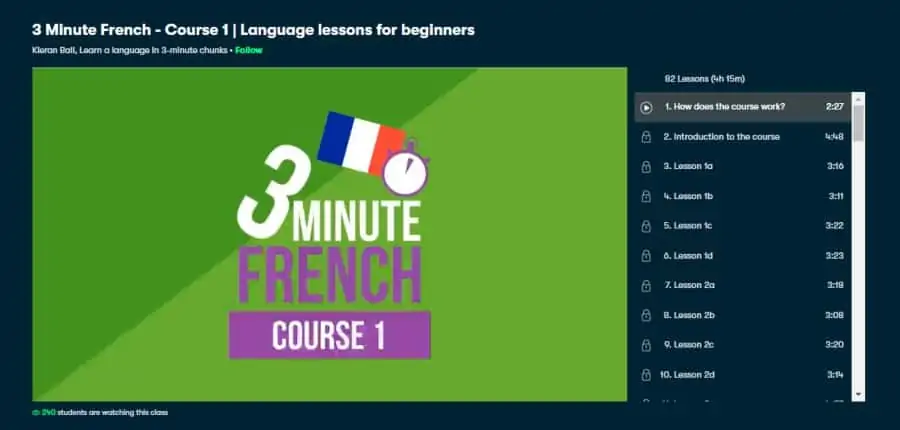
First on my list is a great introductory beginner class that is a fantastic start for anyone wishing to learn the French language.
As the title suggests, each individual lesson is kept to around three minutes, a time frame that seems to work very well for beginners. These 3 Minute lessons also help students to maintain enthusiasm, keeps you consistent, and aid retention.
Your tutor for this class is Kieran Ball, a language instructor with multilingual skills that has helped 190,000 students learn French.
Some of the many lessons covered in this 4.5-hour class include French Les Nombres a 0 – 50, French Au Restaurant La Viande, French Au Restaurant Les Boissons, Vocabulary Expansion Sheets, plus many more.
Along with this course, Kieran has multiple other French courses on Skillshare, including grammar and sentence structure to name a few. So for an in-depth dive into French that is great for beginners, this is a fantastic place to start!
Being hosted on Skillshare, new users can access all class materials, downloadable resources, access to 29,000 other classes, and a 1-month free trial!
- Beginner level
- 4 ¼ hours
- 3 minute lessons
- Taught by an experienced language tutor
- Part of a larger series
- Class projects
Activate FREE Skillshare Trial
2. French for beginners – From zero to almost hero in 60 minutes (Skillshare)
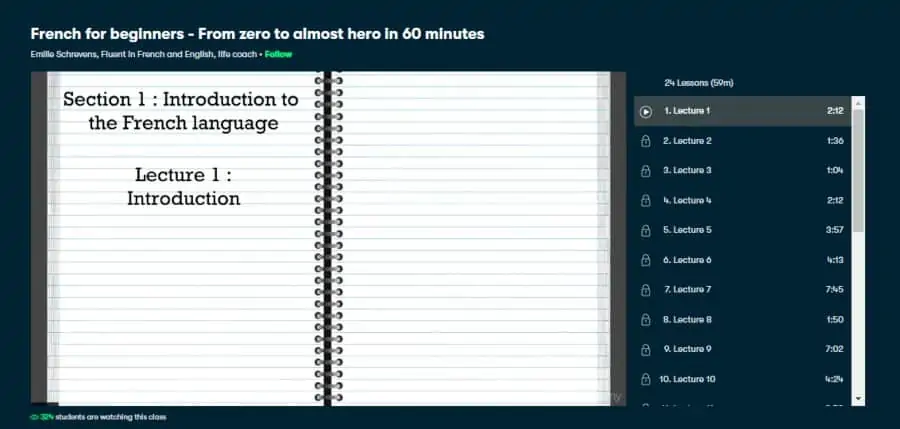
Next on my list is a concise beginner French class that is useful for those traveling to France and looking to learn the absolute basics of French.
Your teacher for this class is Emilie Schrevens, who is a French coach and fluent bilingual teacher who has helped 10,000’s students to learn the basics of French. So you will be in great hands!
Among some of the topics covered in this lesson are ordering food in French, explaining a problem, asking for directions, vocabulary, introducing yourself, making a request, French culture, and many more.
As this course is hosted on Skillshare, new users can this class plus thousands of others when taking advantage of their1-month free trial. Overall, a simple to follow and condensed introduction into the French language.
- Beginner level
- 1 hour
- Taught by a fluent bilingual teacher
- Class projects
- Extra resources
- Great for travelers
Activate FREE Skillshare Trial
3. Improve Your French Now (Udemy)
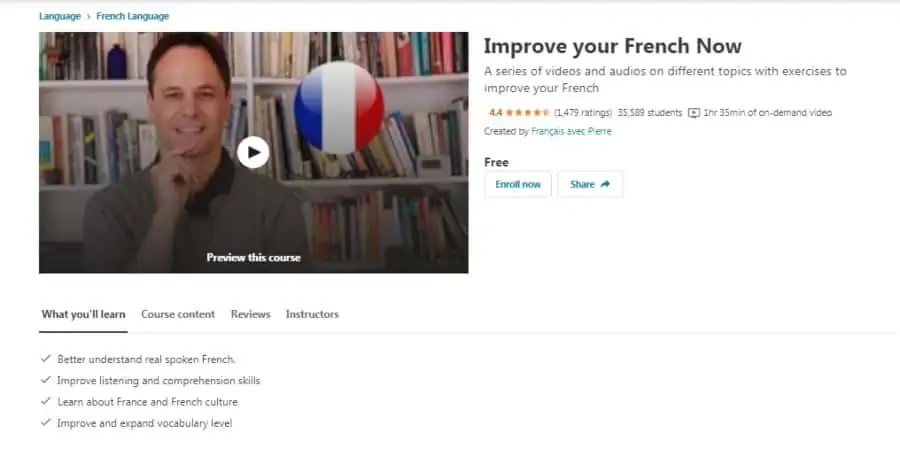
This course from Udemy concentrates on understanding French spoken to you by native speakers as well as teaching you to speak basic French phrases.
Your instructor for this class is Français Avec Pierre, who has taught French and Spanish for more than 15 years and has lots of enthusiasm for teaching his native tongue.
As for the course, it is 1 ½ hour in length and is labeled intermediate level. While it could be taken by beginners, some of the modules assume that some French is already known, so it may be quite challenging. But for those who are looking to brush up on their existing French, this is a great place to start!
Some of the topics covered are masculine and feminine words, speaking at a market, French expressions, and many more! Overall, this is a great refresher class for those who may already have some experience with speaking French.
- Intermediate level
- 1 ½ hour
- Experienced French teacher as instructor
- Conversational skills highlighted
- Downloadable resources
- Certificate of completion
4. 3 Minute French – Course 2 | Language lessons for beginners (Skillshare)
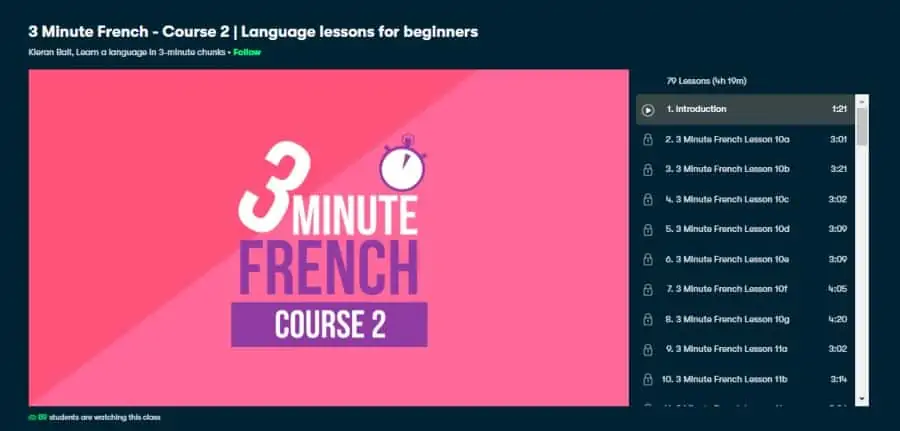
Next on my list is the second class in a series of 7, which is taught by Kieran Bell who is a multilingual language tutor.
Much like Kieran’s first lesson, this one too is split up into dozens of bite-sized 3-minute videos that can be consumed on a desktop, or on the Skillshare mobile app.
Some of the 3-minute lessons included in this class are the pronunciation of tourist attractions, shops, essential places, vocabulary, conversation starters, and many more.
For those that have completed the first course in this series, this is a nice bridge course that will allow you to build upon your existing skills!
- Beginner level
- 4 1/2 hours
- 3-minute lessons
- Taught by an experienced language tutor
- Part of a larger series
- Class projects
Activate FREE Skillshare Trial
5. BBC Languages: Talk French – A Video Introduction to French (BBC)
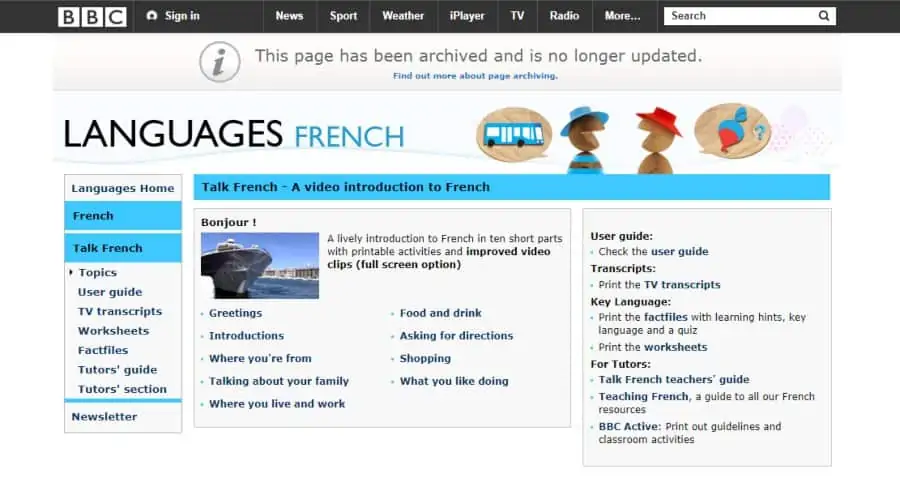
Surprisingly, the BBC French Languages series of videos is an excellent teaching tool for those looking to learn French.
Much like the other courses on this list, the BBC also has highly ranked educators producing educational videos that are quite easy to follow along with.
Modules include French greetings, food and drink, introductions, asking for directions, shopping, and where you live and work. There are even workbooks available for download, as well as teaching guides, TV transcripts, and quizzes!
One downside of this course, however, is that the layout is quite clunky when compared to Skillshare or Udemy. But for the quality of teaching, this is one of the best free online French classes!
- Beginner level
- Several episodes each
- Workbooks
- Taught by a variety of experts
- Suitable for tutors
- Includes original transcripts
6. Learn French Online for Free (E-learning)
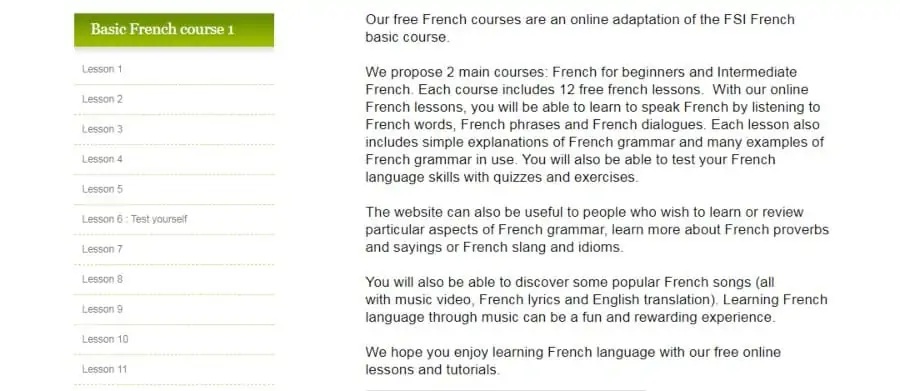
Next on my list is a great offering from eLearningFrench.com which uses a combination of videos and music to teach students the basics of French.
Some of the many lessons included in this class are French proverbs, sayings, slang, and idioms, which can be very beneficial for retention of what you learn.
While the interface of this website is quite clunky and in need of an update, this is still a great resource that teaches valuable French words, sayings, and songs!
- Beginner level
- 12 lessons
- Pronunciation guide
- Optional musical based exercises
- Online flashcards
- Many extra links for further education
7. Language Transfer – French (Language Transfer)
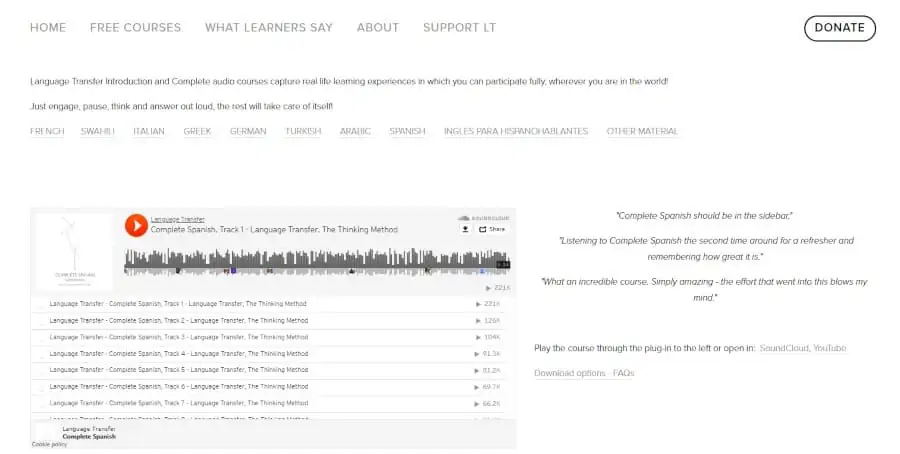
This free French class is a series of online audio tracks of a teaching method called The Thinking Method. In total, there are 40 separate lessons in the French version of the instruction.
Included in this class are various lessons on commons words, asking for the toilet, hello, goodbye, thank you, ordering food, conversation starters, and tons more!
Like all other lessons on this list, this one is also completely free to access and can be used on a desktop or on smartphone devices.
- Beginner level
- 40 audio lessons
- Part of a large language project
- Taught by native bilingual speakers
- Easy to access
- Training manual available
8. French for Beginners. The complete Method. Level 1 (Skillshare)
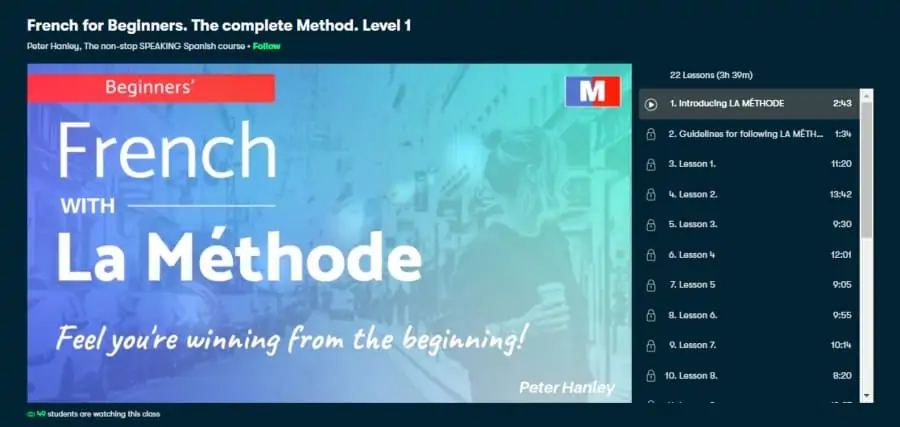
LA MÉTHODE or The French Method, is a way of continuously adding incrementally to your French training as opposed to separate lessons.
Peter Hanley is the instructor for this free online French class who has been teaching for many years in schools across Spain, France, and the UK.
Over the span of 3 ½ hours of self paces lessons, students will learn multiple topics including common sayings, hello, goodbye, thankyou, common foods, transport, taxi, toilet, hotel, and many more!
Since this class is hosted on Skillshare, new users can access this French class, plus all others mentioned on this list for free with their 1-month trial!
- Beginner level
- 3 ½ hours
- Language teacher as instructor
- Incremental method
- Downloadable resources
- Class project
Activate FREE Skillshare Trial
9. French Rules of Pronunciation – Or How to Read French (Udemy)
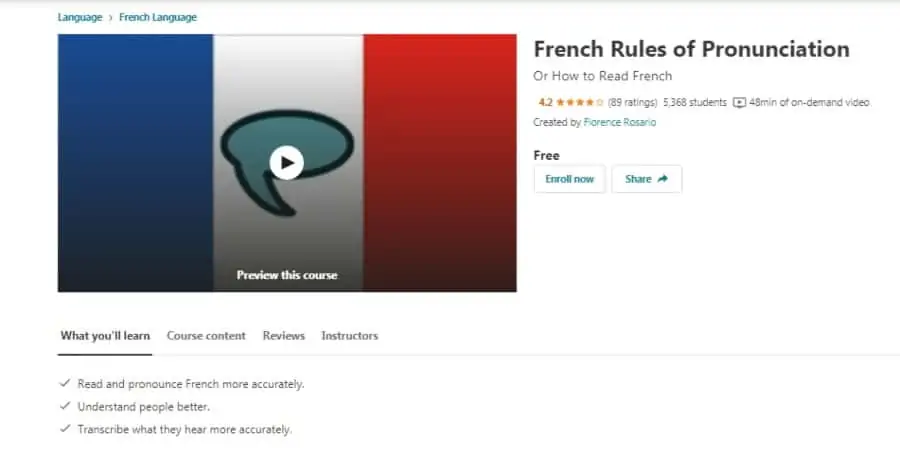
Next on my list is a fantastic (and free) Udemy French class taught by Florence Rosario, who is an international language educator with decades of experience.
In total, this class is only 1-hour in length, but it offers up many valuable modules including pronunciation of consonants, vowels, and combinations of vowels with consonants, how to read French, transcribe French, and much more!
With all Udemy classes, students get lifetime access and all downloadable resources. There is also an option for a certificate of completion once done!
- Intermediate level
- 1 hour on-demand video
- Teaches reading and writing as well as speaking French
- International language educator as the instructor
- Downloadable resources
- Certificate of completion
10. 3 Minute French – Free taster course | Lessons for beginners (Udemy)
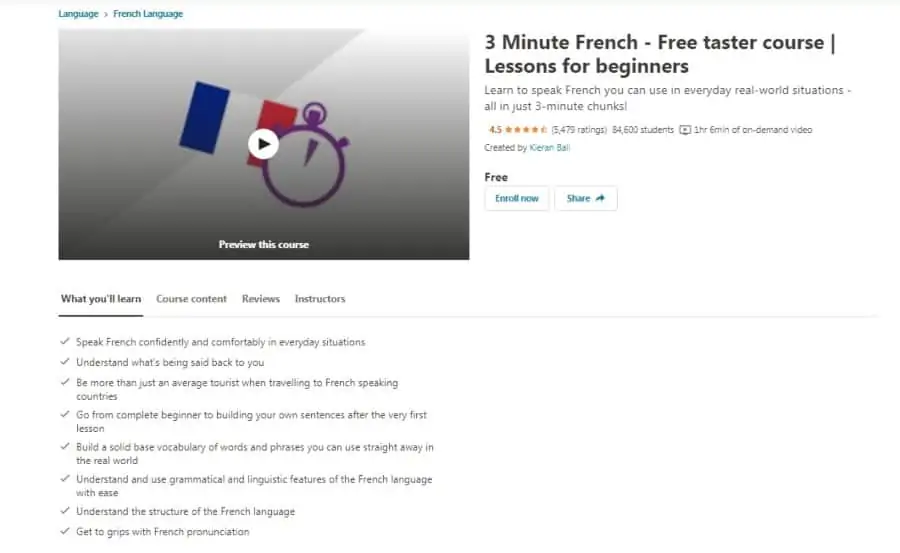
A condensed version of the beginner level Kieran Ball class listed above from SkillShare, this option from Udemy a more condensed class that is only about 1 hour in length.
The 3 Minute approach is the same as the other classes, simply with fewer lessons to see if this style of instruction works for you or to see if you really do want to learn French after all.
Some of the included lessons cover pronunciation, understanding the French language, grammatical features, most used French words, and tons more!
- Beginner level
- 1 hour taster
- 3 minute lessons
- Taught by an experienced language tutor
- Part of a larger series
- Class projects
11. The French Experiment (The French Experiment)
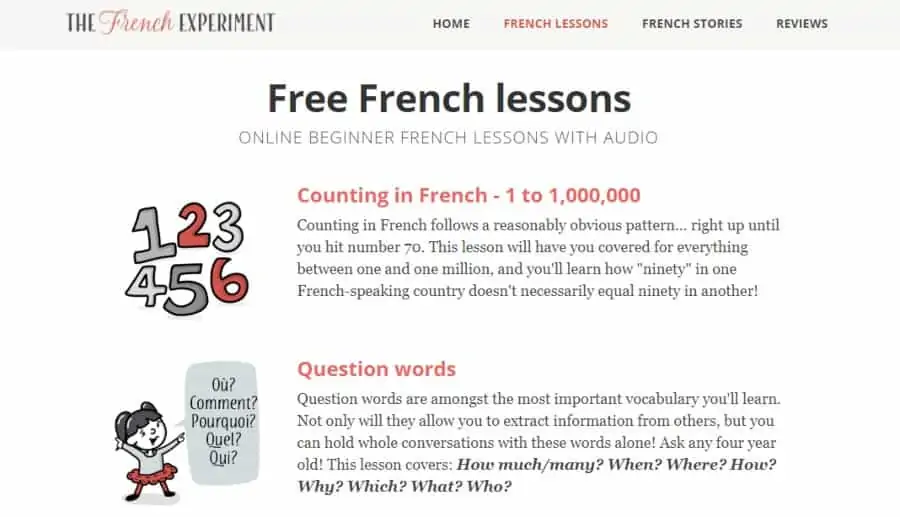
This course operates somewhat differently than the standard on-demand video courses. It is a series of interactive web pages. Each web page has a written lesson with many examples.
Some of the examples are supported by audio files that you simply on in order to hear the word or phrase. How long does the course last? That’s hard to say, as it depends on how long you stay on any one page and there are scores of pages with tons of words and phrases and written explanations.
Arranged in sections such as telling time, possessive nouns, weather, days of the week, and idioms and expressions, among other things.
It could be labeled as a beginner level or advanced due to the sheer volume of the instructive material posted. It’s really fascinating to immerse yourself in this course and you may find yourself coming back to it again and again.
- All levels
- Audio files and written instruction
- Virtually unlimited time frame
- Interactive web pages
- Updated regularly
- Operated by multiple language experts
12. Practice and Perfect your French – Intermediate Level (Udemy)
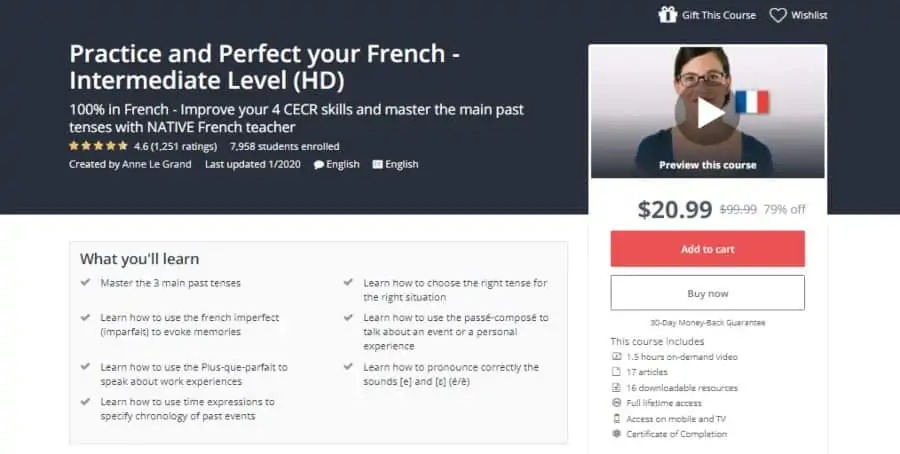
An intermediate-level course from Udemy, this class is presented totally in French. In other words, it’s meant to increase your French language ability, not start you out in it. To some students, that may seem daunting.
If you have the basics of French down, perhaps through one of the other of the best free online French courses listed above, the class will accelerate you into better mastery of spoken French.
Some of the subject sections are the verb tenses, including imperfect tense, how to personalize or turn words possessive, and an in-depth view of all the different sounds and uses of the letter E in the French language.
Taught by a certified instructor and former teacher at the French University Anne Le Grand, you will enjoy the deep level of instruction presented. This class requires you to really concentrate, though. Though on-demand video is used, I would suggest setting aside a larger block of time than the 90-minute total video length.
About 1 ½ hour in length, it has downloadable resources and a certificate of completion. To learn more, you can also see my guide on the top online writing courses to master your skills!
- Intermediate to Advanced level
- 1 ½ hour
- 100% in French
- Detailed instruction
- Downloadable resources
- Certificate of completion
