
Earn A Certificate With 2024‘s Best Online Embedded Systems Courses
![Best Online Embedded Systems Courses Classes Earn A Certificate With [year]'s Best Online Embedded Systems Courses](https://skillscouter.com/wp-content/uploads/2021/01/Best-Online-Embedded-Systems-Courses-Classes.jpg)
From aircraft landing systems to Internet of Things (IoT) devices, embedded systems are used all around us to accomplish a wide variety of feats.
So if you’re looking to launch a career as an embedded systems developer in this growing and in-demand field, you’ve come to the right place!
In this article, I have gathered the best online embedded systems courses in 2024 that will take you deep into the world of microcontrollers and hardware.
You will learn to do bare-metal programming of devices, implement security and safety measures, make real-time systems, and much more! Let’s get started!
Top 7 Best Online Embedded Systems Courses & Certificates 2024
1. Embedded Systems Programming on ARM Cortex-M3/M4 Processor (Udemy)
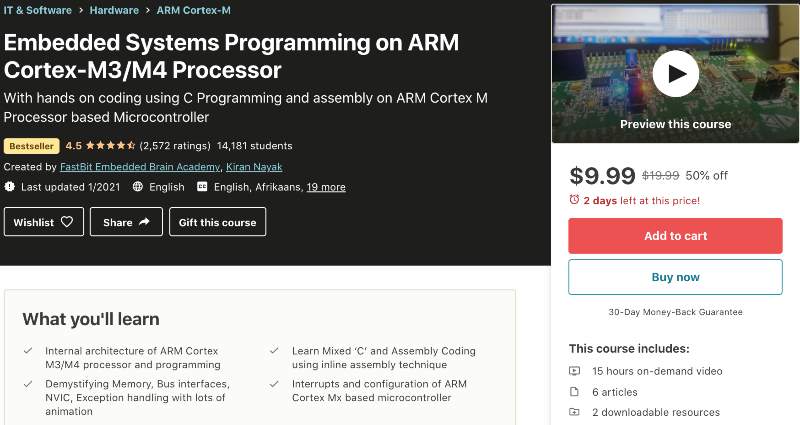
First on my list is a fantastic intermediate-level embedded systems course that has been taken by close to 14,000 students and has an average rating of 4.5 stars! So if you want to learn about ARM-based Cortex-M3/M4 Processor and much more, don’t miss out on this class!
As for your instructor, you will be taught by Kiran Nayak, an embedded software engineer who has a bachelor’s degree in electronics and communication. Kiran has partnered with the FastBit Embedded Brain Academy to develop this comprehensive online course.
Spanning 15-hours of on-demand lessons, you will get to learn everything about the ARM Cortex M3/M4 processor with topics including the memory, bus interfaces, exception handling, low-level register programming, bare-metal build process, mixed C, and Assembly coding to name a few.
At the end of this online embedded systems course, you will receive a certificate of completion which you can share with your network to let them know about your newly acquired skills!
- Intermediate level
- 15 hours long
- Taught by an embedded software engineer
- Full lifetime access
- Certificate of completion
2. Development of Secure Embedded Systems Specialization (Coursera)
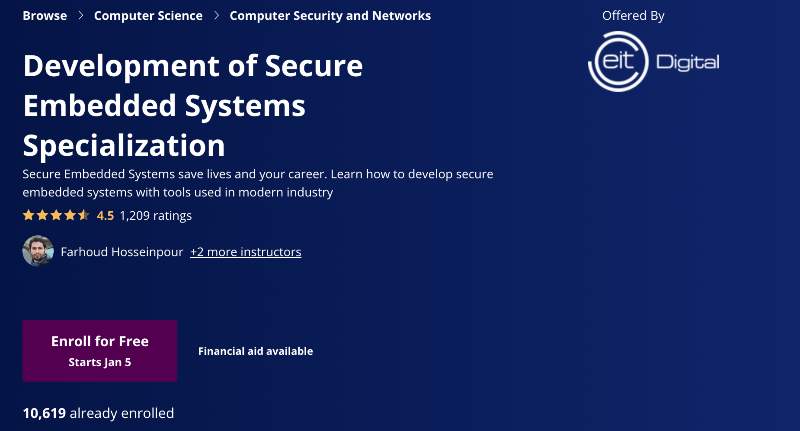
Developed by the European Institute of Innovation and Technology (EIT Digital), this online embedded systems specialization will give you thorough training in this exciting field. You will also be joining over 10,000 students who have completed this course!
For this online specialization, you will be taught by 3 experts in embedded systems including Farhoud Hosseinpour, Juha Plosila, and Nguyen Gia Tuan. They are also PhD-level instructors who have developed this specialization with EIT Digital, so you will be in expert hands!
Over the span of 5 months, students will go through 4 online modules that will start by teaching you the basics of embedded hardware and operating systems before taking you through topics like web connectivity, security in embedded systems, development of real-time systems, and much more.
Don’t worry if you’re unable to afford the monthly subscription fees for this specialization – you can apply for financial aid through Coursera and complete all the online courses for free!
- Intermediate level specialization consisting of 4 courses
- 5 months long with 4 hours of study per week
- Taught by PhD-level instructors from EIT Digital
- Certificate of completion
- Financial aid available
3. Embedded Systems Bare-Metal Programming Ground Up™ (STM32) (Udemy)
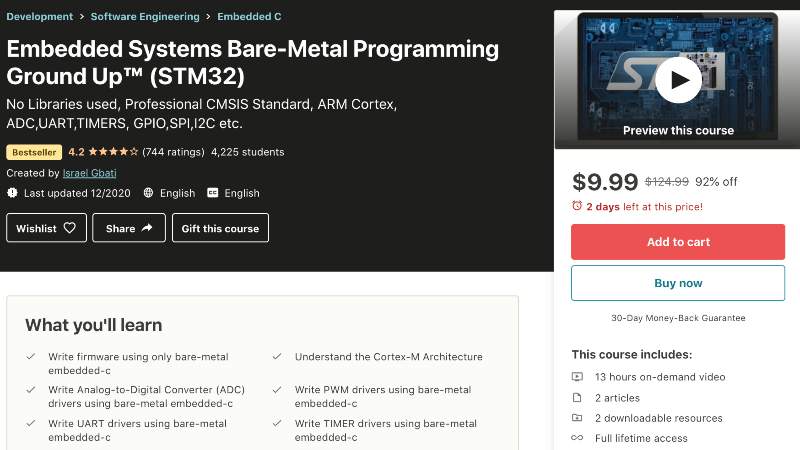
If you’re interested in learning how to program ARM-based microcontrollers from the ground-up, this beginner-level embedded systems course on Udemy can’t be missed. Currently, 4,000 students have taken these lessons with a rating of 4.2 stars.
As for your instructor, Israel Gbati will be teaching you in this online course who is an embedded firmware engineer with over 7 years of professional experience. To date, has published 38 online courses on Udemy, teaching over 62,000 students from all over the world.
During the 13-hours of on-demand video lessons, you will dive into bare-metal programming of ARM-based controllers by going through topics like using embedded-C to code analog-to-digital converters, UART and Interrupt drivers, PWM and TIMER drivers, and SPI drivers to name a few!
The best part is that you have a 30-day money-back guarantee from Udemy if you don’t like the contents of the online course and wish to get a refund!
- Beginner level
- 13 hours long
- Taught by embedded firmware engineer
- Certificate of completion
- Full lifetime access
4. Embedded Systems Essentials with Arm: Getting Started (edX)
ARM-based microcontrollers are the industry standard for embedded devices, and this intermediate-level online embedded systems course by Arm on edX will give you a solid foundation in them. By the end of this online course, you will be confidently able to program your own applications.
You will be provided with instructors for this online course by Arm’s Education division. Khaled Benkrid, Shuojin Hang, Mark Allen, and Tim Wilmshurst will be teaching you in this online course. They are all senior engineers at Arm who have teamed up to develop top-level resources.
Through 6 weeks of learning and hands-on practice, you will gain the skills needed to build real-world embedded systems projects using the Mbed API, make changes to skeleton code to build your own desired functionality, learn about Arm processors and architecture, and much more.
You can access the contents of this online embedded systems course for free, and get a verified certificate of completion as well if you are willing to pay the $149 fee!
- Intermediate level
- 6 weeks long with 3-6 hours of study per week
- Taught by senior engineers from Arm
- Certificate of completion for $149
- Free access to course contents
5. Introduction to Embedded Systems (Udemy)
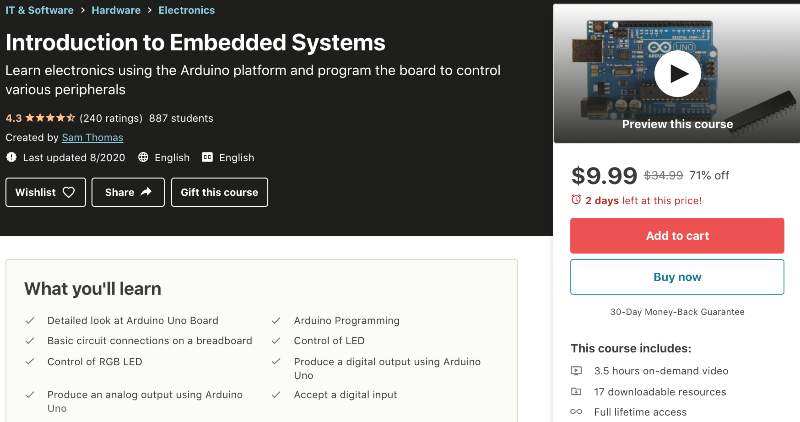
Next on my list is a beginner-level online embedded systems course on Udemy that is a perfect choice for those who want to begin their journey in hardware and software through Arduino. You will work on understanding the basics of Arduino and make simple programs to control peripherals.
Sam Thomas, an electronics expert with a master’s degree, will be teaching you in this online course. Sam has been teaching electronics for over 7 years and has conducted 7+ workshops, teaching about the design and development of embedded systems and networks.
In this 3 ½ hours long online course, Sam will help you get started in the field of embedded systems by taking you through topics like producing digital and analog output using the Arduino Uno board, taking digital and analog inputs, understanding serial communication, and much more.
You will also get loads of hands-on practice as you use an LM35 sensor to measure temperature, work with an LDR to get various outputs, and control an RGB LED!
- Beginner level
- 3 ½ hours long
- Taught by electronics expert with a master’s degree
- Certificate of completion
- Full lifetime access
6. Embedded Systems – Shape The World: Microcontroller Input/Output (edX)
Offered by the University of Texas at Austin, this intermediate-level online embedded systems course on edX is an in-depth introduction to microcontrollers with loads of hands-on practice. Taken by over 70,000 students, this online course is the first of a 2-part series on embedded systems.
You will be taught in this online course by Jonathan Valvano, a professor, and Ramesh Yerraballi, a senior lecturer in the department of electrical engineering at the University of Texas at Austin. UT Austin is ranked in the top 25 universities in the world and is known for its quality.
Over a course of 8 weeks in this online course, you will start by understanding the modular design and abstraction of embedded systems before diving into the C programming language to code microcontrollers, building and testing circuits, synchronizing hardware, and much more.
This online embedded systems course is self-paced, so you can enjoy a great degree of flexibility and freedom by learning on your own time!
- Intermediate level
- 8 weeks long with 8-10 hours of studying per week
- Taught by senior faculty members from UT Austin
- Certificate of completion for $49
- Free access to course contents
7. Embedded Systems Object-Oriented Programming in C/C++ (Udemy)
The final entry on my list is an intermediate-level online embedded systems course on Udemy that will make you confident with using embedded-C and C++ to build object-oriented firmware. Taken by over 1,000 students, this bestselling online course has an average rating of 4.2 stars.
EmbeddedExpertIO, a community of embedded systems experts, and Israel Gbati, an embedded firmware engineer, will be partnering up to teach you in this online course. Together, they have published over 40 online courses on Udemy, teaching more than 65,000 students.
In this 12 hours long online embedded systems course, you will dive deep into embedded-C and embedded-C++ to write object-oriented code and build various aspects of microcontroller firmware. You will write GPIO, TIMERS, and UART drivers using the datasheet, and much more.
Don’t worry if you find yourself forgetting important concepts after some time – with full lifetime access, you can come back whenever you want to review and consolidate your understanding!
- Intermediate level
- 12 hours long
- Taught by embedded systems experts
- Certificate of completion
- Full lifetime access
