
Learn How To Mix Killer Beats With 11 Best Online DJ Courses 2024
Some people see DJing as an art. Some see it as a fun hobby. Others see it as a viable career opportunity. No matter what your reason is for seeking out the best online DJ courses, this list will provide you with some great options for honing your DJ skills.
The courses on this list will cater to everyone from beginners to experienced DJs, to anyone that has an underlying passion for music and creativity.
As your DJ skills and knowledge of music production grow, so too will the many opportunities to share your talents and music with the world!
Top 11 Best Online DJ Courses, Classes & Training 2024
1. Skillshare: DJing Live: From Setup to Soundcheck (Skillshare)
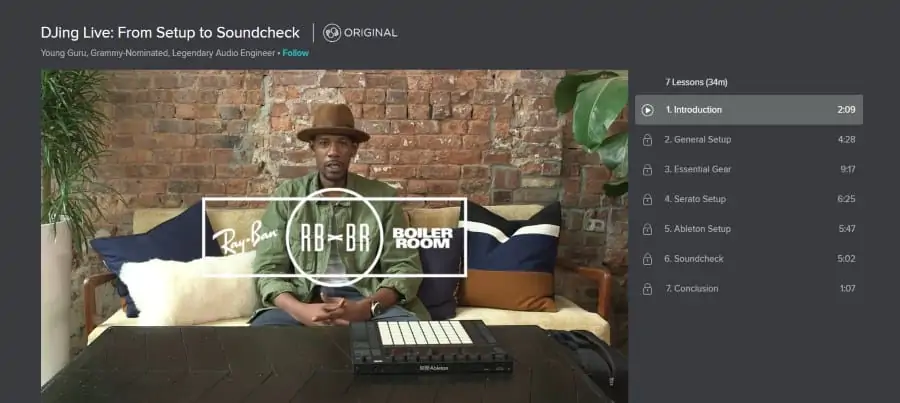
This class will teach you how to be prepared for your gig by having all the necessary equipment and an effective setup. The instructor and Grammy-nominated DJ, Young Guru, keeps things simple in this short yet jampacked course.
Some of the core lessons in this course focus on general setup, essential gear, soundcheck at the venue, and using both Serato and Ableton setups during live sets. If DJing is your profession, then you’ll always want to be (and look) prepared for gigs. This course will help you do just that!
Another great benefit of this class is the included projects that students can undertake to further their skills even more. This will give you the opportunity to really think hard about which materials you need for DJing and make sure that you’re not missing anything important.
Being hosted on Skillshare, students can take this course for FREE on their 1-month trial that can be canceled anytime! Highly recommended!
Strengths:
- Popular! 1,624 students
- Suitable for all levels
- Very low time commitment: 7 lessons, 34m
Activate FREE Skillshare Trial
2. Skillshare: The Basics of Serato DJ (Skillshare)
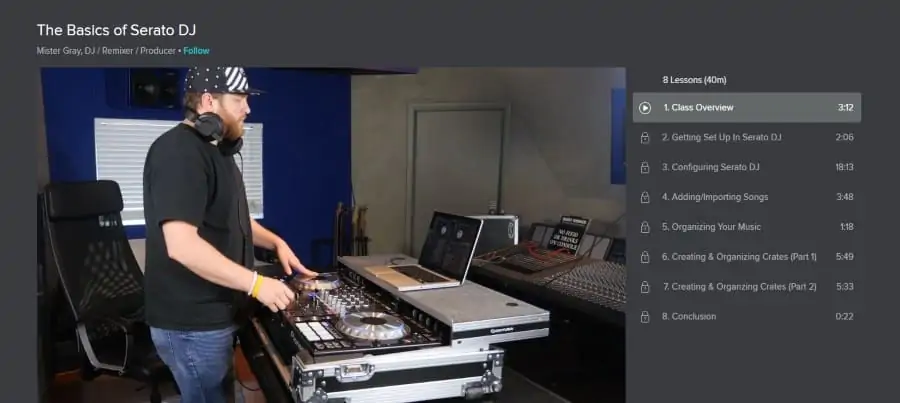
Up next is one of the best online DJ courses to take if you want to learn about the Serato DJ setup. This course is suitable for people who are new to DJing and want to learn the ins and outs of Serato.
Producer, DJ, and remixer, Mister Gray has tons of relevant experience that he will share with you in this 40-minute course. He’ll cover topics such as getting set up in Serato DJ, configuring Serato DJ, adding/importing songs, organizing your music, and creating/ organizing crates.
Once you’ve worked your way through the 8 video lessons, you’ll take on the class project. The project is to organize your crates for your next gig (or imaginary gig if you don’t have a real one lined up yet), take a screenshot, and share it with the class for some real-world feedback.
Again, this course is hosted on Skillshare, so users can take this class and the above one for free on the 1-month free trial!
Strengths:
- Low time commitment: 8 lessons, 40m
- Beginner level: suitable for people new to DJing
- Best for learning Serato DJ
Activate FREE Skillshare Trial
3. Udemy: How to Become a DJ: Learn How to Start DJing Online Today (Udemy)
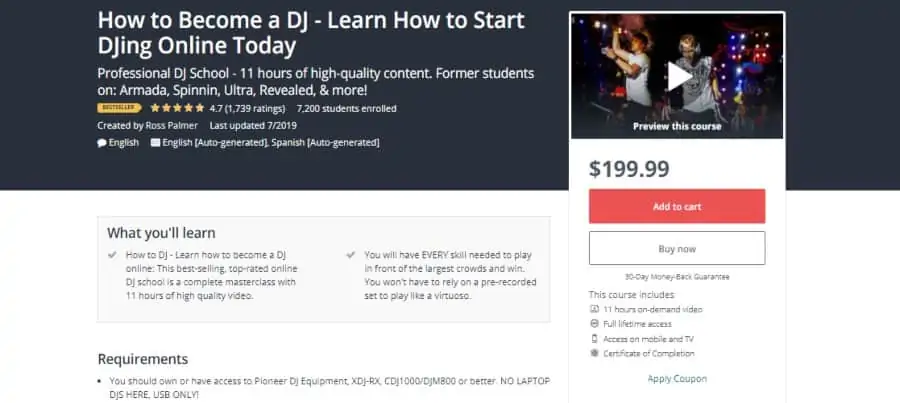
Moving on is a full-fledged course that has 11 hours of course material, and 51 informative video lessons to work through, which makes this course ideal for people who really want to know what it takes to become a professional DJ.
As for the level of experience needed to take this course, it’s suitable for all levels which makes it great for beginners and more advanced users. The focus of this course is to establish the technical foundations you need to be able to execute the skills that the world’s top DJs use – without using a pre-recorded set.
Long-time professional DJ, Ross Palmer, will cover beginner topics like what all the buttons on the DJ set do, how to use headphones when mixing, and how to practice your DJ skills. Some of the intermediate topics covered are using the filter, spiral, echo effects, and how to use two USBs at once.
In the advanced section, Ross will teach you how to use FX with microphone, how to take over from the DJ before you, and how to end your set gracefully. Overall, this is a great course that teaches you both technical DJ skills as well as performance skills and is sure to make a difference in the success of your career as a DJ!
Strengths:
- High 4.7 star rating
- Popular course! 7,151 students
- Extensive course content: 51 lectures, 10h46m
- Taught by long-time professional DJ, Ross Palmer, who is very involved in the music industry, and is tied to DJs who play in major shows like Tomorrowland and EDC
- Certificate of completion
4. Creative Live: Scratch DJ Academy Presents: DJ Fundamentals (CreativeLive)
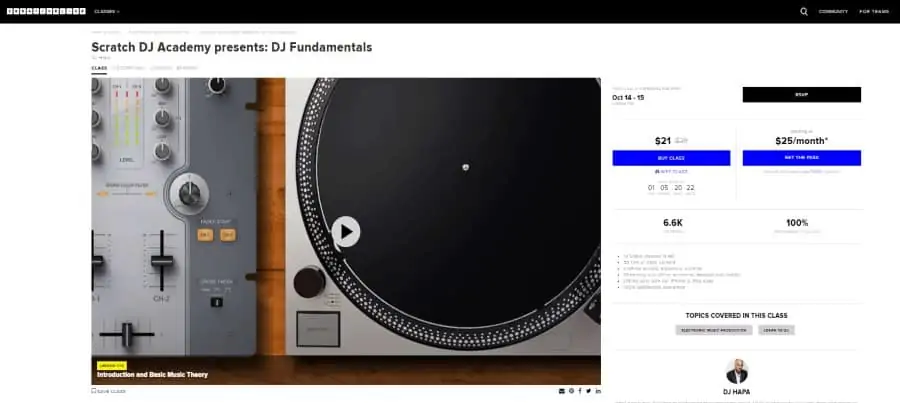
Next up on my list is a fantastic CreativeLive course that is taught by DJ Hapa, who has over two decades of experience performing around the world. The focus of this class is teaching you everything you need to know to get your start as a DJ. Brand new DJs and experienced DJs alike will benefit from taking this course!
Topics covered in the course are basic music theory, scratching 101, using crossfaders, mixing based on BP, mixing based on song structure, song breakdown demo, mixer overview and EQ, inputs and outputs, understanding turntables, manual beatmatching techniques, and beatmatching practice.
This is easily one of the best online DJ courses you can take if you want a great all-around DJ course that covers the fundamental skills you’ll need to make it as a DJ. It’s just over 5 hours long, so the material is comprehensive but not overwhelming for a beginner! Can’t go wrong!
For more information, you can check out my full CreativeLive review here.
Strengths:
- Suitable for all levels, student reviews state that it is a great class for beginners
- Comprehensive course: 13 lessons, 5h17m
- Popular course! 6.5k students
- Lifetime access, anywhere, anytime
- Streaming and offline access on desktop and mobile
- Offline sync with iPhone & iPad apps
5. Ultimate Ableton Live: DJ Techniques and Controllers (Skillshare)
This Skillshare course is taught by Ableton certified trainer, Jason Allen. He is extremely qualified and has worked as a composer, producer, songwriter, engineer, sound designer, DJ, remix artist, multimedia artist, performer, inventor, and entrepreneur.
The class focuses on using Ableton Live for DJing and performing and, as it is an intermediate level, students taking the course should know their way around Ableton Live already. There are 23 video lessons in the course that will take just over 2 hours to work through.
Some of the topics that Jason will cover include audio effect racks, using effect rack presets, building our own effect racks, parallel processing, fade to grey, performance racks; controllers and controllers, MIDI mapping, and follow actions.
You’ll also learn about two interfaces, the Ableton push interface and the APC40 interface, and some different modes, specifically legato mode and launch mode. This course also gives you some great tips and tricks for creating a successful performance when DJing.
Jason will teach you about launching clips in performance; effects setup for performance; the crossfader; and mapping controllers for performance. After you take this course, others will be sure to notice that you really know your stuff!
Strength:
- One part of a course series, if you like the instructor you can check out the other courses at a discounted rate
- Specific focus: Ableton Live
- Features exclusive videos contributed by international DJ, James Patrick
- Intermediate/advanced level
Activate FREE Skillshare Trial
6. Udemy: Learn How to DJ From the Wu-Tang Clan (Udemy)
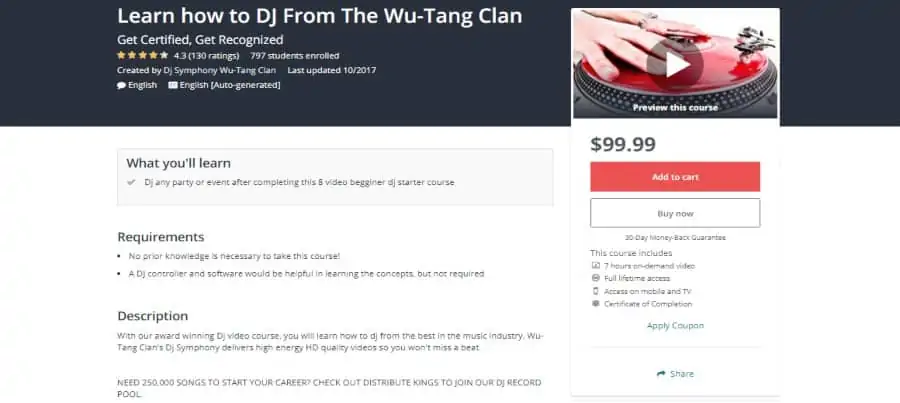
Take the opportunity to learn all about DJing in this starter course and see if it is something that you would like to invest in. DJ Symphony from the Wu-Tang clan will be your instructor and he’ll bring his high-energy style and tons of performance and industry experience to the class!
There are 49 lectures and 7 hours of course material in this class and you’ll learn some great techniques for getting started as a DJ. DJ Symphony covers beginner topics such as using and understanding the fader, understanding beats per minute and song structure, and how to use headphones.
The course is divided into beginner, intermediate, and advanced sections so once you cover the beginner stuff you’ll tackle topics such as cue points and DJ intros; beat matching music with different speeds; using revolutions of sounds to locate song points, and using real vinyl!
Strengths:
- High 4.3 star rating
- Beginner-friendly!
- Extensive course content: 49 lectures, 7 hours
- Certificate of completion
7. LinkedIn Learning: Ableton Live: DJing (LinkedIn Learning)
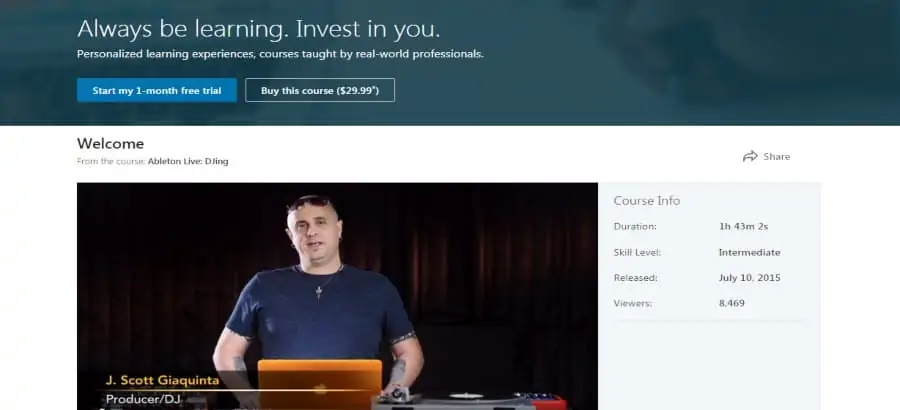
This is one of the best online DJ courses you can take if you want to learn to DJ with Ableton Live. This quick course will take less than 2 hours to work through, but it will provide you with a comprehensive overview of the techniques DJs around the world use with Ableton Live.
A great thing about this course is that it comes with exercise files that you can use to follow along with the course material. Another great thing is that you’ll be taught how to set up your hardware/software correctly so that you don’t run into issues down the road.
Ableton Live expert, J. Scott Giaquinta, will lead you through a huge amount of helpful lessons. Some notable topics that will be covered include traditional DJing vs Ableton DJing; cueing and playing music; using the crossfader; the pros and cons of transposing tracks; and tempo control.
This course also teaches you about alternate controllers that you can use when DJing such as the Wii mote and joystick! (This is the only course on the list that covers that topic).
Strengths:
- Intermediate level, for those who want to take their skills to the next level
- Comes with exercise files
- Teaches you how to set up your hardware/software
- Specific focus: Ableton Live
- Low time commitment: 1h43m
- Popular course: 8,397 students
- Certificate of completion
8. How to DJ With Ableton Live: DJ Techniques Clear and Simple (Skillshare)
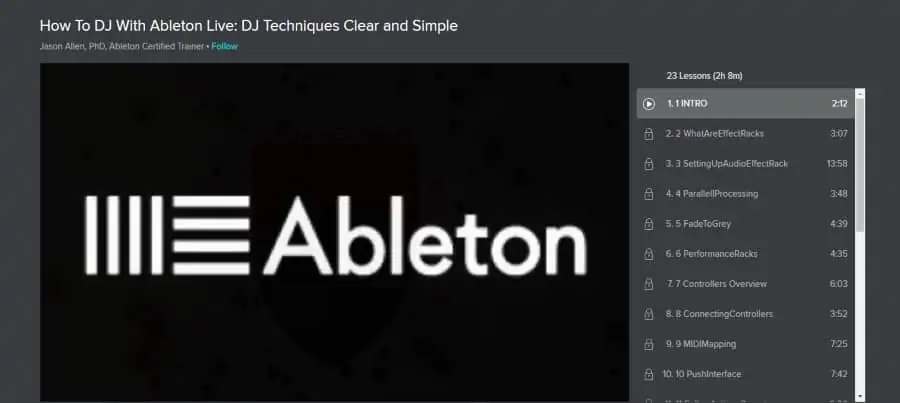
Here is another great option if you are looking for the best online DJ courses that teach you about DJing with Ableton Live. This is an intermediate/advanced level course, so it is for those students who are really trying to push themselves to improve their skills.
There are 23 lessons in this 2-hour long course that focuses on the basics of using controllers, Audio Effect Racks, and some other helpful tricks for using Ableton Live. You’ll be taught by the highly experienced J. Anthony Allen, Ableton Certified Trainer and PhD in Music Composition.
In terms of audio effect racks, there are lessons on using effect rack presets, building your own effect racks, and performance tracks. Other topics covered in the course are MIDI mapping, the Ableton Push and APC40 interfaces, launching clips in performance, and the crossfader.
Strengths:
- Intermediate/advanced
- Specific focus: Ableton Live
- Low time commitment: 2 hours
Activate FREE Skillshare Trial
9. Udemy: Learn How to Become a DJ With Traktor (Udemy)
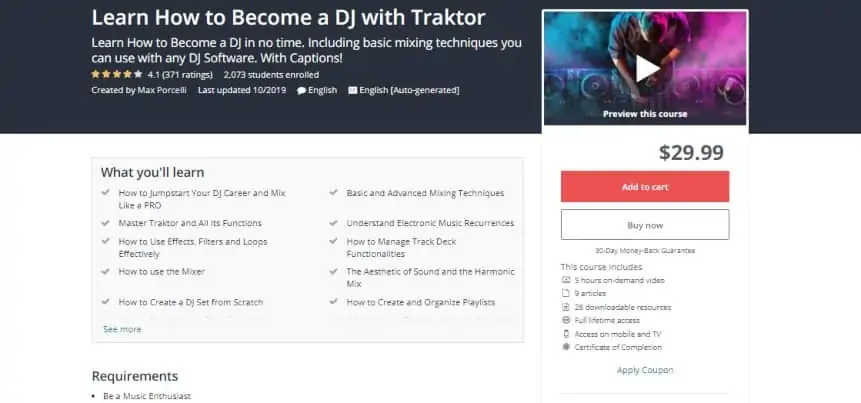
The focus of this course is to gain an understanding of the basic and advanced mixing techniques you can employ with Traktor. This is the best online DJ course for you if Traktor is your chosen DJ platform. The course is designed to be helpful to all levels of students, even experienced DJs!
The first few lessons will teach you all about Traktor’s basic functions and operations which is great for those who are not yet familiar with Traktor. Other topics the course will cover include how to use Traktor effects and loops, how to harmonically mix your songs, and the aesthetic of sound.
This course also covers advanced topics that can help even experienced DJ take their skills to the next level. You will learn about the advanced use of effects, filters and loops; advanced mixing tips and tricks; and how to mix like a pro.
You’ll also get some great tips on how to gain visibility using social networks and how to record and promote your mixes on the web. This is an awesome course for those who want to share their music publicly but need some help to do so effectively!
Strengths:
- 4.2 star rating
- Popular: 2,068 students
- Extensive content: 120 lectures, 4h52m
- Suitable for beginner to advanced students
- There is a quiz at the end of each section that will re-cap what you learned and help with your knowledge retention
- Enrolling into this course, you will also be entitled to download for FREE all the songs used in this course.
- Certificate of completion
10. Creative Live: Mastering the Maschine (CreativeLive)
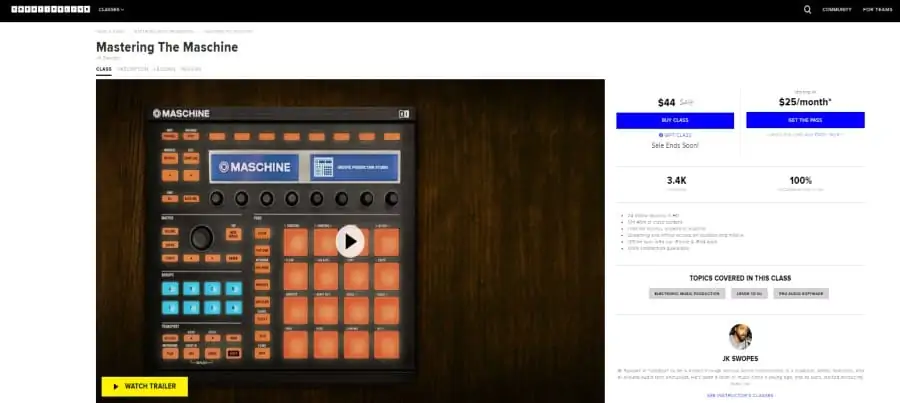
The focus of this course is taking your production to the next level using Maschine – software that allows you to sequence, sample, and add effects to any musical project. It’s taught by JK Swopes, producer, editor, instructor, and all-around audio tech enthusiast.
JK will cover a huge range of topics in this nearly 11-hour-long course. You’ll learn some great ways to work with drums in the following lessons: enhance drums with Velocity; creating drums with Layering, and drum sound design with Flux.
Other topics you’ll cover in this course include FX routing and automation; iPad as a MIDI controller, step sequencer, arp, chord player, or external sound module; sound design techniques; and building a track from start to finish.
Remember, every minute that you put towards furthering your music education will make a real difference in your abilities as a DJ!
Strengths:
- Lifetime access, anywhere, anytime
- Streaming and offline access on desktop and mobile
- 100% recommended by students
- The course includes helpful Q&As on some of the topics
- Popular course: 3.4k students
- Extensive content: 24 lessons, 10h46m
11. Udemy: From Zero to DJ (Udemy)
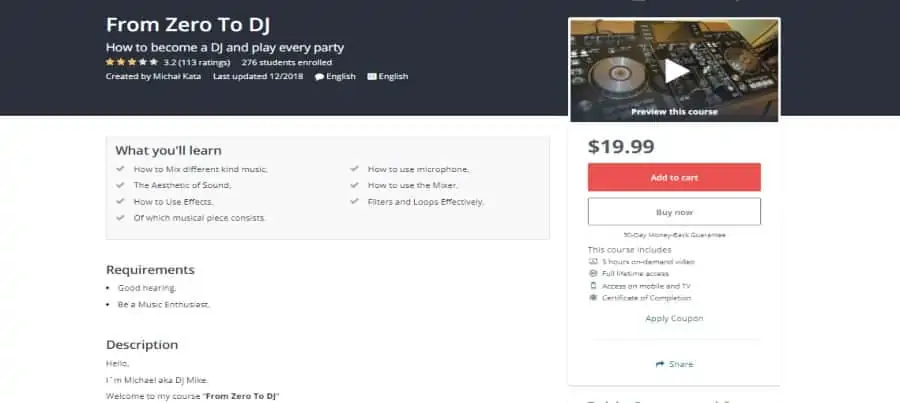
This course is for the people who have the passion and the drive to become a DJ but need some help getting started. It’s a great course that will teach you about different styles of music that you can create as a DJ!
You’ll learn how you can manipulate beats and tracks in order to mix club songs, disco polo and dance songs, old hits, RnB songs, and live music. There are also some great lessons that teach you how to use a microphone with DJ equipment and even how to set the echo/reverb effect for the microphone.
If your goal is to become a professional DJ, you can benefit from the lessons that teach you about essential DJ equipment and the suggested contract template for DJs. However, most importantly, this course is sure to remind you that, above all, DJing is supposed to be fun!
Strengths:
- Lots of course content: 22 lectures, 4h53m
- This course is for all levels and for people who want to be a DJ
- Lifetime access to all course materials
- Certificate of completion
